Thyroid storm with cardiovascular collapse
Endocrine · Shock / Sepsis
Physician-written · Verified by three sets of doctors · Reviewed November 2026
Bedside summary
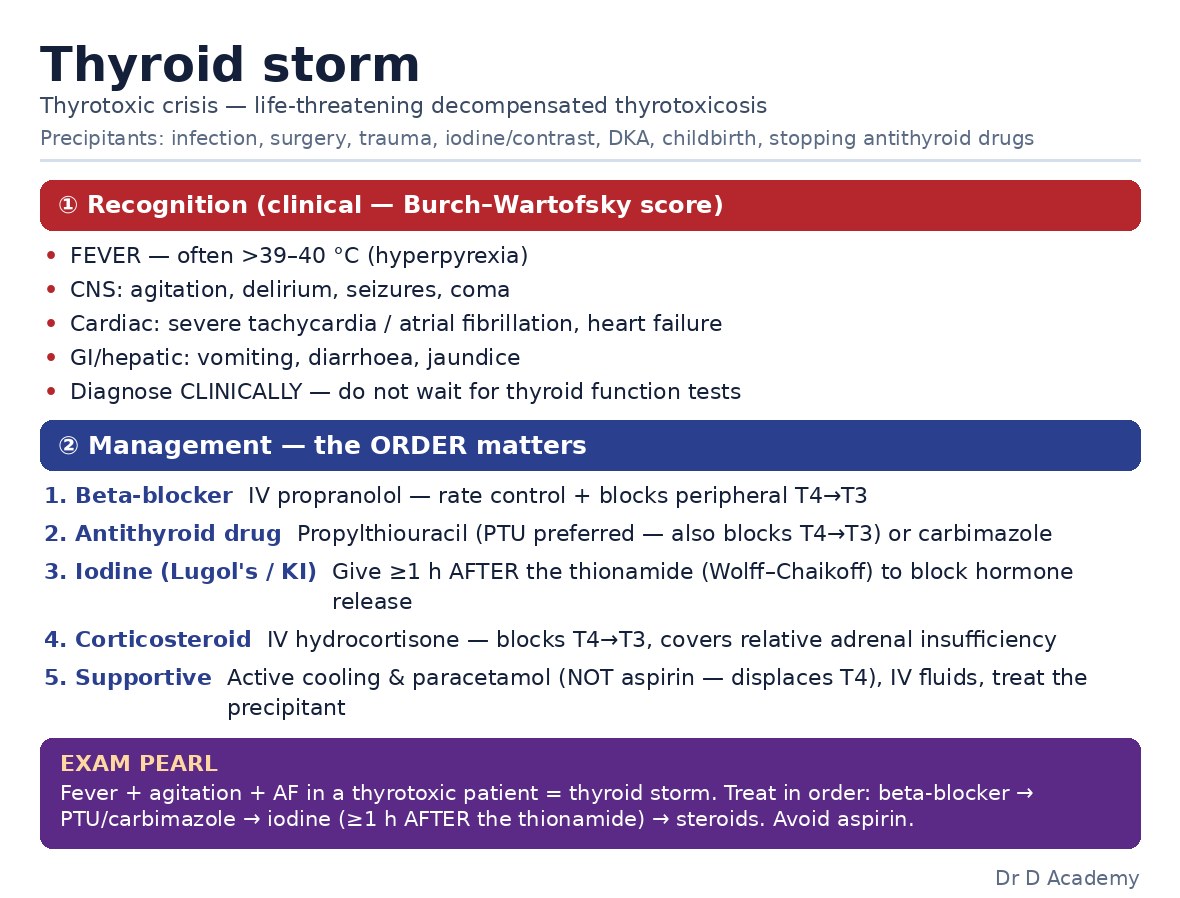
Thyroid storm is decompensated, life-threatening thyrotoxicosis with fever, tachyarrhythmia, heart failure and altered mental state, which can progress to high-output cardiac failure and cardiovascular collapse. It is a clinical diagnosis (do not wait for thyroid results) usually triggered by illness, surgery or non-compliance. Treatment uses a multi-drug approach in a specific ORDER, plus supportive care and treatment of the precipitant.
Figures & algorithms
Red flags
- Hyperthermia with tachyarrhythmia and altered mental state
- High-output or decompensated heart failure / shock
- Giving iodine BEFORE the thionamide (worsens storm)
- Using aspirin for fever (raises free thyroid hormone)
Assessment
Differential diagnosis
- Sepsis, phaeochromocytoma, serotonin/neuroleptic malignant syndrome, sympathomimetic toxicity, heat stroke
- Use a clinical scoring tool (e.g. Burch-Wartofsky) to support the diagnosis — but treat on suspicion
Investigations
- TFTs (suppressed TSH, high free T4/T3) — send but do NOT await results before treating
- ECG and monitoring for AF/tachyarrhythmia; glucose, U&E, LFTs, septic screen for a precipitant
- Assess cardiac function (signs of high-output or decompensated heart failure)
Management
- Resuscitate and cool: oxygen, fluids, active cooling and paracetamol for hyperthermia (AVOID aspirin — it displaces thyroid hormone).
- BETA-BLOCKADE to control the adrenergic storm and rate (e.g. propranolol, or a titratable IV agent); use with care in overt heart failure and seek specialist input.
- Give a THIONAMIDE to block new hormone synthesis (propylthiouracil or carbimazole) — PTU also reduces peripheral T4-to-T3 conversion.
- At least ONE HOUR AFTER the thionamide, give IODINE (e.g. Lugol's/potassium iodide) to block hormone release — giving iodine first can worsen the storm.
- Give CORTICOSTEROIDS (hydrocortisone) to reduce T4-to-T3 conversion and cover possible relative adrenal insufficiency.
- Treat the precipitant (infection, etc.) and manage heart failure/arrhythmia; involve endocrinology and critical care; consider plasmapheresis for refractory cases.
Drugs & doses
Propranolol (oral/IV) or a short-acting titratable beta-blocker for rate/adrenergic control (confirm against local policy)
Propylthiouracil or carbimazole to block synthesis (PTU preferred in storm for its conversion-blocking effect) (confirm against local policy)
Iodine (Lugol's solution / potassium iodide) given >=1 hour AFTER the thionamide (confirm against local policy)
Hydrocortisone IV to reduce peripheral conversion and cover adrenal reserve (confirm against local policy)
Active cooling and paracetamol for pyrexia — avoid aspirin/salicylates
Disposition
Critical care with endocrinology; monitor for arrhythmia and heart failure and treat the precipitant.
Complications & pitfalls
- Cardiovascular collapse and arrhythmia (e.g. fast AF)
- High-output then decompensated heart failure
- Multiorgan failure and death if untreated
Exam pearls
- Treat clinically — do not wait for thyroid function results.
- Order matters: thionamide first, then iodine at least an hour later.
- Avoid aspirin; use paracetamol and active cooling for fever.
Educational — confirm all doses against local policy.
Disclaimer: Educational decision support for qualified clinicians and students — not a substitute for clinical judgement, local protocols or a full drug reference. Confirm every dose and contraindication against your formulary before prescribing.