Adrenal (Addisonian) crisis presenting as shock
Bedside summary
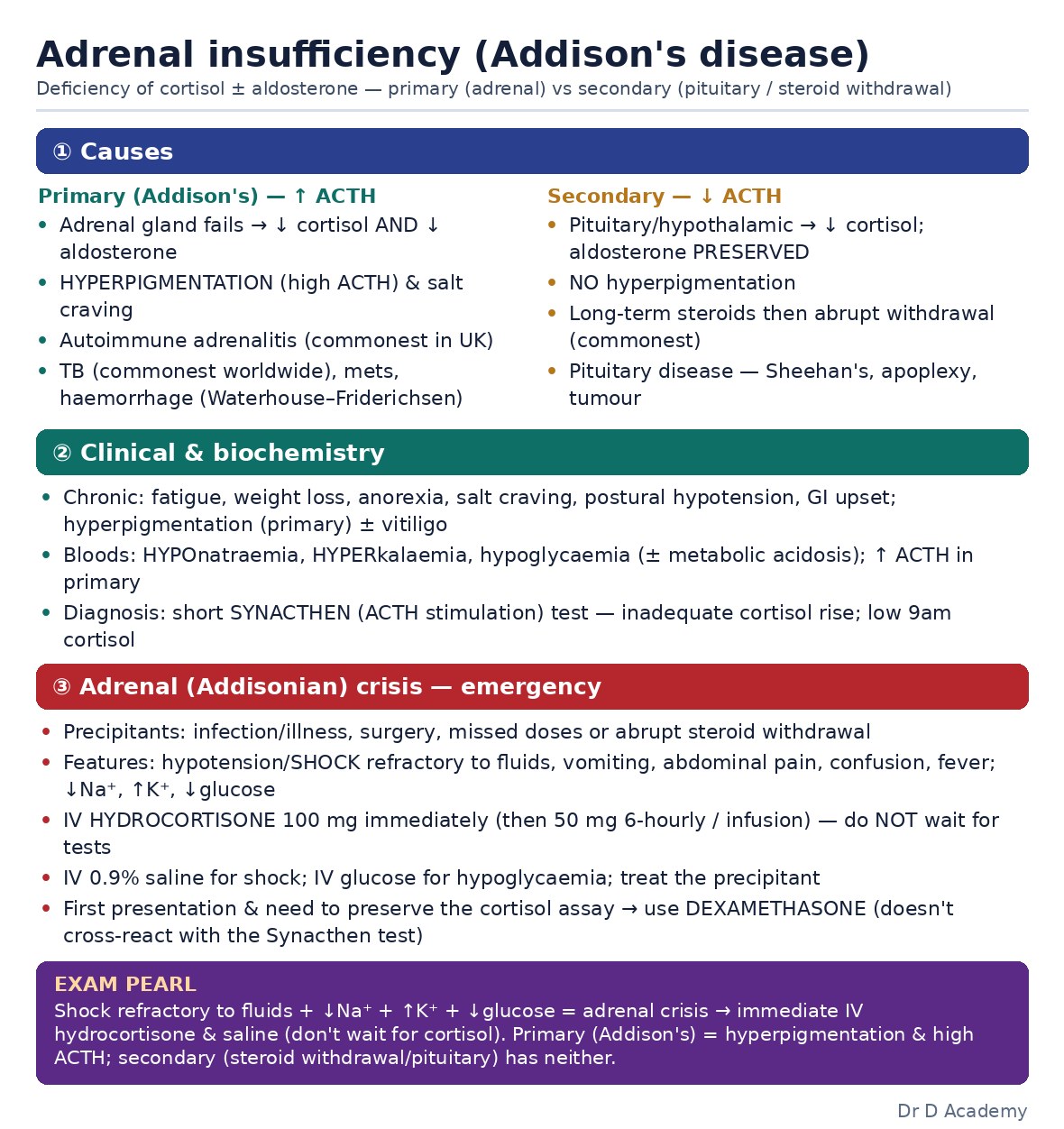
Acute adrenal (Addisonian) crisis is a life-threatening deficiency of cortisol (+/- aldosterone) presenting as shock that is typically refractory to fluids and vasopressors until steroids are given. Suspect it in hypotension with hyponatraemia, hyperkalaemia and hypoglycaemia, in known adrenal insufficiency/steroid-dependence, or after abrupt steroid withdrawal or a precipitating illness. TREAT ON SUSPICION — give hydrocortisone immediately; do not wait for confirmatory results.
Figures & algorithms
Red flags
- Hypotension unresponsive to fluids/vasopressors (think steroid deficiency)
- Hyponatraemia + hyperkalaemia + hypoglycaemia
- Known adrenal insufficiency / recent steroid withdrawal
- Intercurrent illness without stress-dose steroids
Assessment
Differential diagnosis
- Septic/distributive or hypovolaemic shock (crisis is often precipitated by infection)
- Other causes of hyponatraemia/hyperkalaemia (e.g. renal failure)
- Known primary adrenal insufficiency, hypopituitarism, or abrupt withdrawal of long-term glucocorticoids
Investigations
- Take a random cortisol (and ACTH, aldosterone/renin) BEFORE steroids if it will not delay treatment — but never delay therapy
- U&E (hyponatraemia, hyperkalaemia), glucose (hypoglycaemia), and a search for the precipitant (infection, MI)
- Consider a short Synacthen test once stabilised to confirm the diagnosis
Management
- Give IV hydrocortisone IMMEDIATELY on clinical suspicion — this is the key life-saving step.
- Resuscitate the circulation with IV fluids (crystalloid, often large volumes) to correct hypovolaemia and hyponatraemia; correct hypoglycaemia.
- Correct electrolyte disturbances and monitor for hyperkalaemia; treat the precipitating illness (commonly infection).
- Continue regular IV hydrocortisone; with adequate hydrocortisone, separate mineralocorticoid is not needed acutely.
- Avoid over-rapid correction of hyponatraemia (risk of osmotic demyelination).
- Once stable, taper to maintenance replacement, educate on sick-day rules and a steroid emergency card, and arrange endocrine follow-up.
Drugs & doses
Disposition
Complications & pitfalls
- Death from untreated hypocortisolism
- Arrhythmia from hyperkalaemia
- Osmotic demyelination from over-rapid sodium correction
Exam pearls
- Treat on suspicion — give hydrocortisone before biochemical confirmation.
- Shock refractory to fluids and pressors plus low Na/high K should prompt steroids.
- On adequate hydrocortisone you do not need separate fludrocortisone acutely.
Educational — confirm all doses against local policy. Antibiotic doses per BNF (current edition); confirm choice in the in-app Antibiotic Dosing tool.
Disclaimer: Educational decision support for qualified clinicians and students — not a substitute for clinical judgement, local protocols or a full drug reference. Confirm every dose and contraindication against your formulary before prescribing.