Scleritis & the acute red eye in rheumatic disease
Bedside summary
Scleritis is painful inflammation of the sclera that is strongly associated with systemic autoimmune disease (notably rheumatoid arthritis and ANCA-associated vasculitis) and can threaten sight — especially NECROTISING scleritis, which may signal active systemic vasculitis. It must be distinguished from benign episcleritis and from other causes of the acute red eye. Severe, boring eye pain with scleral tenderness in a patient with rheumatic disease mandates urgent ophthalmology assessment.
Figures & algorithms
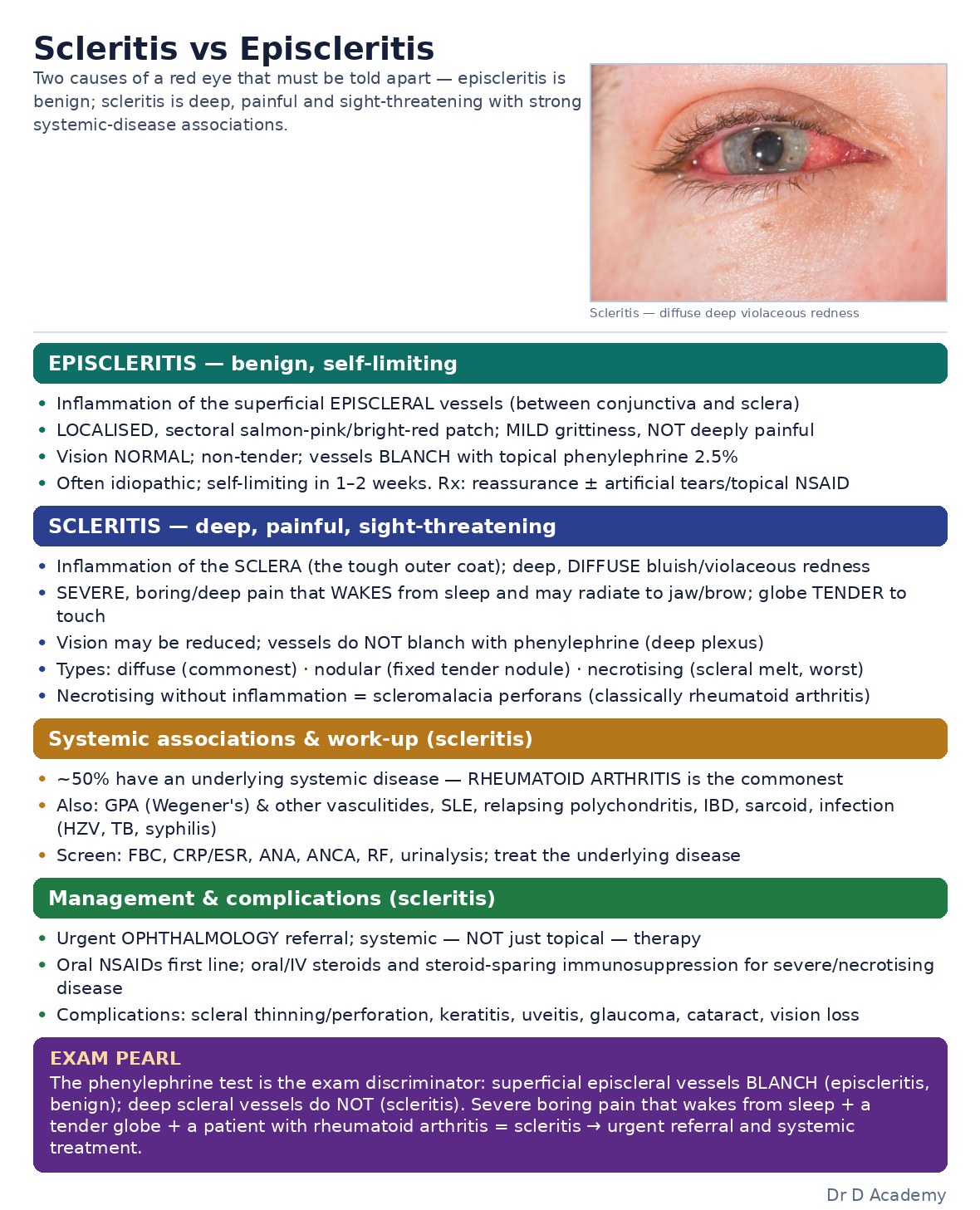
Red flags
- Necrotising scleritis / scleral thinning (risk of perforation, marker of systemic vasculitis)
- Reduced visual acuity or posterior scleritis
- Peripheral ulcerative keratitis with RA (ocular emergency)
- New systemic features of vasculitis (renal, pulmonary, ENT)
Assessment
Differential diagnosis
- Episcleritis (mild, non-sight-threatening; redness blanches with topical phenylephrine, little pain)
- Anterior uveitis (associated with spondyloarthritis, sarcoid, Behçet), keratitis, acute angle-closure glaucoma
- Peripheral ulcerative keratitis (also vasculitis-associated), conjunctivitis, infection
Investigations
- Slit-lamp examination by ophthalmology to confirm scleritis, classify (diffuse/nodular/necrotising; anterior/posterior) and assess for scleral thinning
- Severe boring pain, scleral tenderness and a bluish hue that does NOT blanch with topical phenylephrine favour scleritis over episcleritis
- Systemic work-up for an underlying cause: FBC, CRP/ESR, renal function/urinalysis, RF/anti-CCP, ANA, ANCA; exclude infection
- Imaging (B-scan ultrasound) for suspected posterior scleritis
Management
- Refer any suspected scleritis for URGENT same-day ophthalmology assessment — it is sight-threatening and needs slit-lamp confirmation.
- Distinguish scleritis from episcleritis (phenylephrine blanching test, severity of pain) and exclude infection.
- Treat non-necrotising scleritis with systemic NSAIDs and/or systemic corticosteroids as directed by ophthalmology.
- Treat NECROTISING scleritis aggressively with high-dose corticosteroid and systemic immunosuppression — it usually reflects active systemic vasculitis.
- Investigate for and manage the underlying systemic disease with rheumatology; start steroid-sparing immunosuppression for recurrent/vasculitic disease.
- Avoid topical steroids alone as definitive treatment and monitor for scleral thinning/perforation.
Drugs & doses
Disposition
Complications & pitfalls
- Visual loss, scleral thinning and globe perforation
- Secondary glaucoma, cataract and keratitis
- Indicator of uncontrolled systemic vasculitis
- Corticosteroid/immunosuppression adverse effects
Exam pearls
- Scleritis is painful and sight-threatening; episcleritis is mild and benign — the phenylephrine blanching test helps separate them.
- Necrotising scleritis often signals active systemic vasculitis and needs urgent immunosuppression.
- Severe eye pain in RA or ANCA vasculitis is scleritis until proven otherwise.
Educational — confirm all doses against local policy.
Disclaimer: Educational decision support for qualified clinicians and students — not a substitute for clinical judgement, local protocols or a full drug reference. Confirm every dose and contraindication against your formulary before prescribing.