Acute gout flare
Crystal arthropathy · Rheumatology
Physician-written · Verified by three sets of doctors · Reviewed November 2026
Bedside summary
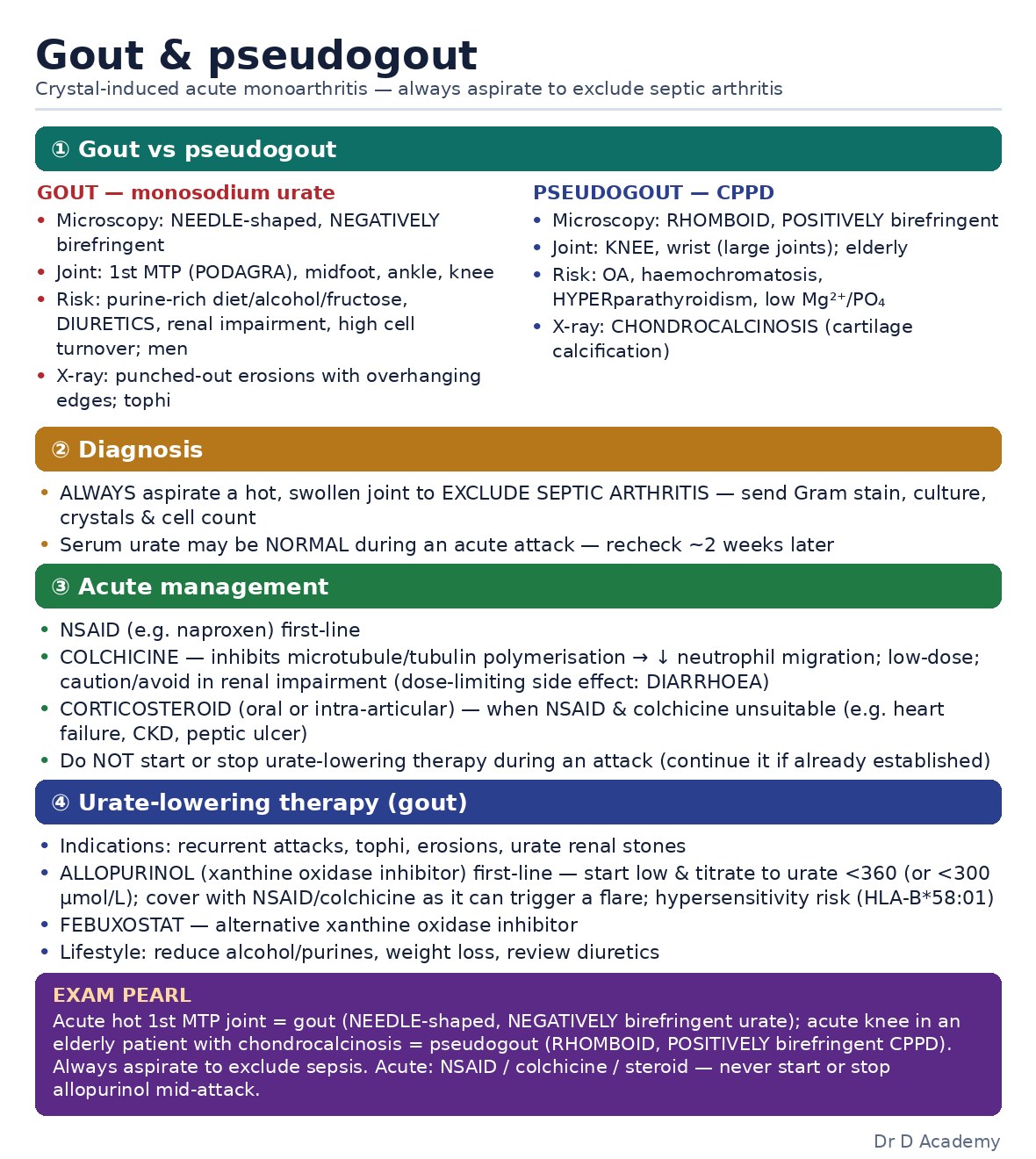
Acute monosodium urate crystal arthritis — abrupt, severe, exquisitely tender MONOarthritis, classically the first MTP joint (podagra), but also midfoot, ankle, knee, wrist. Peaks within 12–24 h with marked swelling, erythema and warmth. The priority is to confirm the diagnosis (ideally by aspiration), treat the flare promptly, and NEVER assume gout in a hot joint until septic arthritis is excluded.
Figures & algorithms
Red flags
- Fever, rigors or a very unwell patient — exclude septic arthritis before attributing a hot joint to gout
- Polyarticular / tophaceous flare in a frail or CKD patient (drug toxicity risk)
- Colchicine overdose features (severe GI symptoms, cytopenias) — especially with interacting drugs or renal failure
Assessment
Differential diagnosis
- Septic arthritis — the must-not-miss; a hot, red joint is septic until proven otherwise (aspirate and culture)
- CPPD (pseudogout) — positively birefringent rhomboid crystals
- Cellulitis / bursitis overlying a joint
- Reactive or other inflammatory arthritis; haemarthrosis (trauma / anticoagulation)
Investigations
- Joint aspiration where feasible — polarised microscopy shows negatively birefringent, needle-shaped urate crystals; send Gram stain, cell count and culture to exclude sepsis
- Serum urate (may be NORMAL or low during an acute flare — do not exclude gout on a normal level; recheck 2–4 weeks after the flare settles)
- FBC, CRP/ESR, renal function (guides drug choice), glucose/lipids as cardiometabolic screen
Management
- Treat the flare EARLY — efficacy is greatest within the first 24 h of onset; choose an anti-inflammatory based on comorbidity, not on urate level.
- First-line options (pick ONE, or combine two for severe/polyarticular flares): an NSAID at full anti-inflammatory dose, colchicine, or a corticosteroid.
- Prefer colchicine or a corticosteroid when NSAIDs are contraindicated (CKD, heart failure, peptic ulcer, anticoagulation).
- For a single large accessible joint, an intra-articular corticosteroid injection is highly effective (once sepsis is excluded).
- Rest, elevate and ice the joint; provide adequate analgesia.
- Do NOT start, stop or change the dose of urate-lowering therapy during the acute flare — but if the patient is already on allopurinol/febuxostat, CONTINUE it uninterrupted.
- Arrange follow-up to discuss long-term urate-lowering therapy and address drivers (alcohol, diuretics, obesity, purine-rich diet).
Drugs & doses
NSAID — e.g. naproxen 500 mg PO twice daily, or indometacin/diclofenac at full dose with a PPI; continue until 1–2 days after resolution (confirm against local policy)
Colchicine 500 micrograms PO 2–3 times daily until the flare settles (lower/less frequent in renal impairment and with interacting drugs e.g. clarithromycin, verapamil, ciclosporin) — confirm against local policy
Corticosteroid — prednisolone 30–35 mg PO daily for 3–5 days (then stop or short taper), especially if NSAIDs/colchicine contraindicated — confirm against local policy
Intra-articular corticosteroid (e.g. methylprednisolone / triamcinolone) for monoarthritis once septic arthritis excluded
IL-1 inhibition (e.g. anakinra) for refractory flares when standard agents fail/are contraindicated — specialist use
Continue any established allopurinol/febuxostat through the flare
Disposition
Most managed as outpatients with prompt anti-inflammatory therapy and rheumatology/GP follow-up; admit if septic arthritis cannot be excluded or the patient is systemically unwell.
Complications & pitfalls
- Chronic tophaceous gout and joint damage if untreated
- Drug toxicity (NSAID AKI/GI bleed; colchicine marrow/neuromuscular toxicity; steroid effects)
- Recurrent flares driving disability
Exam pearls
- A normal serum urate does NOT exclude acute gout — it often falls during a flare.
- Any hot, red, acutely swollen joint is septic arthritis until an aspirate proves otherwise.
- Never stop established urate-lowering therapy during a flare; treating early beats treating late.
Educational — confirm all doses against local policy.
Disclaimer: Educational decision support for qualified clinicians and students — not a substitute for clinical judgement, local protocols or a full drug reference. Confirm every dose and contraindication against your formulary before prescribing.