Calcium pyrophosphate deposition disease (CPPD / pseudogout)
Crystal arthropathy · Rheumatology
Physician-written · Verified by three sets of doctors · Reviewed November 2026
Bedside summary
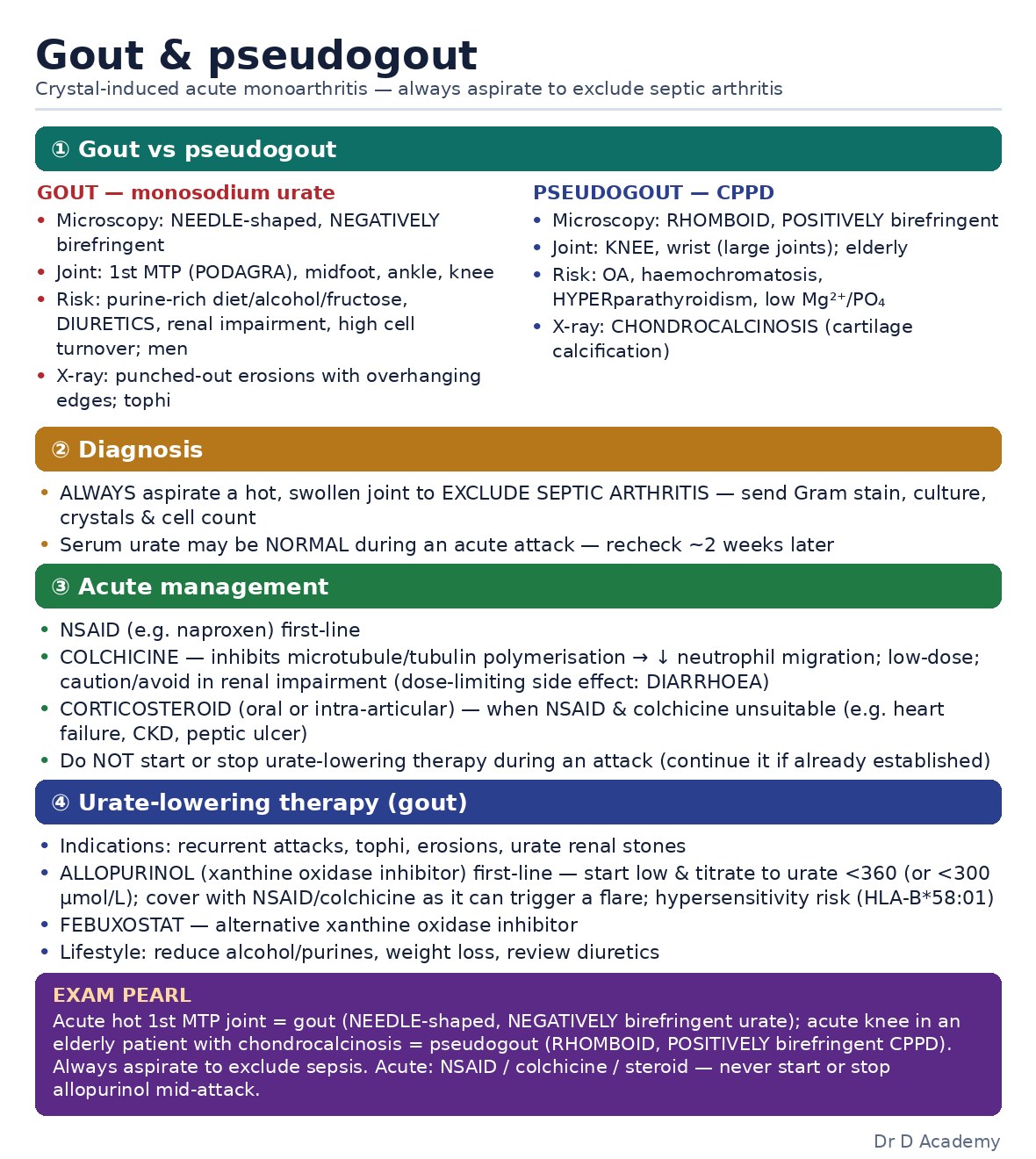
Arthritis caused by calcium pyrophosphate (CPP) crystal deposition. Acute CPP crystal arthritis ('pseudogout') is an acute mono/oligoarthritis — commonly the KNEE or wrist — that mimics gout and septic arthritis. CPPD also causes chronic inflammatory and osteoarthritis-like patterns. Radiographic chondrocalcinosis supports it but is not required; diagnosis rests on identifying CPP crystals.
Figures & algorithms
Red flags
- Hot joint with fever — exclude septic arthritis
- Young patient or florid polyarticular CPPD — look for haemochromatosis, hyperparathyroidism, hypomagnesaemia
- Drug toxicity in elderly/CKD patients (common in this population)
Assessment
Differential diagnosis
- Septic arthritis — exclude first in any acute hot joint (aspirate and culture)
- Acute gout — negatively birefringent needle crystals (CPP are positively birefringent rhomboids)
- Osteoarthritis flare; other inflammatory arthritis
Investigations
- Joint aspiration — polarised microscopy shows weakly POSITIVELY birefringent, rhomboid CPP crystals; always send Gram stain, cell count and culture to exclude sepsis
- X-ray may show chondrocalcinosis (e.g. knee menisci, wrist triangular fibrocartilage, symphysis pubis)
- In younger or florid/polyarticular CPPD, screen for METABOLIC associations: haemochromatosis (ferritin/transferrin saturation), hyperparathyroidism (calcium/PTH), hypomagnesaemia, hypophosphatasia
- CRP/ESR, FBC, renal function to guide therapy
Management
- Confirm the diagnosis by aspiration and EXCLUDE septic arthritis before attributing the joint to crystals.
- Treat the acute attack like a gout flare — there is no therapy to dissolve CPP crystals, so management is anti-inflammatory.
- For an accessible single joint, aspirate and inject an intra-articular corticosteroid (highly effective once sepsis excluded).
- For polyarticular or inaccessible joints, use an NSAID, colchicine, or a short course of systemic corticosteroid, chosen by comorbidity.
- Rest, ice and analgesia; mobilise as symptoms settle.
- For RECURRENT attacks, consider low-dose colchicine prophylaxis; investigate and treat any underlying metabolic cause.
Drugs & doses
Intra-articular corticosteroid (e.g. methylprednisolone / triamcinolone) after aspiration — single accessible joint
NSAID at full anti-inflammatory dose with PPI (if not contraindicated) — confirm against local policy
Colchicine 500 micrograms PO 2–3 times daily for the acute attack (dose-reduce in renal impairment) — confirm against local policy
Prednisolone short course (e.g. 30–35 mg PO daily, taper over days) when NSAIDs/colchicine unsuitable or polyarticular — confirm against local policy
Prophylaxis for frequent recurrences: colchicine 500 micrograms PO once–twice daily — confirm against local policy
Disposition
Usually outpatient with aspiration/anti-inflammatory therapy; admit if septic arthritis cannot be excluded or patient systemically unwell.
Complications & pitfalls
- Chronic CPPD arthropathy and joint destruction
- Recurrent disabling attacks
- Missed septic arthritis or missed metabolic disease
Exam pearls
- CPP crystals are rhomboid and POSITIVELY birefringent — the mirror image of urate.
- Chondrocalcinosis on X-ray supports but does not prove acute CPP arthritis; the aspirate decides.
- Florid or young-onset CPPD warrants a metabolic screen (iron studies, calcium/PTH, magnesium).
Educational — confirm all doses against local policy.
Disclaimer: Educational decision support for qualified clinicians and students — not a substitute for clinical judgement, local protocols or a full drug reference. Confirm every dose and contraindication against your formulary before prescribing.