Recurrent tonsillitis & tonsillectomy indications
Bedside summary
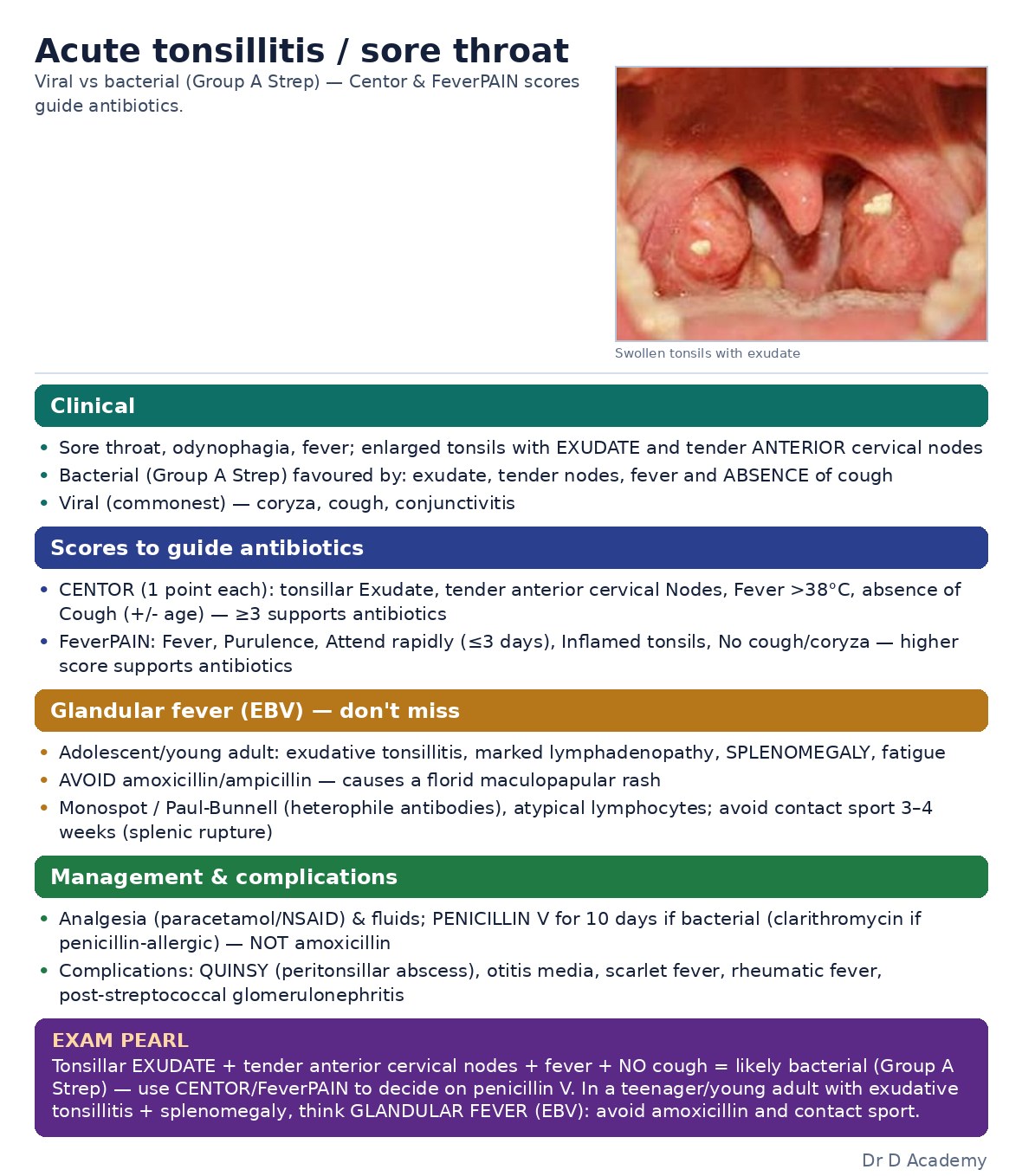
Recurrent acute tonsillitis is a common reason for ENT referral. Most sore throats are viral and self-limiting; bacterial (group A streptococcal) episodes can be targeted with scoring tools. Tonsillectomy is reserved for patients with a well-documented FREQUENCY of significant episodes (SIGN/Paradise-type criteria) or specific complications/indications, balancing benefit against operative and haemorrhage risk. The clinician must also recognise sinister causes of tonsillar/throat pathology that are not simple tonsillitis.
Figures & algorithms
Red flags
- Trismus, uvular deviation, drooling, muffled voice → peritonsillar abscess (quinsy) / deep-neck infection — emergency
- Stridor, respiratory distress or inability to swallow secretions → airway emergency
- Persistent UNILATERAL tonsil enlargement/ulceration or neck node → exclude malignancy
- Post-tonsillectomy bleeding → emergency (secondary haemorrhage typically 5–10 days post-op)
Assessment
Differential diagnosis
- Viral pharyngitis/tonsillitis (commonest)
- Group A streptococcal (bacterial) tonsillitis
- Infectious mononucleosis (EBV) — marked lymphadenopathy, malaise, exudative tonsils
- Peritonsillar abscess (quinsy) — trismus, uvular deviation, "hot potato" voice (emergency)
- Unilateral tonsillar enlargement/ulceration → tonsillar lymphoma or squamous cell carcinoma
- Scarlet fever; rarely diphtheria
Investigations
- Clinical scoring for bacterial likelihood (Centor / FeverPAIN) to guide antibiotic use
- Document the number, dates and severity of episodes (needed to justify surgery)
- Consider monospot/EBV serology where glandular fever is suspected; FBC if unwell
- Investigate/refer any persistent unilateral tonsillar enlargement or ulceration (exclude malignancy)
Management
- Manage acute episodes supportively: analgesia/antipyretics, fluids; use FeverPAIN/Centor to decide on antibiotics (most need none).
- Prescribe penicillin V (or a macrolide if penicillin-allergic) for likely bacterial tonsillitis; AVOID amoxicillin/ampicillin if glandular fever is possible (rash).
- Safety-net for quinsy, airway compromise and inability to swallow (admit for IV therapy if dehydrated/unable to swallow).
- Refer for consideration of TONSILLECTOMY when SIGN-type criteria are met: ≥7 adequately treated significant episodes in 1 year, ≥5/year for 2 years, or ≥3/year for 3 years, each disabling and preventing normal functioning.
- Other tonsillectomy indications: recurrent quinsy, obstructive sleep-disordered breathing from tonsillar hypertrophy, suspected malignancy (unilateral enlargement), and some systemic conditions (e.g. PFAPA) — confirm against local policy.
- Counsel on operative risks, especially primary and secondary post-tonsillectomy haemorrhage, and when to seek urgent help.
- Consider watchful waiting where episodes are improving, as frequency often declines over time.
Drugs & doses
Disposition
Complications & pitfalls
- Peritonsillar/parapharyngeal abscess
- Dehydration and difficulty swallowing
- Post-streptococcal sequelae (rheumatic fever, glomerulonephritis) — now rare
- Post-tonsillectomy haemorrhage (primary <24h; secondary ~day 5–10)
Exam pearls
- Use FeverPAIN/Centor — most sore throats are viral and need no antibiotic.
- Never give amoxicillin/ampicillin if glandular fever is possible.
- Unilateral tonsil enlargement is cancer until proven otherwise — refer, do not just re-treat.
Educational — confirm all doses against local policy. Antibiotic doses per BNF (current edition); confirm choice in the in-app Antibiotic Dosing tool.
Disclaimer: Educational decision support for qualified clinicians and students — not a substitute for clinical judgement, local protocols or a full drug reference. Confirm every dose and contraindication against your formulary before prescribing.