Acute mastoiditis with subperiosteal abscess
Bedside summary
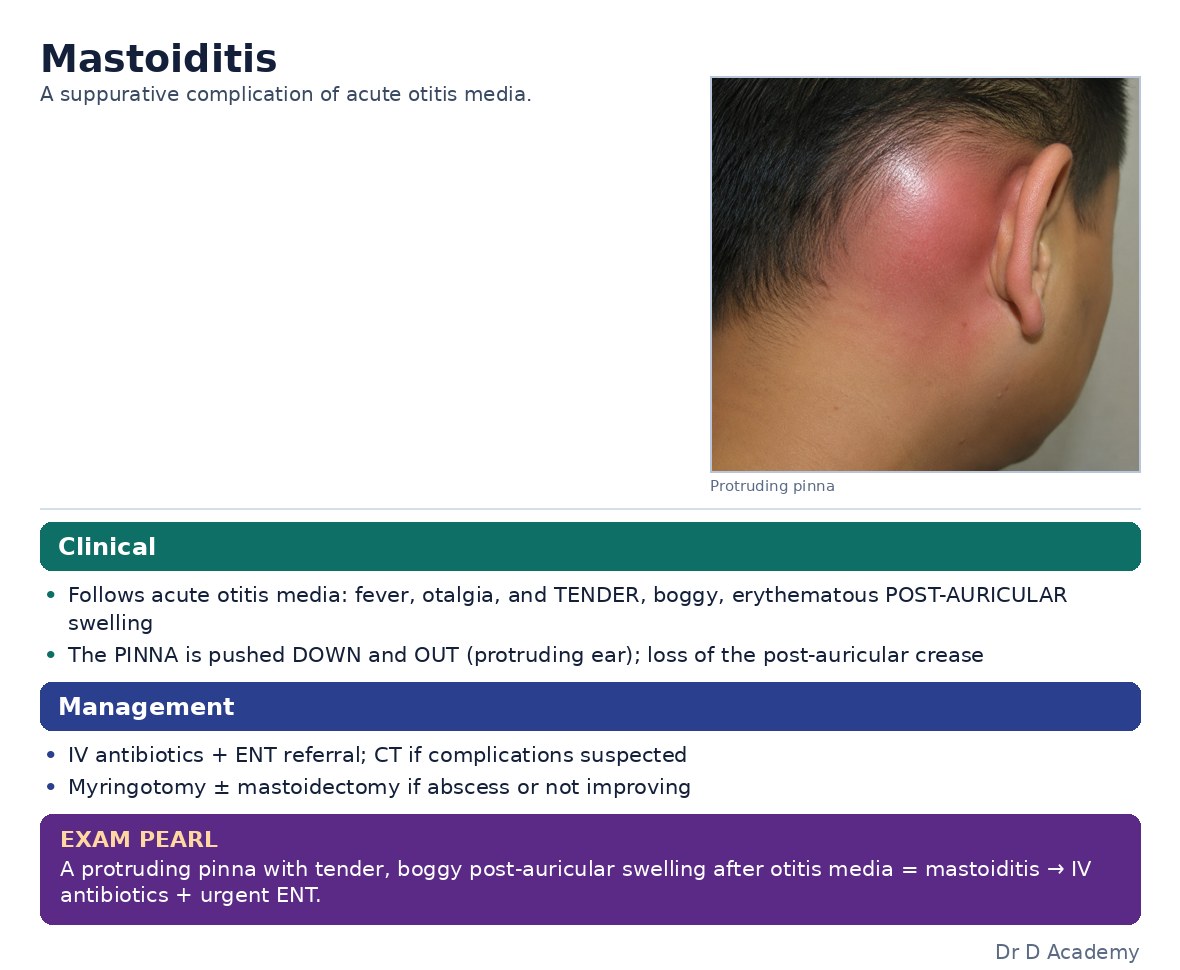
Acute mastoiditis is suppurative infection of the mastoid air cells, usually a complication of acute otitis media (AOM), that erodes bone and can form a subperiosteal abscess or progress to intracranial complications. The hallmark is a child or adult with AOM who develops post-auricular swelling, erythema and tenderness with an anteriorly/inferiorly displaced pinna. It is an emergency: start IV antibiotics, image with CT, and involve ENT early for drainage/mastoidectomy.
Figures & algorithms
Red flags
- Facial nerve weakness
- Severe headache, neck stiffness, drowsiness or seizures (intracranial complication)
- Vertigo/sensorineural hearing loss (labyrinthitis)
- Spiking fevers/rigors (sigmoid sinus thrombosis)
- Neck swelling below the mastoid tip (Bezold abscess)
Assessment
Differential diagnosis
- Severe AOM without mastoiditis (no post-auricular signs, mastoid not boggy)
- Post-auricular lymphadenitis / infected sebaceous cyst / cellulitis
- Bezold abscess (pus tracking into the neck below the mastoid tip)
- First presentation of cholesteatoma with acute infection
Investigations
- Examine for the classic triad: post-auricular swelling/erythema, tenderness over the mastoid, and a protruding/down-and-out pinna
- Otoscopy (bulging/perforated TM, otorrhoea); test facial nerve and assess for meningism/altered consciousness
- FBC, CRP, blood cultures; ear swab if discharging
- Contrast CT of the temporal bones (coalescence, subperiosteal abscess, bony erosion); MRI/CT brain if any intracranial concern
- Audiometry when stable
Management
- Resuscitate as needed and give IV broad-spectrum antibiotics early with good CNS penetration, covering common AOM pathogens.
- Give adequate analgesia and antipyretics; keep the patient nil-by-mouth if theatre is likely.
- Arrange urgent contrast CT to define coalescence, a subperiosteal abscess and any intracranial extension.
- Involve ENT urgently: a subperiosteal abscess, failure to improve on IV antibiotics, or any complication is an indication for cortical mastoidectomy +/- myringotomy/grommet and abscess drainage.
- Screen continuously for complications (facial palsy, labyrinthitis, sigmoid sinus thrombosis, meningitis, intracranial abscess) and image/escalate if they appear.
- Send pus for microbiology and refine antibiotics on sensitivities.
Drugs & doses
Disposition
Complications & pitfalls
- Subperiosteal/Bezold abscess
- Facial nerve palsy
- Labyrinthitis / sensorineural hearing loss
- Sigmoid (lateral) sinus thrombosis
- Meningitis, extradural/subdural or brain abscess
- Petrous apicitis (Gradenigo)
Exam pearls
- A down-and-out pinna with post-auricular swelling is mastoiditis until proven otherwise.
- IV antibiotics plus urgent CT; a subperiosteal abscess or lack of improvement means theatre.
- Always re-examine for the intratemporal and intracranial complications — they change management.
Educational — confirm all doses against local policy. Antibiotic doses per BNF (current edition); confirm choice in the in-app Antibiotic Dosing tool.
Disclaimer: Educational decision support for qualified clinicians and students — not a substitute for clinical judgement, local protocols or a full drug reference. Confirm every dose and contraindication against your formulary before prescribing.