Paediatric epiglottitis / supraglottitis
Bedside summary
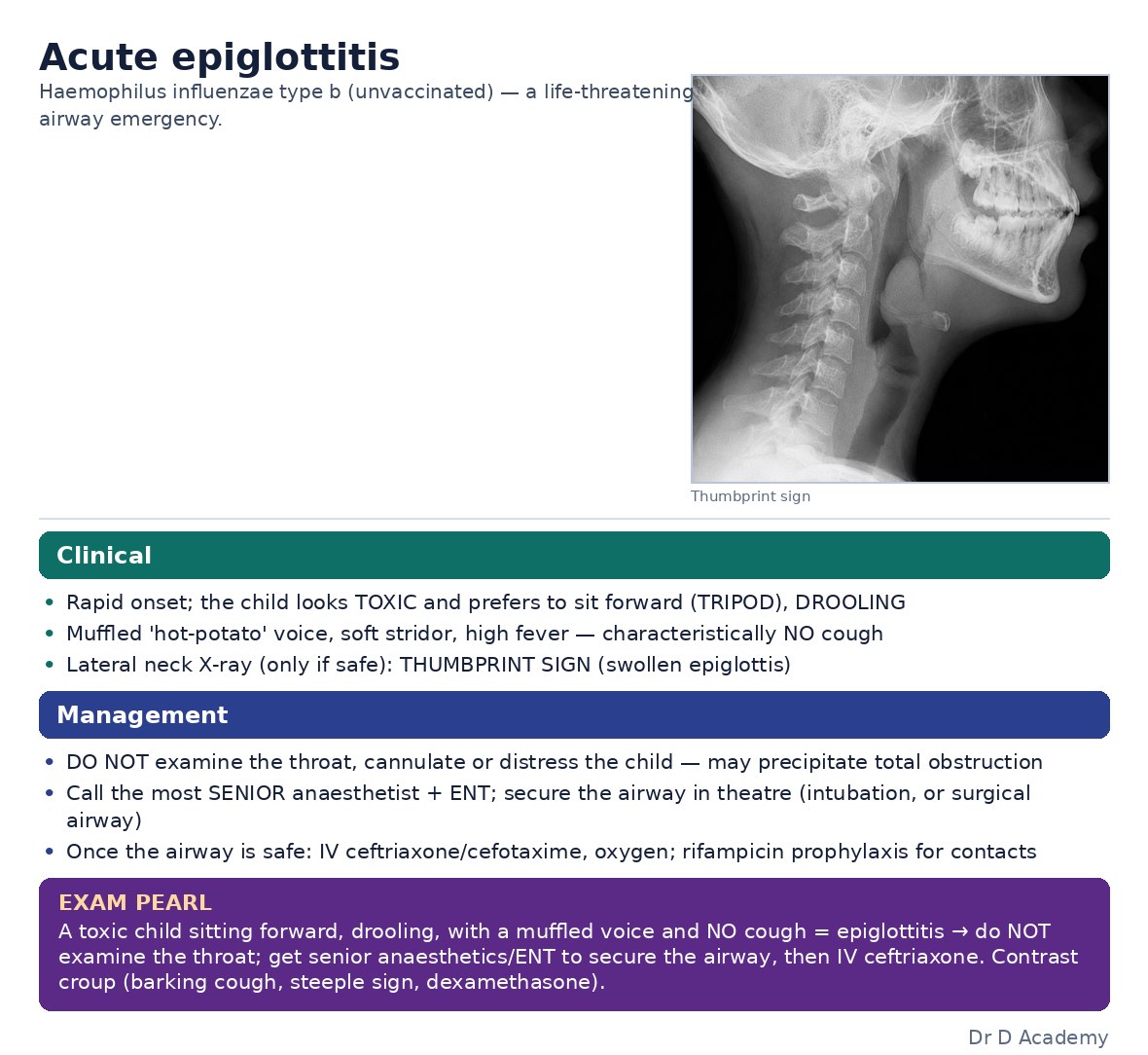
Acute inflammation of the epiglottis and supraglottis, now rare after Hib vaccination but rapidly fatal. The child is TOXIC, sitting forward (tripod), drooling and quiet with a muffled voice and minimal cough. Management is strictly AIRWAY-FIRST: do NOT examine the throat, lie the child down, cannulate or distress them — keep them calm with a parent and summon the most senior ENT/anaesthetic/paediatric team for controlled airway management in theatre.
Figures & algorithms
Red flags
- Toxic, drooling, tripod posture, muffled "hot-potato" voice, minimal cough
- Any attempt to examine the throat, lie the child flat, or cannulate before the airway is secured
- Rapid deterioration / exhaustion
- Sudden complete obstruction
Assessment
Differential diagnosis
- Croup — barking cough, less toxic, responds to steroid/adrenaline
- Bacterial tracheitis — toxic, purulent secretions, poor adrenaline response
- Inhaled foreign body; retropharyngeal abscess; anaphylaxis/angioedema; diphtheria
Investigations
- CLINICAL diagnosis — do NOT perform throat examination, lie the child flat, take bloods or imaging in the acute phase (risk of fatal obstruction)
- Diagnosis and airway are secured together in theatre (laryngoscopy shows a swollen cherry-red epiglottis)
- Blood cultures and definitive investigation only AFTER the airway is safe
Management
- Keep the child calm and upright on the parent's lap; give blow-by oxygen only if tolerated — avoid ALL distress.
- Summon the most experienced anaesthetist, ENT surgeon and paediatric team immediately; move to theatre for a controlled airway.
- Perform inhalational (gas) induction with the child sitting, and secure the airway (intubation, with surgical airway backup ready).
- Only AFTER the airway is secured: obtain IV access, blood cultures and start IV antibiotics.
- Give IV antibiotics covering typical organisms (incl. Haemophilus influenzae type b and streptococci).
- Admit to intensive care; extubate when the swelling settles.
Drugs & doses
Disposition
Complications & pitfalls
- Acute complete airway obstruction and arrest
- Hypoxic injury
- Sepsis
- Epiglottic abscess
Exam pearls
- Do NOT examine the throat or distress the child — epiglottitis is airway-first.
- Secure the airway with inhalational induction in theatre with the most senior team; bloods and antibiotics come after.
- Keep the child upright and calm with a parent until the airway is controlled.
Educational — confirm all doses against local policy.
Disclaimer: Educational decision support for qualified clinicians and students — not a substitute for clinical judgement, local protocols or a full drug reference. Confirm every dose and contraindication against your formulary before prescribing.