Acute vertigo — HINTS exam & central vs peripheral differentiation
Neuro-otology · ENT
Physician-written · Verified by three sets of doctors · Reviewed November 2026
Bedside summary
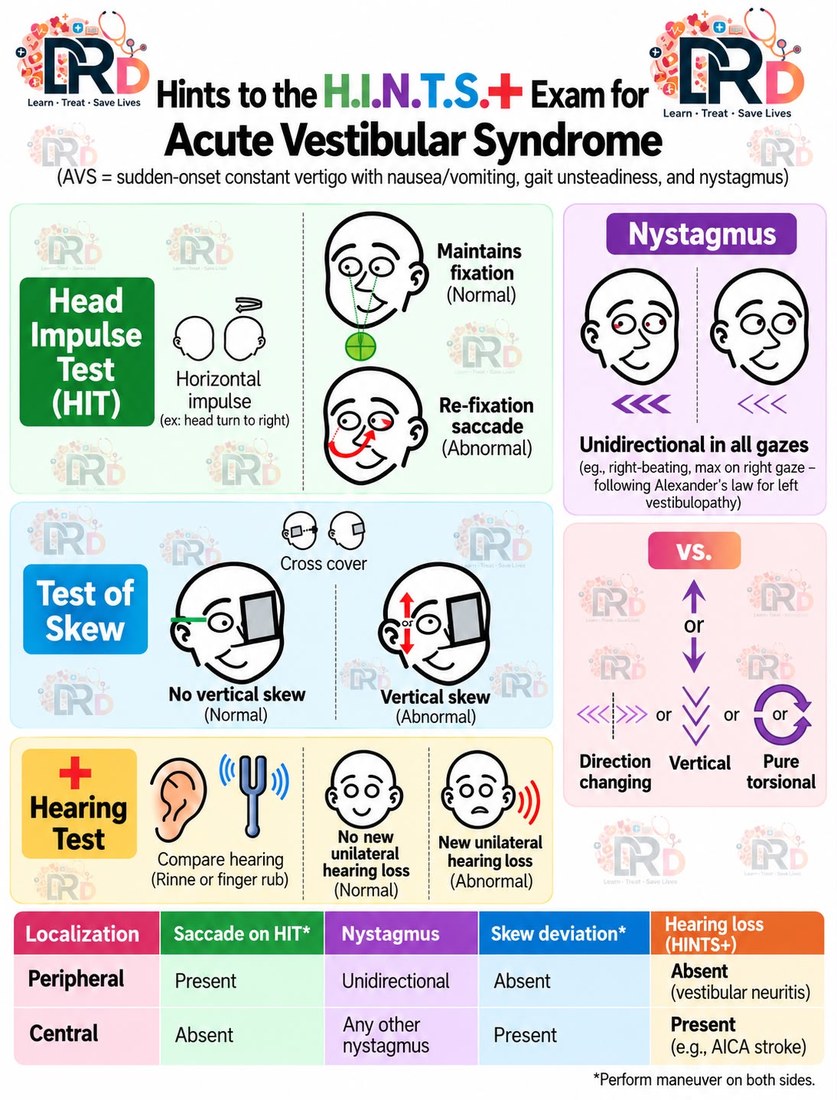
A structured approach to the patient with acute, continuous, spontaneous vertigo (acute vestibular syndrome) whose main job is to NOT miss a posterior-circulation stroke. In a patient with continuous vertigo and nystagmus, the three-step bedside HINTS examination is MORE sensitive than early MRI for stroke. A 'central' HINTS pattern mandates urgent stroke work-up regardless of age.
Figures & algorithms
Red flags
- Normal head impulse test in acute continuous vertigo (central until proven otherwise)
- Direction-changing or vertical/torsional nystagmus; skew deviation
- Inability to stand/walk unaided; new severe headache or neck pain
- New deafness can accompany AICA-territory stroke — do not assume it is benign
Assessment
Differential diagnosis
- Peripheral: vestibular neuritis, labyrinthitis, Meniere, BPPV (BPPV is episodic/positional — HINTS is for continuous vertigo)
- Central: posterior-circulation (cerebellar/brainstem) stroke or TIA, demyelination, posterior fossa lesion
- Non-vestibular mimics: cardiac/pre-syncope, hypoglycaemia, intoxication, drugs
Investigations
- HINTS (only valid in ACUTE, CONTINUOUS vertigo WITH nystagmus): Head Impulse, Nystagmus direction, Test of Skew
- Check gait/truncal ataxia (inability to sit/stand unaided suggests central), and a full neuro exam incl. other cranial nerves
- MRI with diffusion (may be falsely negative in the first 24–48 h for small posterior strokes) if any central feature; CT is insensitive for posterior fossa
Management
- Decide the pattern: episodic/positional (think BPPV — do Dix-Hallpike) vs acute continuous vertigo (apply HINTS).
- Perform HINTS in continuous vertigo with nystagmus: a REASSURING peripheral pattern = abnormal (corrective saccade) head impulse, unidirectional horizontal nystagmus, and NO skew.
- A CENTRAL (dangerous) pattern = NORMAL head impulse, direction-changing or vertical/torsional nystagmus, OR skew deviation — any one is concerning.
- Add gait testing: inability to walk/stand unaided points central even with a benign HINTS.
- If any central feature, new headache/neck pain, or vascular risk — treat as stroke: urgent imaging and stroke pathway.
- If clearly peripheral, treat symptomatically (short-term vestibular suppressant, antiemetic, early mobilisation) and arrange follow-up.
Drugs & doses
Short-term vestibular suppressant for severe peripheral vertigo (e.g. prochlorperazine or an antihistamine) — limit to a few days to avoid delaying compensation (confirm against local policy)
Antiemetic for vomiting (e.g. ondansetron or metoclopramide) — confirm against local policy
No vestibular suppressant long-term; none of these treat a central cause
Disposition
Admit/stroke pathway for any central feature; discharge peripheral cases with symptomatic care, falls advice and follow-up.
Complications & pitfalls
- Missed cerebellar/brainstem stroke (may deteriorate with oedema/hydrocephalus)
- Prolonged vestibular suppressant use delaying recovery
- Falls
Exam pearls
- HINTS applies only to ACUTE CONTINUOUS vertigo with nystagmus — not to episodic/positional BPPV.
- A NORMAL head impulse test in this setting is a red flag for stroke.
- Cannot-walk-unaided is central until proven otherwise; HINTS beats early MRI for stroke.
Educational — confirm all doses against local policy.
Disclaimer: Educational decision support for qualified clinicians and students — not a substitute for clinical judgement, local protocols or a full drug reference. Confirm every dose and contraindication against your formulary before prescribing.