Vibratory urticaria / angioedema
Urticaria · Allergy / Immunology
Physician-written · Verified by three sets of doctors · Reviewed November 2026
Bedside summary
An inducible (physical) urticaria in which vibration (jogging, towel-drying, machinery, clapping) triggers localised weals, itch and swelling within minutes. It may be acquired or a rare autosomal-dominant familial form (ADGRE2 mutation) with vibration-induced mast-cell degranulation. It is benign but can be mistaken for an allergic reaction; confirmation is by a provocation (vortex/laboratory shaker) test.
Figures & algorithms
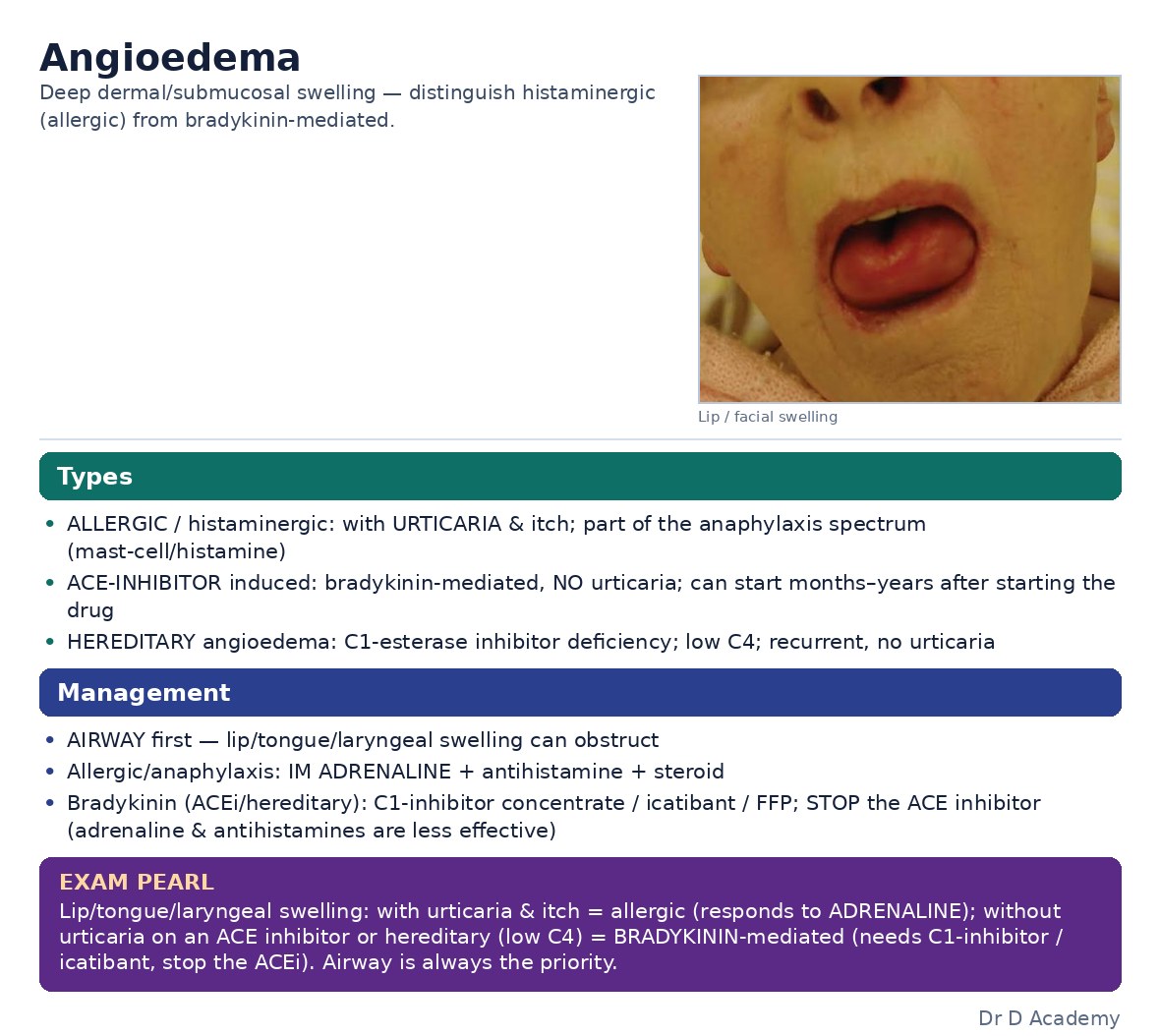
Red flags
- Systemic features (hypotension, bronchospasm) — reassess for anaphylaxis
- Angioedema involving the airway
- Diagnostic uncertainty with another inducible urticaria
Assessment
Differential diagnosis
- Other inducible urticarias — delayed-pressure, dermographism, cholinergic (overlap possible)
- Exercise-induced anaphylaxis / food-dependent exercise-induced anaphylaxis (systemic, not purely vibratory)
- Contact or allergic reactions to materials handled during vibration
Investigations
- Provocation test — apply a standardised vibratory stimulus (e.g. a laboratory vortex/shaker to the forearm) and observe for a weal
- History of reproducible reactions to specific vibratory triggers; ask about a family history (familial form)
Management
- Confirm the diagnosis by correlating the history with a positive vibratory provocation test.
- Educate the patient to AVOID or minimise identified vibratory triggers (the mainstay of management).
- For symptomatic relief, use non-sedating H1 antihistamines, up-titrated as for chronic urticaria if needed.
- Reassure that reactions are usually localised and self-limiting; provide a clear plan for troublesome episodes.
- If systemic features (hypotension, wheeze, generalised reaction) ever occur, reassess for exercise-induced anaphylaxis and provide an adrenaline auto-injector.
- Refer to allergy/immunology for diagnostic confirmation and, in familial cases, counselling.
Drugs & doses
Non-sedating H1 antihistamine, up-titrated (off-licence) as needed for symptom control (confirm against local policy)
Adrenaline auto-injector only if systemic/anaphylactic features have occurred (confirm against local policy)
Disposition
Outpatient allergy follow-up; manage with trigger avoidance and antihistamines, with an action plan for flares.
Complications & pitfalls
- Occupational limitation from triggering activities
- Misdiagnosis as food/drug allergy
Exam pearls
- Weals appearing within minutes of vibration (towel-drying, jogging, tools) point to vibratory urticaria.
- A vortex/shaker provocation test confirms it; trigger avoidance is the core treatment.
- Ask about family history — there is a rare autosomal-dominant ADGRE2 form.
Educational — confirm all doses against local policy.
Disclaimer: Educational decision support for qualified clinicians and students — not a substitute for clinical judgement, local protocols or a full drug reference. Confirm every dose and contraindication against your formulary before prescribing.