Refractory anaphylaxis — adrenaline infusion (adult)
Anaphylaxis not responding to two or more IM adrenaline doses · Allergy / Immunology
Physician-written · Verified by three sets of doctors · Reviewed November 2026
Bedside summary
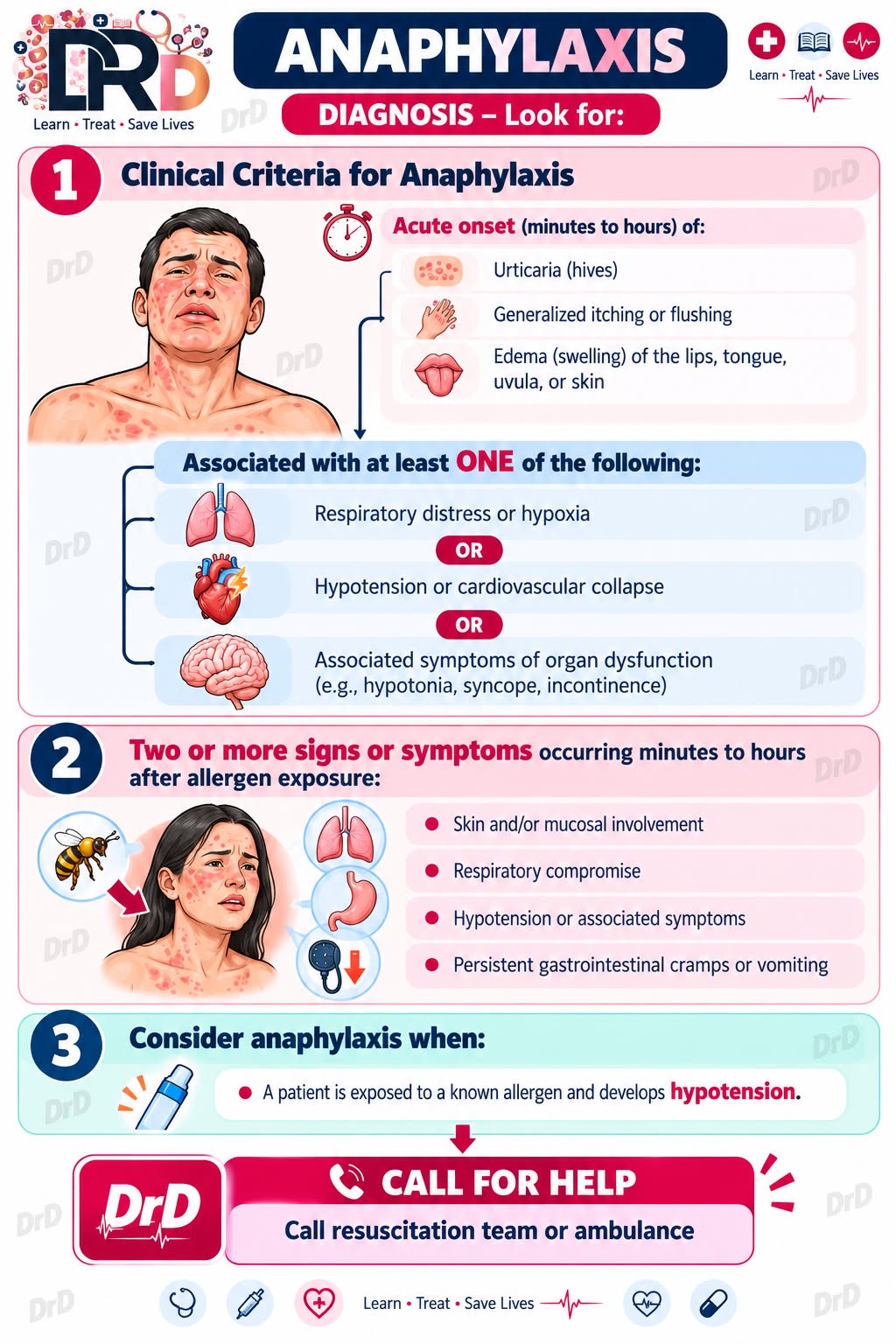
Refractory anaphylaxis is persistent respiratory/cardiovascular compromise despite two appropriate IM adrenaline doses and fluid resuscitation. It mandates escalation to a low-dose IV adrenaline infusion with critical-care involvement rather than repeated large IV boluses, which risk arrhythmia and myocardial ischaemia.
Figures & algorithms
Red flags
- Falling SpO2 or rising CO2 signalling impending respiratory arrest
- Progressive tongue/laryngeal oedema with stridor
- Persistent hypotension despite adrenaline infusion and 2 L fluid
- New ECG ischaemia or arrhythmia during adrenaline therapy
- Reduced conscious level
Assessment
Differential diagnosis
- Adrenaline under-dosing or delayed administration
- Severe asthma / acute bronchospasm
- Cardiogenic or distributive (septic) shock
- Beta-blocker or ACE-inhibitor interference with response
- Tension pneumothorax or pulmonary embolism mimicking shock
Investigations
- Continuous ECG, SpO2, non-invasive then arterial BP monitoring
- Serial mast cell tryptase (at resuscitation, 1-2 h, and >24 h baseline)
- Venous/arterial blood gas with lactate
- 12-lead ECG to exclude ischaemia/arrhythmia
- Bedside echo if shock persists (exclude cardiogenic cause / assess filling)
Management
- Confirm high-flow oxygen 15 L/min, remove trigger, lie flat with legs raised (sit up if airway swelling/respiratory distress)
- Give repeat IM adrenaline 500 mcg every 5 min while preparing infusion; call for critical care / anaesthetics early
- Establish large-bore IV access and give rapid crystalloid bolus 500-1000 mL, repeat to total 1-2 L guided by response
- Start IV adrenaline infusion titrated to effect once two IM doses have failed
- Add a second vasopressor/inotrope (noradrenaline, metaraminol or vasopressin) if shock persists despite adrenaline and fluids
- Give glucagon if the patient takes beta-blockers and is not responding
- Treat refractory bronchospasm with nebulised salbutamol and consider IV magnesium
- Secure definitive airway early if progressive angioedema or exhaustion; prepare for front-of-neck access
- Admit to ICU/HDU for monitored observation and taper infusion slowly
Drugs & doses
Adrenaline IM — 500 mcg (0.5 mL 1:1000), repeat every 5 min
Adrenaline IV infusion — 1 mg in 100 mL 0.9% saline (10 mcg/mL), start 0.5-1 mL/kg/hour (approx 0.05-0.1 mcg/kg/min), titrate to response (critical-care supervised)
Glucagon — 1-2 mg IV every 5 min, then infusion 5-15 mcg/min for beta-blocked patients
Noradrenaline — 0.05-0.5 mcg/kg/min IV infusion via central access, titrated
Magnesium sulfate — 2 g IV over 20 min for refractory bronchospasm
Salbutamol — 5 mg nebulised, repeated/back-to-back
Disposition
Admit to ICU/HDU for monitored weaning of the infusion, minimum 6-12 h observation after stabilisation, and specialist allergy follow-up before discharge.
Complications & pitfalls
- Adrenaline-induced tachyarrhythmia or Takotsubo/myocardial ischaemia
- Cardiac arrest from hypoxia or profound vasodilation
- Pulmonary oedema from over-aggressive fluid resuscitation
- Biphasic reaction during recovery
- Hypoxic-ischaemic brain injury
Exam pearls
- Refractory anaphylaxis is an infusion problem, not a bolus problem — avoid repeated undiluted IV adrenaline boluses on the ward
- Always ask about beta-blockers/ACE-inhibitors — they predict poor response and guide glucagon use
- Antihistamines and steroids do not treat shock and must not delay adrenaline
- A normal initial tryptase does not exclude anaphylaxis; serial samples are more informative
Disclaimer: Educational decision support for qualified clinicians and students — not a substitute for clinical judgement, local protocols or a full drug reference. Confirm every dose and contraindication against your formulary before prescribing.