Angioedema (airway-threatening)
Bedside summary
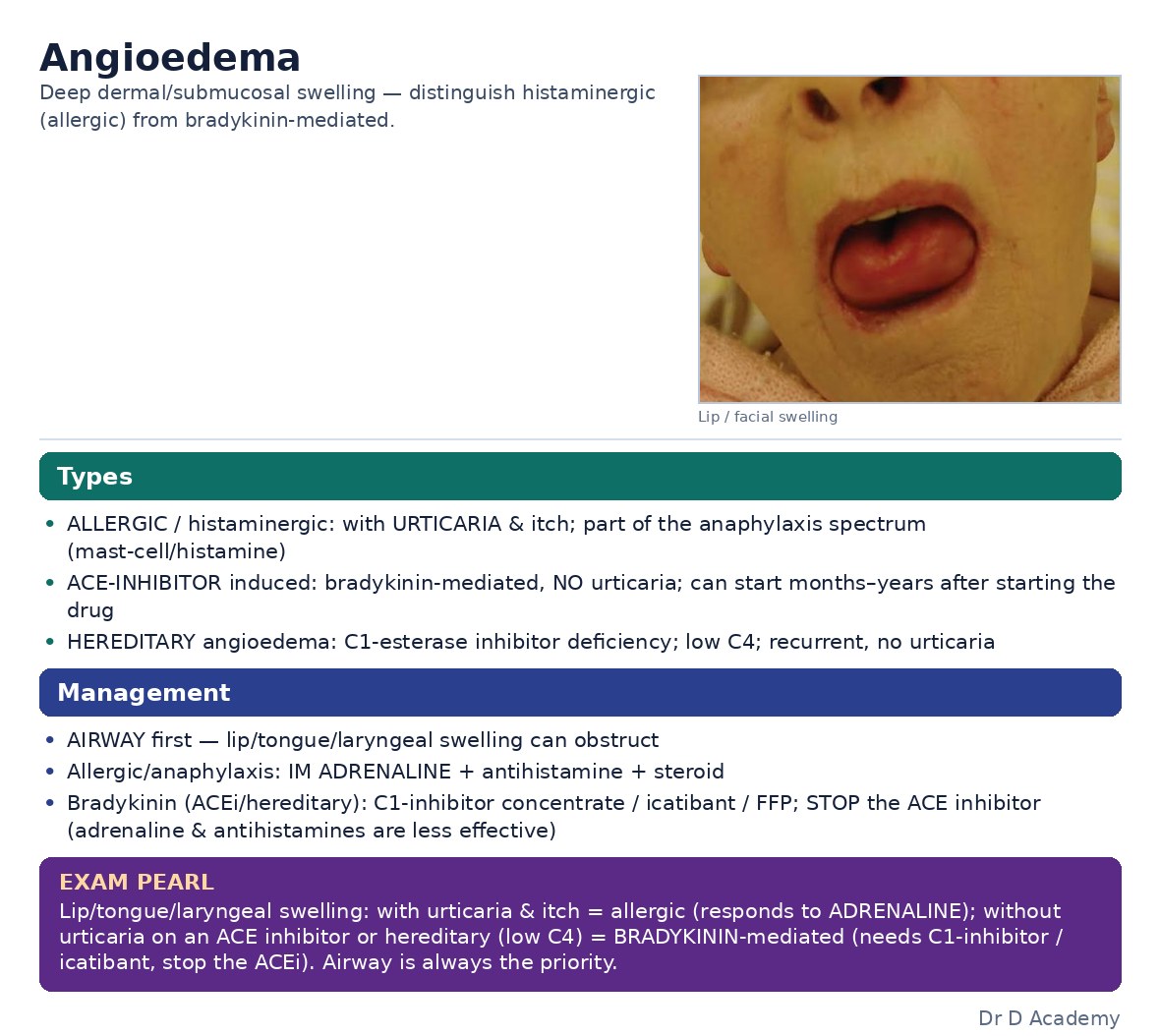
Non-pitting deep dermal/submucosal swelling that can obstruct the airway. The first decision is MECHANISM, because it changes the drugs: (1) HISTAMINERGIC (mast-cell/allergic) — with urticaria/itch/flush, rapid, part of anaphylaxis; responds to adrenaline/antihistamine/steroid. (2) BRADYKININ-mediated — ACE-inhibitor, hereditary (HAE) or acquired C1-inhibitor deficiency; NO urticaria, slower onset over hours, poorly responsive to adrenaline/antihistamine/steroid. Whatever the cause, the AIRWAY is the priority.
Figures & algorithms
Red flags
- Voice change, stridor, drooling or dysphagia
- Tongue / floor-of-mouth / laryngeal swelling
- Rapid progression
- Hypoxia or exhaustion
Assessment
Differential diagnosis
- Anaphylaxis / allergic (histaminergic) angioedema (urticaria, bronchospasm, hypotension)
- ACE-inhibitor angioedema (bradykinin; may start years into therapy)
- Hereditary / acquired C1-inhibitor deficiency (recurrent, family history, abdominal attacks)
- Ludwig's angina / deep-neck infection, retropharyngeal abscess
- Idiopathic angioedema; SVC obstruction; facial cellulitis
Investigations
- Clinical — immediate airway assessment (voice, stridor, drooling, tongue/floor-of-mouth, oropharynx); nasendoscopy for laryngeal involvement
- Do NOT delay treatment for tests; tryptase (anaphylaxis) and C4/C1-INH level & function (if bradykinin cause suspected, mainly for later confirmation)
Management
- Assess the airway CONTINUOUSLY; call senior anaesthetics + ENT early; high-flow oxygen.
- If ANY allergic features (urticaria, wheeze, hypotension) or doubt → treat as ANAPHYLAXIS: IM adrenaline 0.5 mg (repeat q5min) — see Anaphylaxis.
- If bradykinin-mediated (ACE-inhibitor or known/suspected HAE, no urticaria): stop the trigger and give a specific agent (icatibant or C1-inhibitor); FFP if neither available — see Hereditary angioedema attack.
- Secure the airway EARLY if progressive — awake fibreoptic intubation by the most experienced operator; prepare for a surgical airway (swelling may not reverse quickly and agents act over hours).
- Lay the patient in the position they can best maintain their airway; do not force supine if it worsens obstruction.
- Observe for progression over several hours; ICU/theatre standby for laryngeal involvement.
Drugs & doses
Disposition
Complications & pitfalls
- Complete airway obstruction and asphyxiation
- Failed intubation requiring surgical airway
- Recurrence (if bradykinin trigger continued)
Exam pearls
- Look for urticaria: present → histaminergic (adrenaline works); absent + slow onset → think bradykinin (adrenaline/steroid/antihistamine do NOT reliably work).
- When unsure, give adrenaline AND consider bradykinin-specific therapy — and secure the airway early either way.
- ACE-inhibitor angioedema can begin years after starting the drug.
Adapted from UpToDate angioedema topics (©2026). Educational — confirm drug availability and doses locally; mechanism determines therapy.
Disclaimer: Educational decision support for qualified clinicians and students — not a substitute for clinical judgement, local protocols or a full drug reference. Confirm every dose and contraindication against your formulary before prescribing.