Coral snakebite
Bedside summary
Envenomation by North American coral snakes (Micrurus, elapids). The venom is neurotoxic, blocking neuromuscular transmission to cause a descending flaccid paralysis; local pain and swelling are often minimal. Neurological signs may be delayed many hours, so all credible bites are observed and antivenom is given for any evidence of envenomation. Arizona (Sonoran) coral snake bites are not clinically significant.
Figures & algorithms
Red flags
- Ptosis, diplopia, dysarthria or dysphagia — early bulbar signs
- Falling vital capacity or rising carbon dioxide
- Generalised or respiratory-muscle weakness
- Hypersalivation, vomiting or paraesthesiae (systemic envenomation)
Assessment
Differential diagnosis
- Dry bite (common — coral snakes must chew to envenomate)
- Pit viper bite (prominent local swelling and coagulopathy)
- Myasthenia gravis or botulism
- Tick paralysis
- Other causes of descending weakness or bulbar palsy
Investigations
- Serial neuromuscular and respiratory assessment — the key monitoring
- Bedside spirometry: forced vital capacity and maximal inspiratory/expiratory pressures
- Continuous capnography and pulse oximetry (oximetry is insensitive to impending failure)
- Baseline bloods; add CK and coagulation only if a species causing myo- or haematotoxicity is suspected
Management
- First aid: keep calm and still, immobilise the limb in a functional position at heart level; pressure immobilisation may help for neurotoxic elapid bites if antivenom is delayed; no tourniquet, incision or suction
- Observe ALL suspected bites for at least 24 h where antivenom and advanced airway support are available
- Monitor motor strength and pulmonary function hourly for the first 12 h
- Intubate early for ventilatory failure, bulbar weakness or aspiration risk — do not wait for antivenom
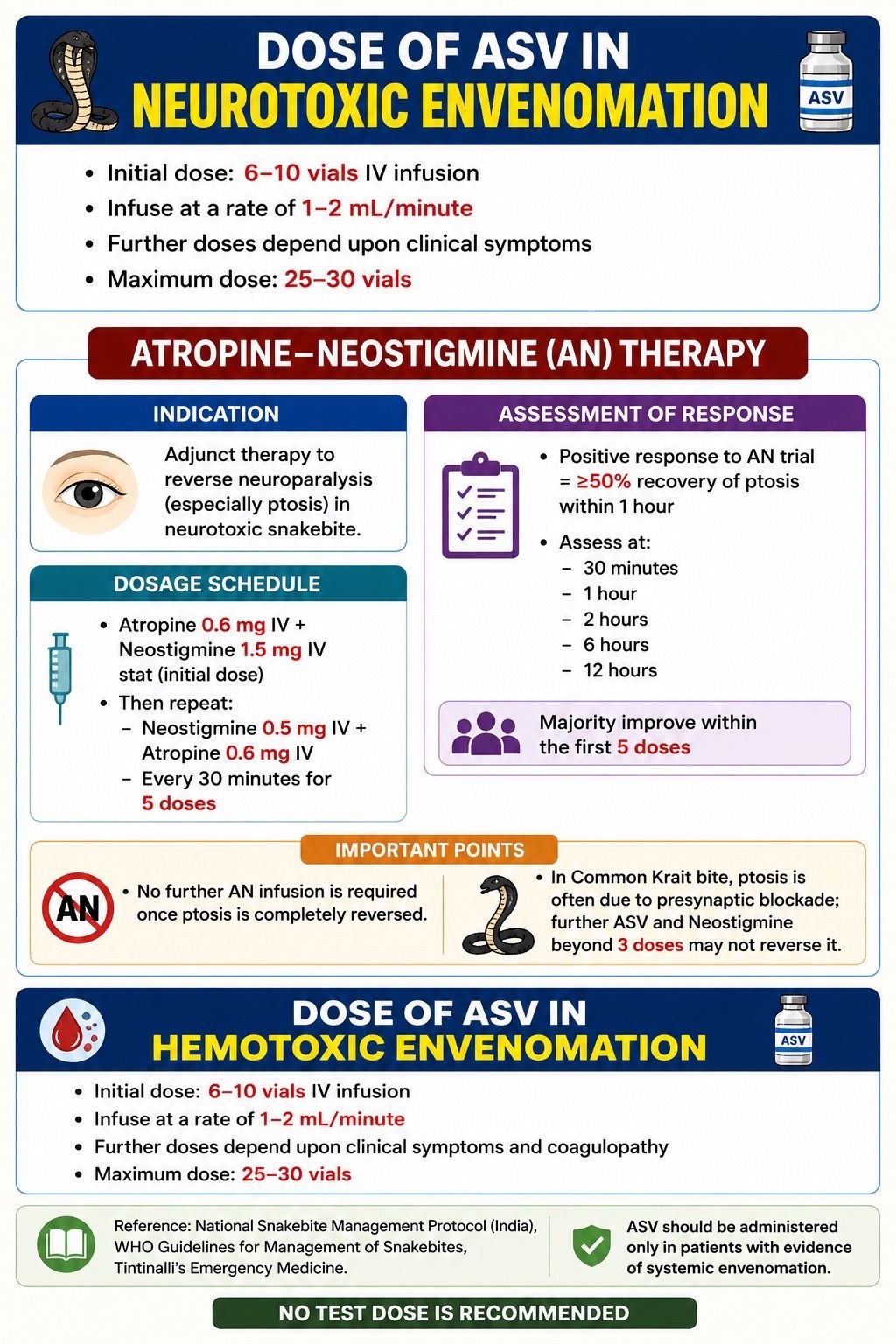
- Give antivenom at the first sign of envenomation beyond trivial local effects
- Provide analgesia and tetanus prophylaxis
Drugs & doses
Disposition
Complications & pitfalls
- Respiratory failure requiring prolonged ventilation
- Aspiration
- Antivenom hypersensitivity or anaphylaxis (around 18% have adverse reactions)
- Established presynaptic block that may not reverse with antivenom
Exam pearls
- Absence of local pain or swelling does NOT exclude envenomation — neurotoxicity can appear after a symptom-free interval of 4-12 h or more
- Give antivenom early: once presynaptic neurotoxicity is established it is poorly reversible
- For an asymptomatic, confirmed eastern coral snake bite many experts observe rather than give empirical antivenom, as reaction risk may outweigh benefit
- No skin testing before antivenom — it is neither sensitive nor specific
- The antivenom does not neutralise Arizona (Sonoran) coral snake venom, whose bites are not clinically significant
Observe for at least 24 hours and give antivenom early — coral snake neurotoxicity is delayed and, once established, hard to reverse.
Disclaimer: Educational decision support for qualified clinicians and students — not a substitute for clinical judgement, local protocols or a full drug reference. Confirm every dose and contraindication against your formulary before prescribing.