Parenteral thiamine prophylaxis in alcohol dependence (Wernicke prevention)
Thiamine prophylaxis · Psychiatry / Behavioural
Physician-written · Verified by three sets of doctors · Reviewed November 2026
Bedside summary
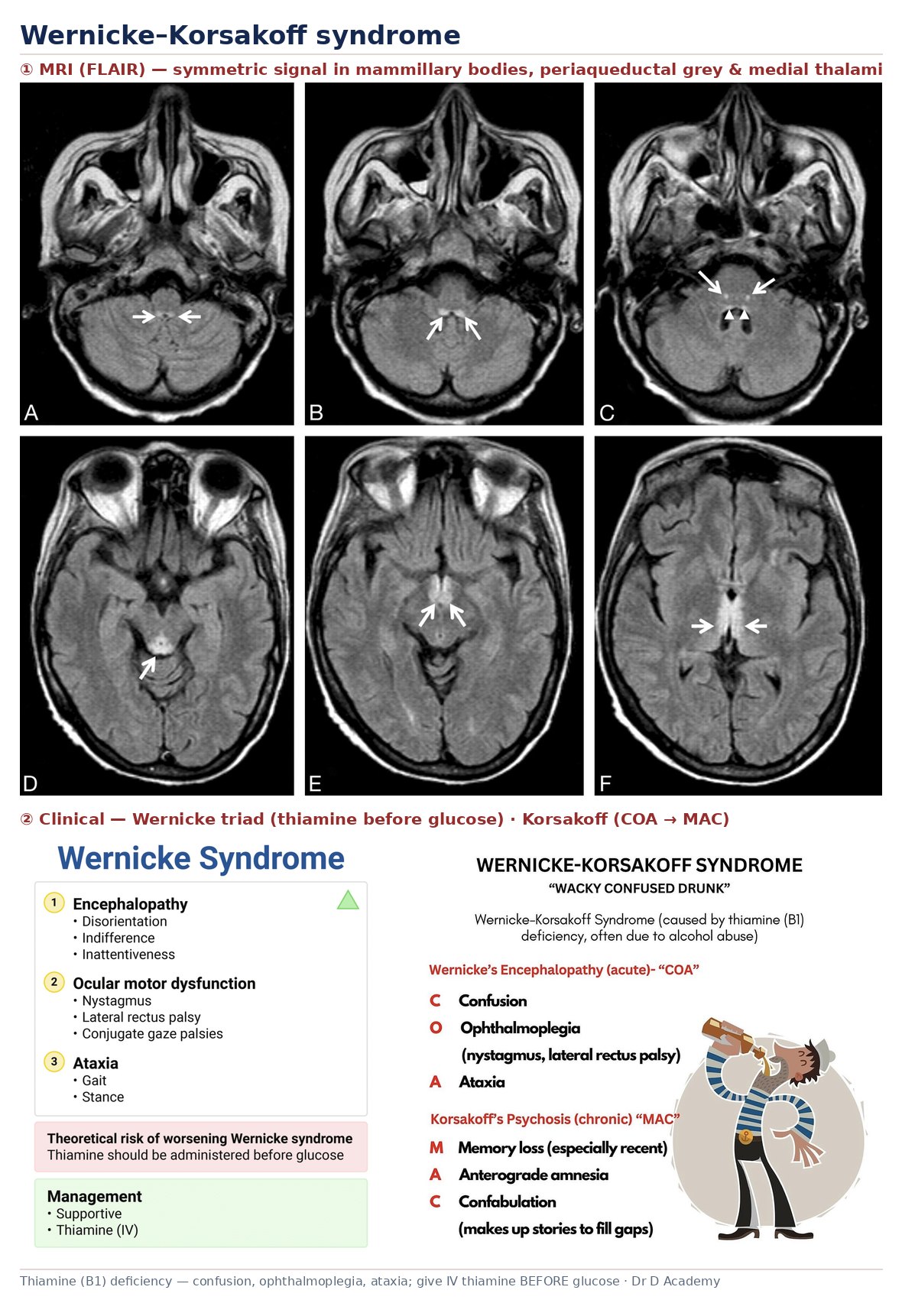
Thiamine-dependent patients (chronic alcohol misuse, malnutrition) are at risk of Wernicke's encephalopathy, which is frequently missed and often does not show the classic triad. Parenteral B-vitamin replacement is cheap, safe and must be given prophylactically to at-risk patients and therapeutically at the first suspicion of Wernicke's.
Figures & algorithms
Red flags
- Any confusion, ataxia or eye signs (treat as Wernicke's immediately)
- Vomiting, weight loss or refeeding in a dependent patient
- Giving glucose without thiamine in the malnourished (can precipitate Wernicke's)
- Anaphylaxis to the infusion
- Progression to Korsakoff's amnesia (irreversible)
Assessment
Differential diagnosis
- Established Wernicke's encephalopathy (confusion, ataxia, ophthalmoplegia)
- Alcohol withdrawal / delirium tremens
- Hepatic encephalopathy
- Hypoglycaemia or other metabolic cause of confusion
- Head injury or intracranial event
Investigations
- Clinical risk assessment (dependence, poor diet, vomiting, weight loss)
- Capillary glucose and observations
- Bloods: FBC, U&E, LFTs, magnesium, glucose
- Assess for signs of Wernicke's (nystagmus, ophthalmoplegia, ataxia, confusion)
- Red-cell transketolase is not practical acutely — treat empirically
Management
- Identify at-risk patients: chronic alcohol misuse, malnutrition, hyperemesis, refeeding risk
- Give parenteral thiamine before or with any carbohydrate/glucose load
- Use prophylactic dosing for well, at-risk patients; therapeutic dosing if any Wernicke's features
- Correct magnesium (a cofactor — Wernicke's is refractory if hypomagnesaemic)
- Continue oral thiamine after the parenteral course
- Observe for infusion reactions (rare anaphylaxis — have resuscitation available)
- Treat coexisting withdrawal and refer to alcohol services
Drugs & doses
Pabrinex — 1 pair IV OD for 3-5 days as prophylaxis in at-risk dependent patients
Pabrinex — 2 pairs IV TDS for 3 days if Wernicke's suspected (then reassess/step down)
Thiamine — 100 mg PO BD-TDS after the parenteral course / for lower-risk patients
Magnesium sulfate — 2 g IV if hypomagnesaemic (essential cofactor)
Disposition
Give parenteral thiamine and discharge well patients with oral thiamine and alcohol-service referral; admit and treat therapeutically if Wernicke's is suspected, involving medicine and liaison psychiatry.
Complications & pitfalls
- Wernicke's encephalopathy progressing to Korsakoff's syndrome
- Irreversible amnesia and institutionalisation
- Death from untreated Wernicke's
- Rare anaphylaxis to parenteral B vitamins
- Refeeding syndrome if nutrition restarted without monitoring
Exam pearls
- Only ~10% of Wernicke's cases show the full triad — treat on suspicion, never wait
- Give thiamine before glucose in the malnourished patient
- Oral thiamine is poorly absorbed in dependence — parenteral is essential for at-risk patients
- Correct magnesium or thiamine will not work
- Prophylaxis is cheap and safe; the cost of missing Wernicke's is lifelong disability
Disclaimer: Educational decision support for qualified clinicians and students — not a substitute for clinical judgement, local protocols or a full drug reference. Confirm every dose and contraindication against your formulary before prescribing.