Internuclear ophthalmoplegia
Localisation · Neurology
Physician-written · Verified by three sets of doctors · Reviewed November 2026
Bedside summary
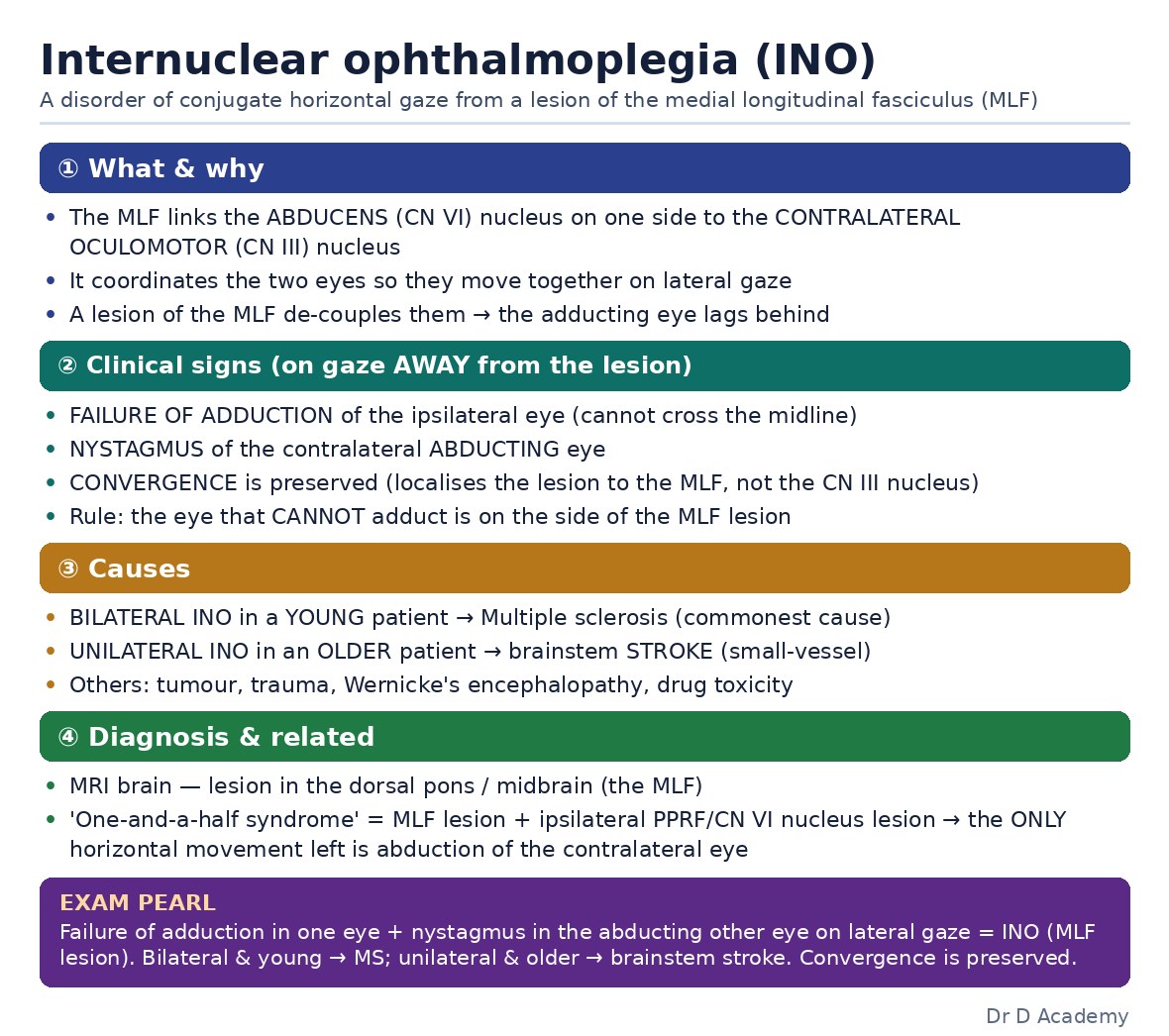
Impaired adduction of one eye on horizontal gaze with nystagmus of the abducting fellow eye, from a lesion of the medial longitudinal fasciculus. In young patients suggests demyelination; in older patients, a brainstem stroke.
Figures & algorithms
Red flags
- Reduced consciousness or additional brainstem signs
- Rapidly progressive or bilateral deficits
- Associated bulbar or respiratory weakness (myasthenia)
Assessment
Differential diagnosis
- Multiple sclerosis (especially bilateral INO in young patients)
- Brainstem (pontine) infarct
- Myasthenia gravis (pseudo-INO)
- Wernicke encephalopathy
- Brainstem tumour or Chiari malformation
Investigations
- MRI brain with attention to the dorsal pons/midbrain
- Assess vascular risk vs demyelination based on age/context
- Acetylcholine receptor antibodies and fatigability testing if myasthenia possible
- Thiamine status if malnutrition/alcohol
- CSF oligoclonal bands if demyelination suspected
Management
- Confirm the adduction deficit with abducting nystagmus and assess for skew/vertical signs
- Determine likely mechanism from age and risk factors
- In older/vascular patients treat as brainstem stroke and image urgently
- In younger patients arrange MRI for demyelination and neurology referral
- Consider and exclude myasthenia and Wernicke as mimics
Drugs & doses
Directed at underlying cause (stroke pathway, relapse steroids, thiamine, or myasthenia therapy)
No specific drug for the INO itself
Disposition
Neurology referral; admit and image as stroke if vascular risk or acute onset.
Complications & pitfalls
- Underlying stroke extension
- Missed treatable mimic (myasthenia, Wernicke)
- Persistent diplopia
Exam pearls
- Bilateral INO in a young person is multiple sclerosis until proven otherwise; unilateral INO in an older person is usually a small brainstem stroke
- Fatigable INO-like signs may be myasthenia (pseudo-INO)
Disclaimer: Educational decision support for qualified clinicians and students — not a substitute for clinical judgement, local protocols or a full drug reference. Confirm every dose and contraindication against your formulary before prescribing.