Capsular warning syndrome (crescendo lacunar TIA)
Stroke / TIA · Neurology
Physician-written · Verified by three sets of doctors · Reviewed November 2026
Bedside summary
A pattern of recurrent, stereotyped, fluctuating episodes of pure motor (or sensorimotor) hemiparesis due to unstable small-vessel (internal capsule/pons) perfusion, without cortical signs. It carries a very HIGH early risk of completed lacunar infarction (often within days). It behaves unlike ordinary TIA: episodes cluster and crescendo, and progression to fixed deficit is common despite standard single antiplatelet therapy.
Figures & algorithms
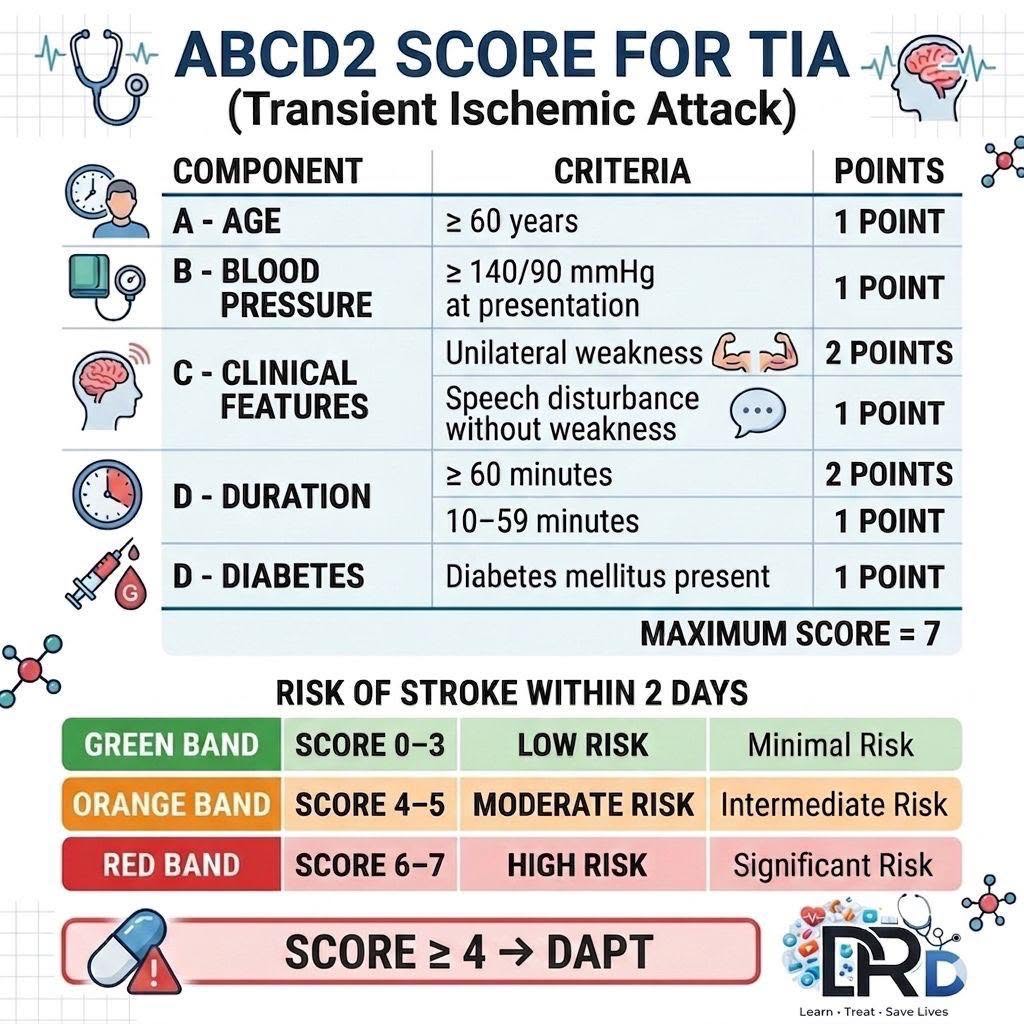
Red flags
- Crescendo, stereotyped recurrent hemiparesis
- Any fixed/residual deficit between episodes
- Reduced consciousness or crossed signs (consider pontine/basilar cause)
- Progression to completed stroke
Assessment
Differential diagnosis
- Ordinary TIA/large-vessel disease (but capsular warning lacks cortical signs — no aphasia/neglect)
- Focal seizure, hypoglycaemia, hemiplegic migraine, functional episodes
- Pontine warning syndrome (analogous, from basilar perforator disease)
Investigations
- Urgent brain imaging (MRI-DWI preferred) to detect established lacunar infarct; CT may be normal early
- Vascular imaging to exclude a large-vessel/embolic source, glucose, ECG
- Monitor and document the stereotyped recurring deficits
Management
- Recognise the clustering, stereotyped, cortical-sign-free hemiparesis as a high-risk warning pattern, not a benign TIA.
- Admit and monitor closely — do NOT discharge; a completed capsular infarct frequently follows.
- Image urgently (MRI) and exclude a large-vessel/cardioembolic cause and stroke mimics.
- Start antiplatelet therapy promptly; intensified antiplatelet strategies (e.g. short-term dual antiplatelet therapy) are commonly used given the high recurrence risk — follow local stroke-team guidance.
- Optimise perfusion: avoid aggressive blood-pressure lowering, ensure euvolaemia and treat hyperglycaemia.
- If the deficit completes within the thrombolysis window, assess for reperfusion (thrombolysis) per the acute ischaemic stroke pathway.
Drugs & doses
Antiplatelet therapy — aspirin, with short-course dual antiplatelet therapy (e.g. aspirin plus clopidogrel) commonly used for high-risk minor stroke/TIA; follow local stroke protocol (confirm against local policy)
Statin and standard secondary-prevention measures
Avoid aggressive antihypertensives acutely (maintain perfusion)
Thrombolysis per the acute stroke pathway if a deficit completes in-window
Disposition
Admit to a stroke unit for monitoring, urgent imaging and intensified antiplatelet therapy; secondary-prevention work-up before discharge.
Complications & pitfalls
- Completed lacunar (capsular/pontine) infarction with fixed deficit
- Recurrent disabling events
- Missed large-vessel/cardioembolic source
Exam pearls
- Clustering, stereotyped, cortical-sign-free hemiparesis = high risk of completed lacunar stroke.
- Admit and monitor — do not treat it like an ordinary low-risk TIA.
- Maintain cerebral perfusion; thrombolyse if the deficit completes in-window.
Educational — confirm all doses against local policy.
Disclaimer: Educational decision support for qualified clinicians and students — not a substitute for clinical judgement, local protocols or a full drug reference. Confirm every dose and contraindication against your formulary before prescribing.