Necrotising fasciitis of a limb
Infection · Musculoskeletal
Physician-written · Verified by three sets of doctors · Reviewed November 2026
Bedside summary
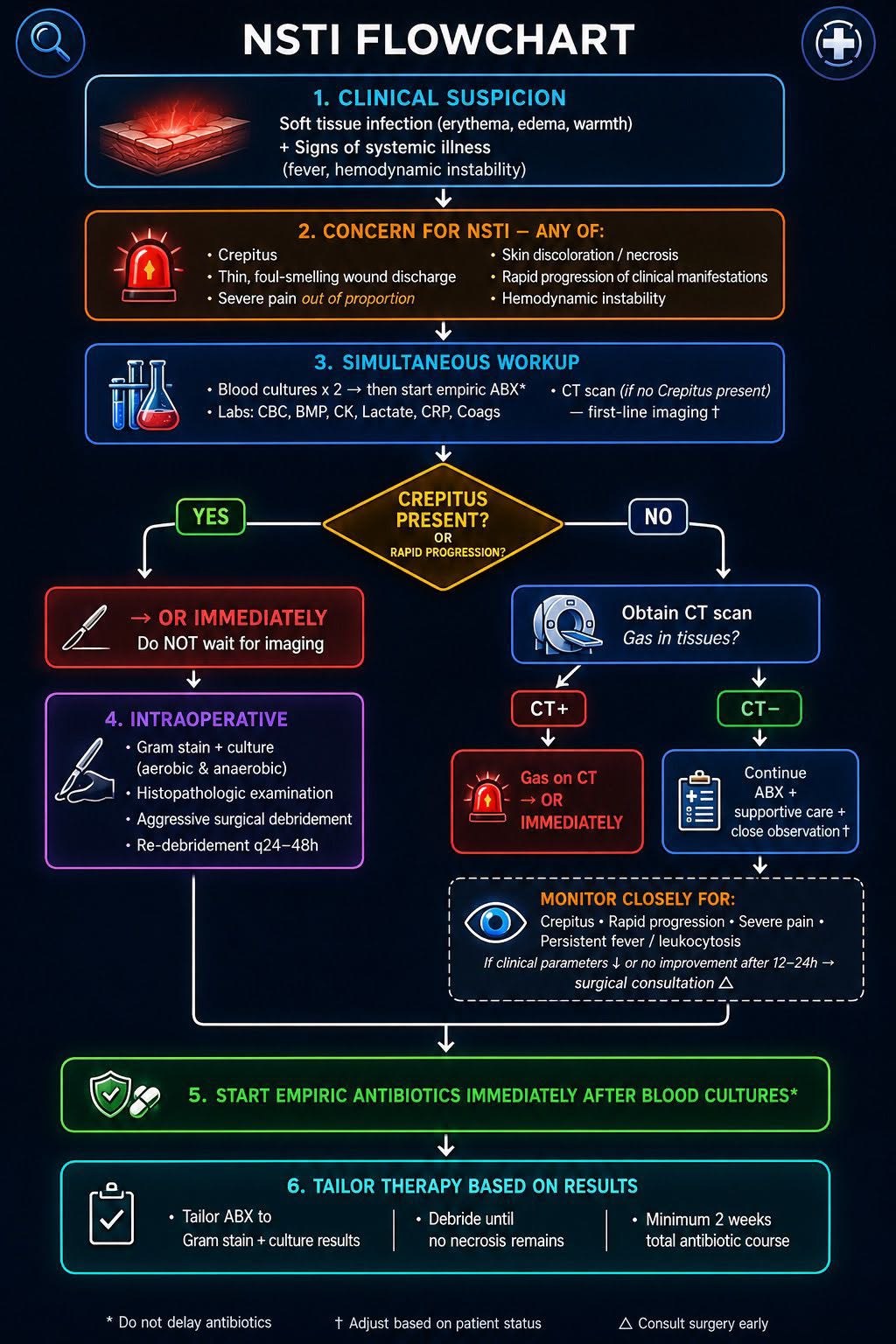
A rapidly progressive, limb- and life-threatening necrotising soft-tissue infection tracking along fascial planes. The diagnosis is CLINICAL and surgical — pain out of proportion, systemic toxicity and rapid progression — and definitive treatment is URGENT surgical debridement. Imaging must NOT delay theatre; antibiotics alone are inadequate.
Figures & algorithms
Red flags
- Pain out of proportion to visible findings
- Rapidly advancing erythema, skin necrosis, bullae, crepitus
- Systemic toxicity / septic shock
- Anaesthesia over the affected skin
Assessment
Differential diagnosis
- Severe cellulitis / erysipelas (no necrosis, less systemic toxicity, responds to antibiotics)
- Clostridial myonecrosis (gas gangrene) — a distinct necrotising muscle infection
- Pyomyositis, deep abscess, acute compartment syndrome
Investigations
- Do NOT delay surgery for tests — this is a clinical/surgical diagnosis
- Bloods: FBC, U&E, CRP, CK, lactate, glucose, coagulation, blood cultures; LRINEC score may support but cannot exclude
- Mark the skin margin and time it to track spread; plain films/CT may show gas but normal imaging does not exclude it
- Surgical exploration is diagnostic (grey dishwater fluid, loss of fascial resistance, necrosis)
Management
- Resuscitate for sepsis: oxygen, IV fluids, and senior surgical + critical care involvement immediately.
- Start broad-spectrum IV antibiotics early INCLUDING an agent that suppresses toxin production (add clindamycin or linezolid).
- Arrange EMERGENCY surgical debridement — repeated explorations until all necrotic tissue is excised; amputation may be life-saving.
- Take deep tissue and blood cultures; de-escalate antibiotics to culture results.
- Consider IV immunoglobulin in streptococcal/staphylococcal toxic shock per local guidance.
- Support in ICU; involve plastics for later reconstruction.
Drugs & doses
Empirical broad-spectrum regimen (e.g. piperacillin-tazobactam or a carbapenem) PLUS clindamycin (antitoxin effect) PLUS MRSA cover (vancomycin/linezolid) — confirm against local policy
Add clindamycin or linezolid specifically to switch off exotoxin production in streptococcal/staphylococcal disease
IV fluid resuscitation and vasopressors as needed for septic shock
IV immunoglobulin considered in toxic shock syndrome (confirm against local policy)
Disposition
Emergency theatre then ICU; serial debridement and multidisciplinary (surgery, microbiology, plastics, critical care) care.
Complications & pitfalls
- Septic shock and multi-organ failure
- Limb loss
- Toxic shock syndrome
- Death if surgery delayed
Exam pearls
- Pain out of proportion plus toxicity = theatre, not imaging.
- Add clindamycin/linezolid to shut down toxin production.
- Repeat debridement is the rule; a single washout is rarely enough.
Educational — confirm all doses against local policy.
Disclaimer: Educational decision support for qualified clinicians and students — not a substitute for clinical judgement, local protocols or a full drug reference. Confirm every dose and contraindication against your formulary before prescribing.