Acute mastoiditis
Bedside summary
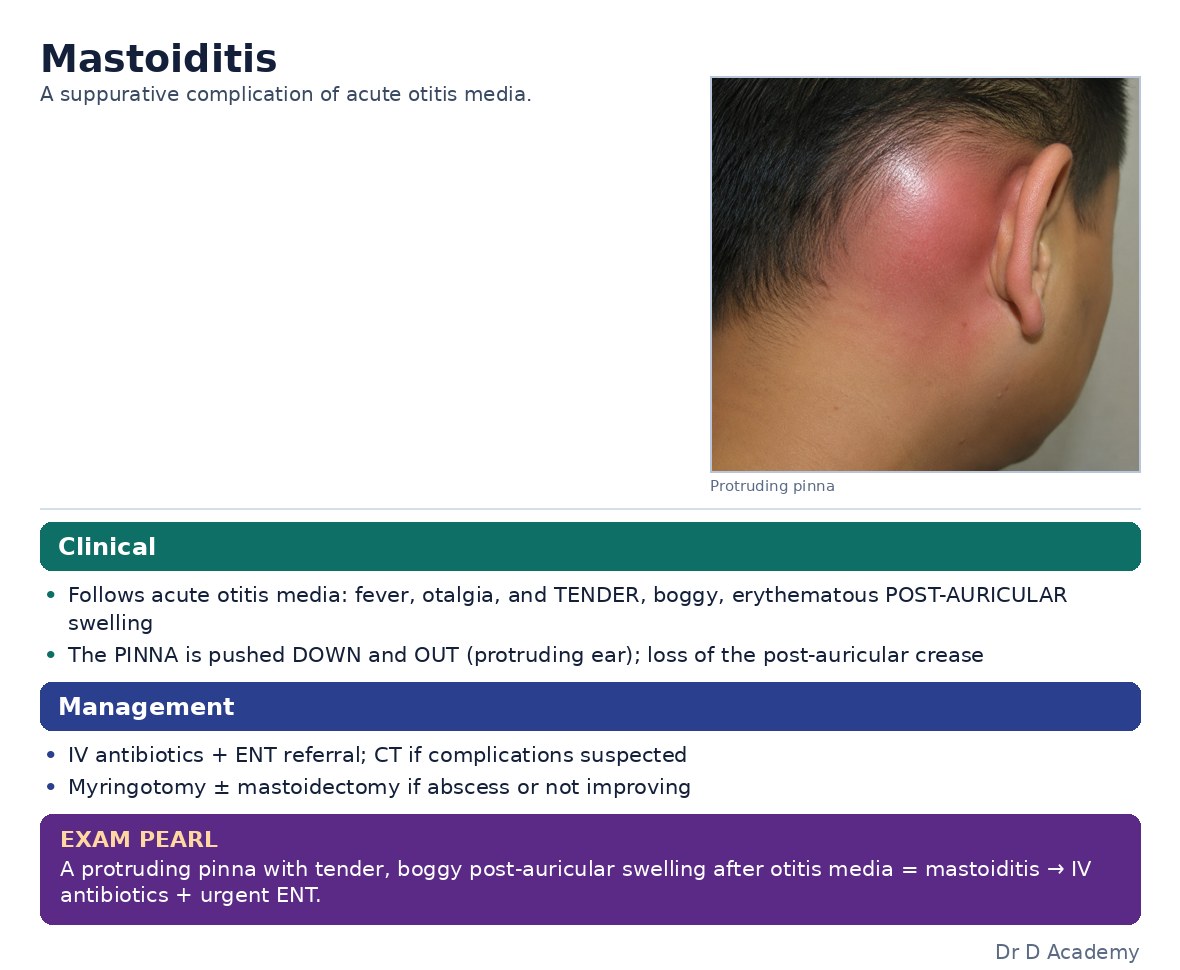
A suppurative complication of acute otitis media in which infection extends into the mastoid air cells. It presents with postauricular pain, erythema and swelling, a protruding auricle, otalgia and fever — most commonly in young children. The safety principle is early recognition and treatment with IV antibiotics and ENT referral, with imaging and surgical drainage for abscess or intracranial complications, which can be life-threatening.
Figures & algorithms
Red flags
- Altered consciousness, severe headache, meningism (intracranial spread)
- Facial nerve palsy
- Signs of lateral/sigmoid sinus thrombosis (spiking fevers, papilloedema)
- Fluctuant neck swelling (Bezold abscess)
Assessment
Differential diagnosis
- Severe acute otitis media without mastoiditis, postauricular lymphadenitis, external otitis
- Mastoid/subperiosteal abscess, Bezold abscess (into the neck)
- Intracranial complications: sigmoid/lateral sinus thrombosis, meningitis, intracranial abscess
Investigations
- Clinical examination: postauricular swelling/erythema/tenderness, protruding pinna, bulging tympanic membrane
- CT of the temporal bone (coalescent mastoiditis, abscess) when complications are suspected or the patient is not improving; MR venogram if sinus thrombosis is suspected
- Inflammatory markers and blood cultures; culture of any ear discharge or surgical specimen
Management
- Recognise the postauricular signs complicating acute otitis media and refer to ENT.
- Start IV broad-spectrum antibiotics covering common otitis pathogens (and Staphylococcus/Pseudomonas in chronic or at-risk cases).
- Perform myringotomy (with or without grommet) to drain the middle ear and obtain cultures.
- Image with CT temporal bone if there is a suspected abscess, intracranial complication or failure to improve.
- Proceed to cortical mastoidectomy for a subperiosteal abscess, coalescent mastoiditis unresponsive to medical therapy, or intracranial complications.
- Monitor for and manage neurological/intracranial complications; involve neurosurgery if needed.
Drugs & doses
Disposition
Complications & pitfalls
- Subperiosteal/Bezold abscess
- Sigmoid/lateral sinus thrombosis
- Meningitis and intracranial abscess
- Facial palsy, hearing loss
Exam pearls
- A protruding auricle with postauricular swelling in a child with otitis media is mastoiditis until proven otherwise.
- Image with CT and involve ENT early if complications are suspected or recovery stalls.
- Watch for intracranial complications — they change management urgently.
Educational — confirm all doses against local policy. Antibiotic doses per BNF (current edition); confirm choice in the in-app Antibiotic Dosing tool.
Disclaimer: Educational decision support for qualified clinicians and students — not a substitute for clinical judgement, local protocols or a full drug reference. Confirm every dose and contraindication against your formulary before prescribing.