Stevens-Johnson syndrome / toxic epidermal necrolysis
Dermatological emergency · Dermatology
Physician-written · Verified by three sets of doctors · Reviewed November 2026
Bedside summary
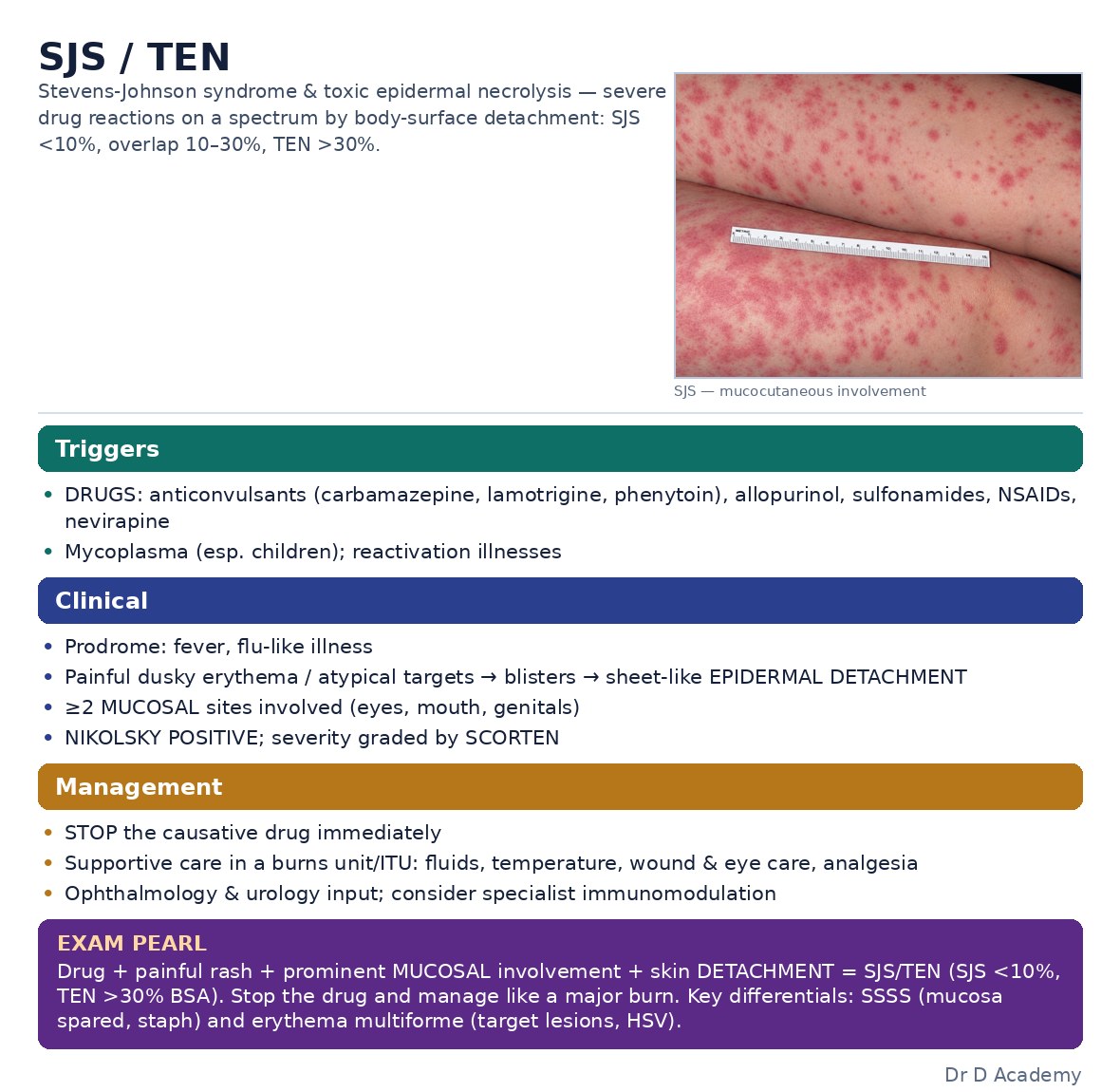
Severe drug reaction with epidermal detachment and mucosal involvement (SJS <10% BSA, TEN >30%). Treat like a burn; high mortality.
Figures & algorithms
Red flags
- Skin detachment (positive Nikolsky), mucosal involvement
- Large BSA, sepsis
- Eye involvement
Assessment
Differential diagnosis
- Staphylococcal scalded skin syndrome
- Erythema multiforme major
- DRESS
- Autoimmune blistering disease
- Burn
Investigations
- Identify and stop the culprit drug
- SCORTEN severity score; FBC, U&E, LFT, glucose, cultures
- Dermatology + skin biopsy
Management
- STOP the causative drug immediately
- Manage like a burn: fluids, temperature control, meticulous wound/eye/mucosa care
- Transfer to a burns/specialist centre; analgesia; infection surveillance
- Ophthalmology, urology and other mucosal specialty input
- Supportive ICU/burns care; consider immunomodulation (specialist)
Drugs & doses
Stop culprit drug; analgesia; IV fluids
Immunomodulators (specialist-directed)
Treat secondary infection
Disposition
Burns/specialist centre; ICU; dermatology.
Complications & pitfalls
- Sepsis, fluid loss
- Ocular scarring/blindness
- Multi-organ failure, death
Exam pearls
- Stop the drug and treat like a major burn
- Mucosal + skin detachment is the hallmark
- Early transfer to a burns/specialist centre
Stop the drug, resuscitate and treat like a burn, and transfer to a burns/specialist centre.
Disclaimer: Educational decision support for qualified clinicians and students — not a substitute for clinical judgement, local protocols or a full drug reference. Confirm every dose and contraindication against your formulary before prescribing.