Scabies & pediculosis (lice) (incl. crusted/Norwegian scabies)
scabies, Sarcoptes scabiei, crusted scabies, Norwegian scabies, pediculosis, head lice, body lice, pubic lice, permethrin, ivermectin · Dermatology
Physician-written · Verified by three sets of doctors · Reviewed November 2026
Bedside summary
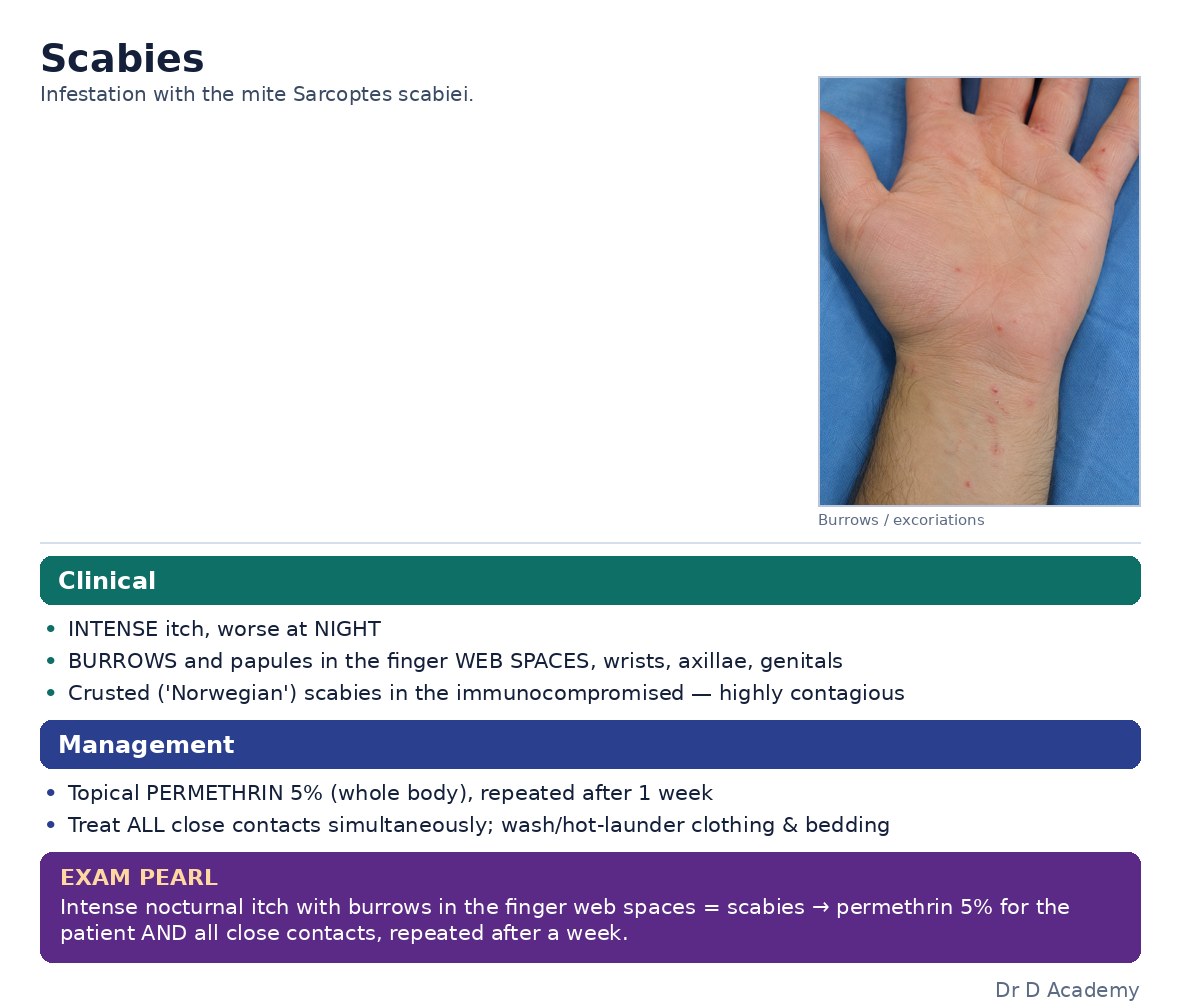
Scabies is intensely pruritic infestation by Sarcoptes scabiei, spread by skin contact; classic burrows in finger webs, wrists, genitalia with nocturnal itch and household clustering. Crusted (Norwegian) scabies carries thousands of mites, is highly contagious and occurs in immunosuppressed/elderly/institutional patients - a public-health priority. Pediculosis (head, body, pubic lice) causes itch and, for body lice, can transmit systemic disease.
Figures & algorithms
Red flags
- Crusted (Norwegian) scabies - hyperkeratotic scaling, often minimal itch, massive mite burden, outbreaks in care homes/hospitals
- Immunosuppression (HIV/HTLV-1/steroids) with atypical or crusted presentation
- Secondary bacterial infection / post-streptococcal complications (impetigo, cellulitis, sepsis, AKI, rheumatic sequelae)
- Febrile patient with body lice - louse-borne systemic infection
- Institutional outbreak requiring public-health notification
Assessment
Differential diagnosis
- Atopic/contact dermatitis
- Papular urticaria / insect bites
- Dermatitis herpetiformis
- Bullous pemphigoid (nodular/urticarial phase)
- Prurigo nodularis
- Folliculitis
- Crusted scabies vs psoriasis/eczema/erythroderma
- Delusional parasitosis
Investigations
- Clinical diagnosis: burrows (finger webs, wrists, genitals, periumbilical), widespread itch worse at night, affected contacts
- Dermoscopy ('delta-wing jet' mite) or skin scraping microscopy for mite/eggs/faeces (high yield in crusted scabies)
- In crusted scabies assess immunosuppression - HIV, HTLV-1, haematological malignancy, long-term steroids
- Body lice: examine clothing seams; consider louse-borne disease if febrile (typhus, relapsing fever, trench fever) in at-risk populations
Management
- Treat the patient AND all close/household contacts simultaneously, even if asymptomatic
- Classic scabies: topical permethrin 5% applied to whole body (neck-down in adults; include scalp/face in infants/elderly), left 8-12 h then washed off, repeated after 7 days
- Apply to cool dry skin, under nails, all skin folds and genitalia; reapply to hands after washing
- Oral ivermectin is an alternative/adjunct, especially for outbreaks, institutions or when topical application impractical (2 doses 1 week apart)
- Crusted scabies: combine oral ivermectin (multiple doses, days 0,1,7,8,14,15 +/- 21,28) WITH topical permethrin (and a keratolytic to reduce crust) - isolate, barrier nurse, dermatology/ID input
- Launder/hot-wash clothing and bedding (>=50C) or seal in plastic bag 72 h; environmental cleaning
- Warn that itch (post-scabetic) persists 2-4 weeks after successful treatment - treat with emollient/antihistamine/mild steroid, do not over-treat with acaricide
- Head lice: wet combing +/- dimeticone 4% lotion, repeat at day 7-9; pubic lice: permethrin, treat sexual contacts and screen for other STIs
Drugs & doses
Permethrin 5% cream whole-body application, wash off after 8-12 h, REPEAT after 7 days (first-line; safe in pregnancy and infants >2 months)
Ivermectin 200 micrograms/kg ORAL, repeat on day 7-14 (classic scabies); not in pregnancy or <15 kg [verify local dose]
Malathion 0.5% aqueous lotion as alternative scabicide, wash off after 24 h, repeat day 7 [verify local]
Crusted scabies: ivermectin 200 micrograms/kg ORAL on days 0, 1, 7, 8, 14, 15 (add 21 and 28 for severe) PLUS permethrin 5% repeated, plus keratolytic (e.g. 5-10% salicylic acid or lactic/urea cream) [verify local dose]
Post-scabetic itch: emollient + sedating antihistamine (e.g. chlorphenamine) + short course mild-moderate topical corticosteroid
Head lice: dimeticone 4% lotion applied, left per product (often 8 h/overnight), repeat after 7 days; or wet-combing
Pubic lice: permethrin 5% or 1% to affected areas, repeat after 7 days; treat partners [verify local]
Disposition
Classic scabies/lice: discharge with treatment, contact treatment and decontamination advice. Crusted scabies: admit/isolate with dermatology/ID; notify infection control/public health. Treat secondary infection and screen for immunosuppression.
Complications & pitfalls
- Secondary bacterial infection (impetigo, cellulitis, sepsis) and post-streptococcal glomerulonephritis/rheumatic fever in endemic areas
- Persistent post-scabetic pruritus and nodular scabies
- Outbreaks in households, schools, care homes and hospitals
- Crusted scabies: erythroderma, high transmissibility, mortality in frail patients
- Secondary eczematisation
Exam pearls
- Always treat all household/close contacts simultaneously and decontaminate bedding/clothing - the commonest cause of 'treatment failure' is reinfestation or untreated contacts
- 2026 GALE CRUSTED trial supports oral ivermectin 200 micrograms/kg on days 0, 7, 14 PLUS permethrin and emollient for severe/crusted scabies; higher 400 micrograms/kg dose gave no benefit
- Apply permethrin to cool, dry skin and reapply to hands after any washing
- Itch persisting after treatment is usually post-scabetic hypersensitivity, not failure
- Crusted scabies is a public-health emergency - isolate and notify
- Examine clothing seams for body lice; consider louse-borne infection in febrile homeless/displaced patients
Disclaimer: Educational decision support for qualified clinicians and students — not a substitute for clinical judgement, local protocols or a full drug reference. Confirm every dose and contraindication against your formulary before prescribing.