Orbital floor blow-out fracture
Bedside summary
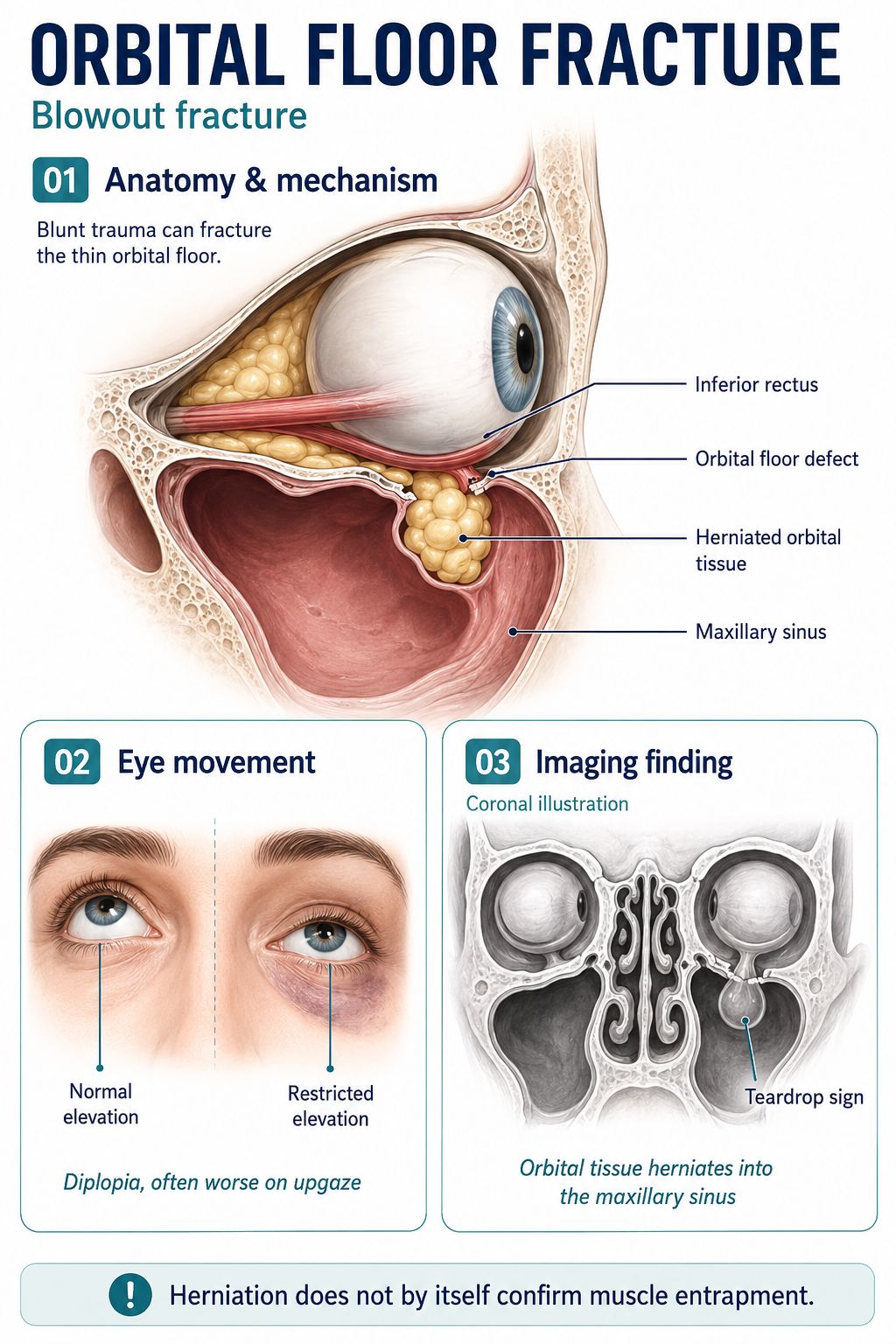
A blow-out fracture is a defect in the thin orbital floor (or medial wall) from blunt periorbital trauma, with herniation of orbital contents into the maxillary sinus. Signs include diplopia (especially on upgaze), restricted eye movement, infraorbital nerve numbness, and enophthalmos. The paediatric 'white-eyed blow-out' is a trapdoor fracture with muscle entrapment, minimal external signs and an oculocardiac reflex (bradycardia, nausea, syncope) — a true surgical emergency.
Figures & algorithms
Red flags
- Paediatric white-eyed blow-out with entrapment (emergency surgery)
- Oculocardiac reflex: bradycardia, nausea, syncope with eye movement
- Reduced visual acuity / RAPD (optic nerve or globe injury)
- Marked enophthalmos or a fixed, non-elevating eye
Assessment
Differential diagnosis
- ZMC or nasoethmoid fracture, isolated orbital rim fracture
- Orbital/retrobulbar haematoma, globe rupture, traumatic optic neuropathy
- Entrapment (mechanical restriction) vs oedema/contusion (restriction that resolves)
Investigations
- CT orbit (fine-cut coronal views) — shows the floor defect, herniation and muscle entrapment ("tear-drop" sign)
- Visual acuity, pupils (RAPD), eye movements, forced duction if available, and intraocular pressure
- Assess for the oculocardiac reflex (bradycardia/nausea with eye movement) in children
Management
- Full ophthalmic assessment to exclude globe rupture, retrobulbar haemorrhage and optic nerve injury.
- Identify entrapment: marked restriction of upgaze, nausea/vomiting and bradycardia (oculocardiac reflex), particularly the paediatric white-eyed blow-out.
- Advise strict NO nose blowing and give a nasal decongestant to reduce orbital emphysema.
- URGENT (within ~24–48 h) surgical referral for muscle entrapment, the white-eyed blow-out, or non-resolving oculocardiac reflex — this is time-critical to save muscle.
- Non-entrapped fractures: review at ~1–2 weeks once swelling settles; operate for persistent diplopia, significant enophthalmos or large defects.
- Analgesia and antiemetics; ophthalmology and maxillofacial co-management.
Drugs & doses
Disposition
Complications & pitfalls
- Permanent diplopia from untreated entrapment / muscle ischaemia
- Enophthalmos and hypoglobus
- Infraorbital nerve anaesthesia
- Orbital infection / surgical emphysema
Exam pearls
- In children, minimal bruising can hide a trapdoor with entrapment — the white-eyed blow-out is a surgical emergency.
- The oculocardiac reflex (bradycardia/vomiting on eye movement) signals entrapment.
- No nose blowing — it forces air into the orbit.
Educational — confirm all doses against local policy. Antibiotic doses per BNF (current edition); confirm choice in the in-app Antibiotic Dosing tool.
Disclaimer: Educational decision support for qualified clinicians and students — not a substitute for clinical judgement, local protocols or a full drug reference. Confirm every dose and contraindication against your formulary before prescribing.