Necrotising fasciitis
Bedside summary
Necrotising soft-tissue infections (NSTIs) are rapidly progressive infections of the fascia and subcutaneous tissue with tissue necrosis and systemic toxicity — a SURGICAL emergency. Classified by microbiology: TYPE I is POLYMICROBIAL (mixed aerobes/anaerobes — diabetics, the elderly, perineum/Fournier’s and abdominal wall); TYPE II is MONOMICROBIAL, usually GROUP A STREPTOCOCCUS (± Staph aureus, often in previously healthy people, and associated with streptococcal toxic shock); TYPE III is clostridial (gas gangrene) or marine Vibrio vulnificus (seawater exposure/liver disease); TYPE IV is fungal (immunocompromised/trauma). Risk factors include diabetes, immunosuppression, injecting drug use, peripheral vascular disease, obesity, and any skin breach.
Figures & algorithms
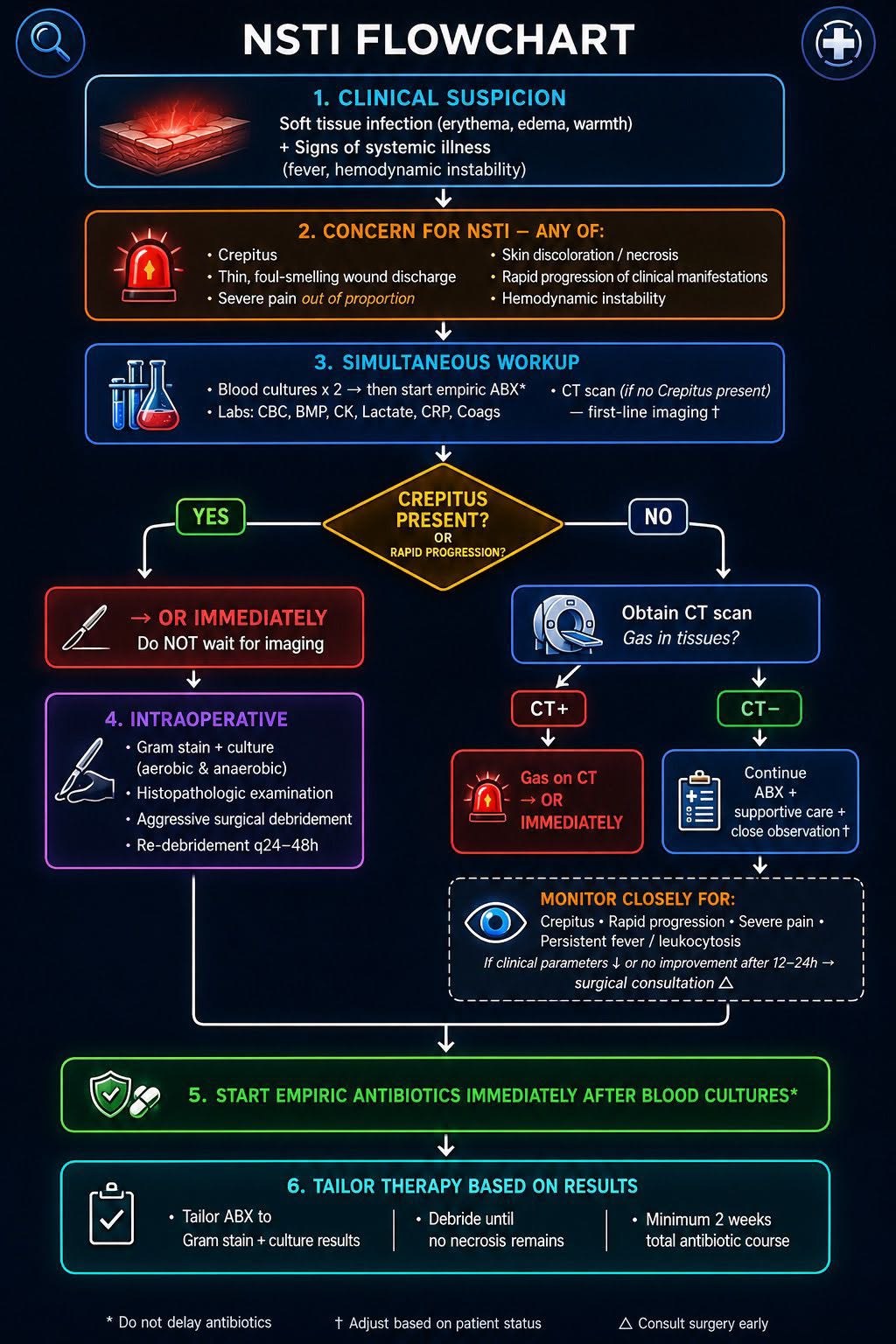
Red flags
- PAIN OUT OF PROPORTION to visible findings (early hallmark)
- Tense oedema beyond the erythema, dusky skin, haemorrhagic bullae, crepitus, or skin anaesthesia/necrosis
- Rapid spread and systemic toxicity (tachycardia, hypotension, confusion)
- Failure to improve on IV antibiotics for presumed cellulitis
Assessment
Differential diagnosis
- Severe cellulitis / erysipelas
- Cutaneous abscess
- Clostridial myonecrosis / gas gangrene (see separate protocol)
- Pyomyositis
- Deep vein thrombosis (early, before skin signs)
Investigations
- This is a CLINICAL and SURGICAL diagnosis — do not delay theatre for tests
- Bloods: FBC, U&E, CRP, glucose, lactate, CK, coagulation, blood cultures, group & save; the LRINEC score is an ADJUNCT only — a low score does NOT exclude NSTI
- The bedside “finger test” / surgical exploration (grey dishwater fluid, lack of bleeding, easy separation of tissue planes) is the reference standard
- Imaging (CT/MRI/X-ray for gas) may support the diagnosis but must NOT delay surgery in an unstable or clinically obvious case
Complications & pitfalls
- Septic shock, DIC and multi-organ failure
- Streptococcal toxic shock syndrome
- Limb loss (amputation) and extensive tissue loss
- Death — mortality rises sharply with any delay to surgery
Exam pearls
- Antibiotics never cure NSTI — the diagnosis is SURGICAL and early, repeated DEBRIDEMENT is the definitive, life-saving treatment.
- Pain out of proportion (± later anaesthesia), tense oedema and systemic toxicity out of keeping with the skin appearance = explore, don’t wait for imaging.
- Empirical antibiotics are BROAD-SPECTRUM (e.g. piperacillin-tazobactam or a carbapenem) PLUS CLINDAMYCIN (toxin suppression) ± vancomycin (MRSA); add IVIG for streptococcal toxic shock.
- LRINEC is a supportive adjunct — a low score must NOT reassure you out of a clinical NSTI.
- Think of the special settings: perineum (Fournier’s), seawater/liver disease (Vibrio), and gas in tissues (clostridial myonecrosis — separate protocol).
Disclaimer: Educational decision support for qualified clinicians and students — not a substitute for clinical judgement, local protocols or a full drug reference. Confirm every dose and contraindication against your formulary before prescribing.