Maxillofacial trauma (mandible/midface)
Trauma · Dental & Oral
Physician-written · Verified by three sets of doctors · Reviewed November 2026
Bedside summary
Facial fractures (mandible, maxilla/Le Fort, zygoma, orbit) from blunt trauma. Airway and associated head/C-spine injuries take priority over the obvious facial deformity.
Figures & algorithms
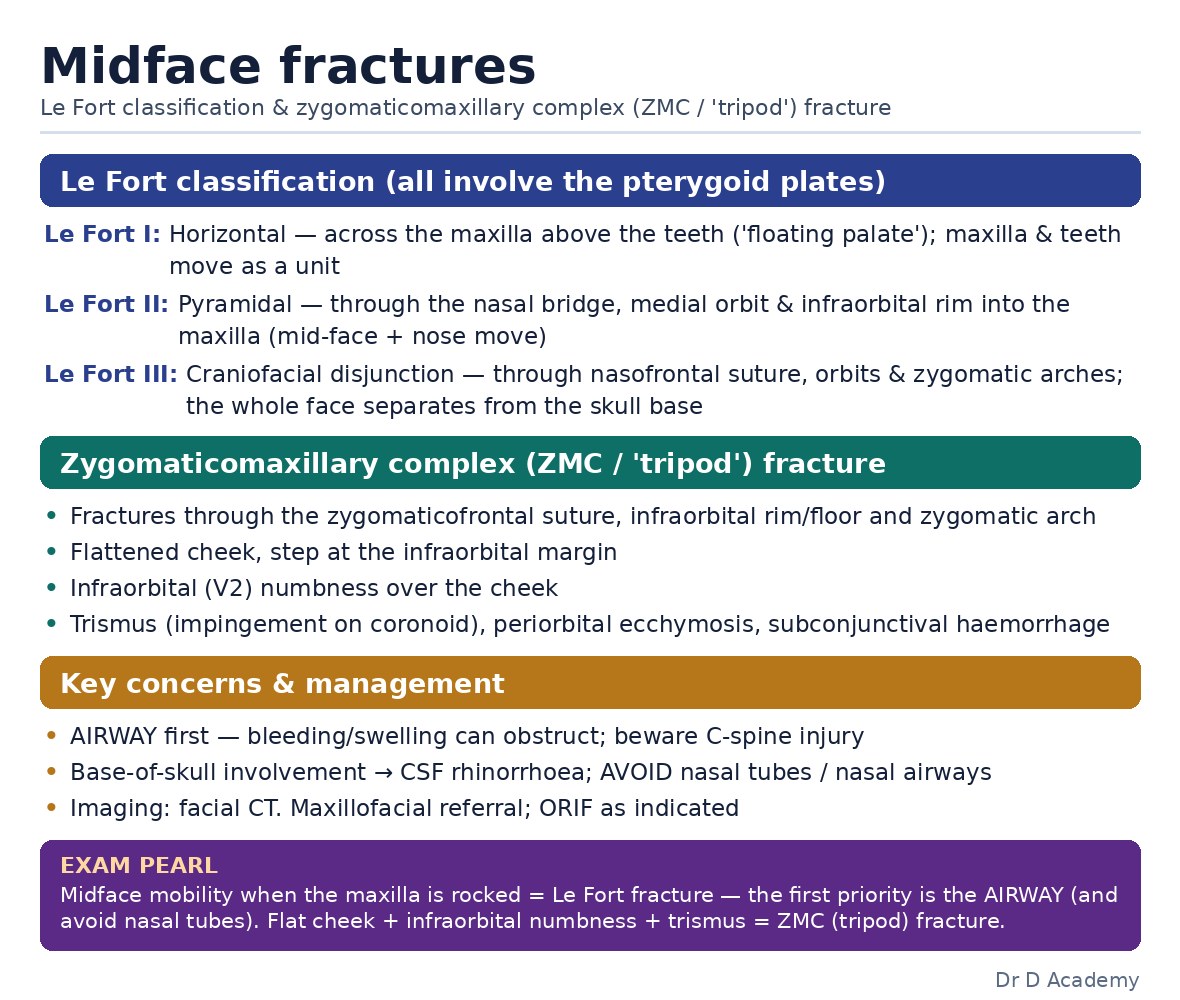
Red flags
- Airway compromise
- Le Fort fracture with mobile midface
- Retrobulbar haemorrhage (proptosis, ↓vision — sight emergency)
- CSF rhinorrhoea (base of skull)
Assessment
Differential diagnosis
- Isolated dental injury
- Soft-tissue contusion
- Nasal fracture
- TMJ dislocation
- Orbital blowout fracture
Investigations
- CT facial bones (± head and C-spine)
- Assess occlusion, trismus, infraorbital sensation, eye movements/diplopia
- Orthopantomogram for isolated mandible
Management
- ABCDE — secure airway (blood, displaced segments, Le Fort can obstruct)
- Control haemorrhage; consider C-spine injury
- Assess and document neurovascular and visual function
- Analgesia; antibiotics for compound/intraoral fractures
- Refer to maxillofacial surgery; ophthalmology if orbital involvement
Drugs & doses
Analgesia
Antibiotics for compound fractures (e.g. co-amoxiclav)
Tetanus prophylaxis
Disposition
Maxillofacial referral; admit for airway/eye threat or significant fractures.
Complications & pitfalls
- Airway obstruction
- Vision loss (retrobulbar haematoma)
- Malocclusion, infection
- Associated brain/C-spine injury
Exam pearls
- Retrobulbar haemorrhage needs immediate lateral canthotomy — do not wait
- Bilateral mandibular (“flail”) fractures threaten the airway when supine
- Always look for associated injuries, not just the face
Airway and eye (retrobulbar haemorrhage) are the time-critical threats — the facial fracture itself rarely is.
Disclaimer: Educational decision support for qualified clinicians and students — not a substitute for clinical judgement, local protocols or a full drug reference. Confirm every dose and contraindication against your formulary before prescribing.