Le Fort maxillary fractures (I / II / III)
Bedside summary
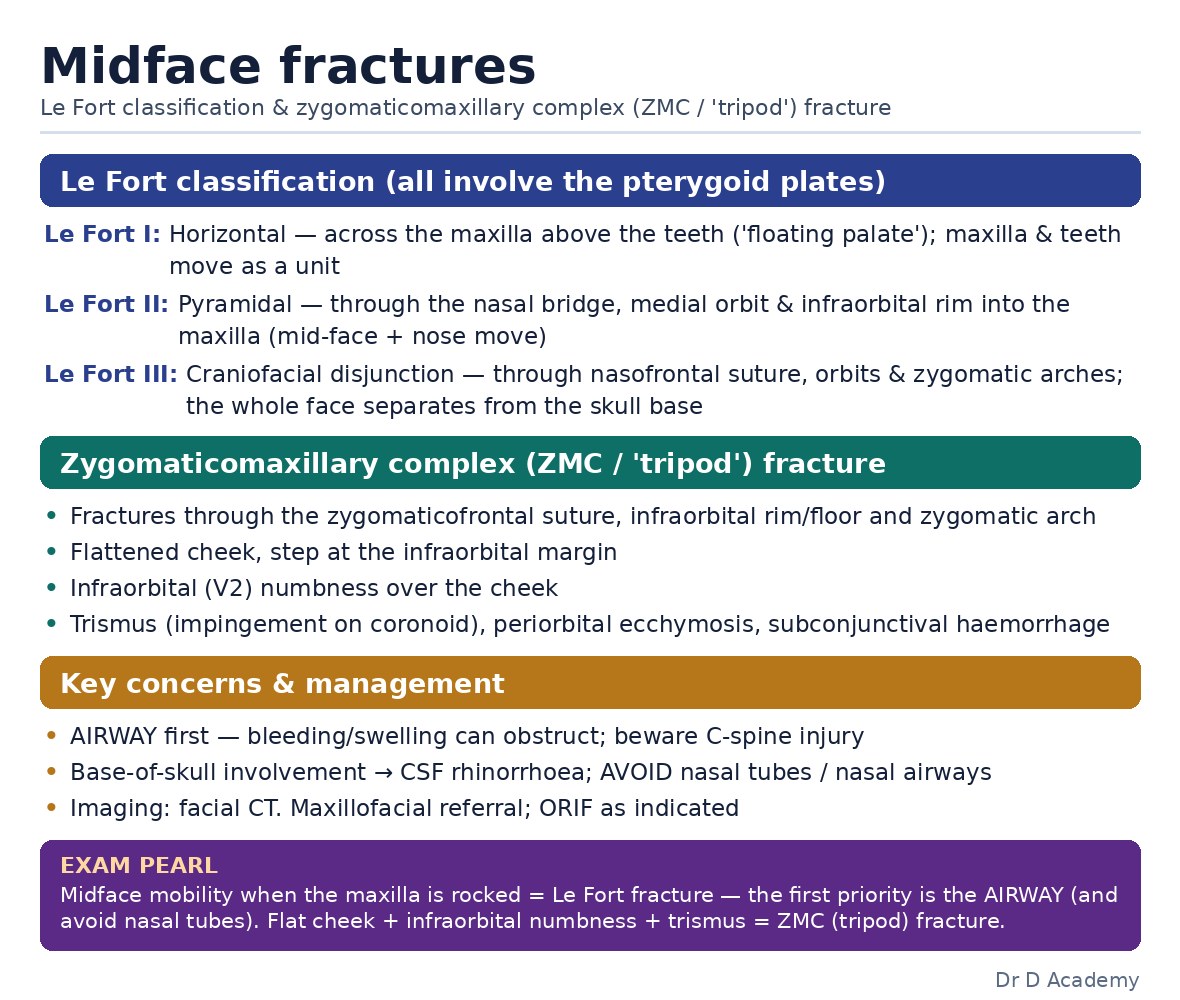
Le Fort fractures are high-energy midface fractures that, by definition, separate the maxilla (and midface) from the skull base along predictable planes: Le Fort I (horizontal, a 'floating palate'), Le Fort II (pyramidal, involving the nasal bones and orbital rims), and Le Fort III (craniofacial disjunction, complete separation of the midface from the cranium). The immediate priorities are AIRWAY and haemorrhage control, cervical-spine protection, and recognition of associated head, orbital and CSF-leak injuries.
Figures & algorithms
Red flags
- Airway compromise from midface mobility, bleeding or swelling
- Massive midface haemorrhage / haemodynamic instability
- CSF rhinorrhoea or signs of skull-base/intracranial injury
- Associated cervical-spine or globe injury
Assessment
Differential diagnosis
- Classify the level by what moves: palate only (I), midface pyramid incl. orbital rims (II), whole midface/craniofacial disjunction (III) — mixed/bilateral patterns are common
- Associated traumatic brain injury, cervical-spine injury and skull-base fracture
- Globe/orbital injury and CSF rhinorrhoea (II and III)
Investigations
- CT head, facial bones and cervical spine (the imaging standard); assess for intracranial injury and CSF leak
- Airway and haemodynamic assessment; group-and-save/crossmatch for midface haemorrhage
- Test for CSF rhinorrhoea (e.g. beta-2 transferrin) where a leak is suspected
Management
- ATLS primary survey: secure the AIRWAY early — midface swelling, bleeding and mobility threaten it; involve anaesthesia/ENT for a potentially difficult airway.
- Protect the cervical spine and control haemorrhage (direct pressure, reduce/stabilise the mobile midface, anterior/posterior nasal packing; interventional radiology/surgery for uncontrolled bleeding).
- Assess for and manage associated brain injury, globe/orbital injury and CSF leak; avoid blind nasal tubes/NG insertion if a skull-base fracture is possible.
- Give analgesia, antiemetics and tetanus prophylaxis; antibiotics per policy for open/CSF-leak injuries.
- Refer urgently to maxillofacial surgery for reduction and internal fixation once the patient is stabilised and life-threatening injuries addressed.
- Admit under the appropriate trauma/neurosurgical team with close neuro-observation.
Drugs & doses
Disposition
Complications & pitfalls
- Airway obstruction and aspiration
- Exsanguinating haemorrhage
- Meningitis / CSF leak, intracranial injury
- Malocclusion, facial deformity, blindness
Exam pearls
- Airway first — a mobile, bleeding midface is a difficult-airway situation; plan early.
- Avoid blind nasal tubes (NG, nasal airway) when a skull-base fracture is possible.
- Le Fort fractures are high-energy — actively seek brain, C-spine, orbital and CSF-leak injuries.
Educational — confirm all doses against local policy. Antibiotic doses per BNF (current edition); confirm choice in the in-app Antibiotic Dosing tool.
Disclaimer: Educational decision support for qualified clinicians and students — not a substitute for clinical judgement, local protocols or a full drug reference. Confirm every dose and contraindication against your formulary before prescribing.