Herpes zoster ophthalmicus (HZO)
Infection · Ophthalmology
Physician-written · Verified by three sets of doctors · Reviewed November 2026
Bedside summary
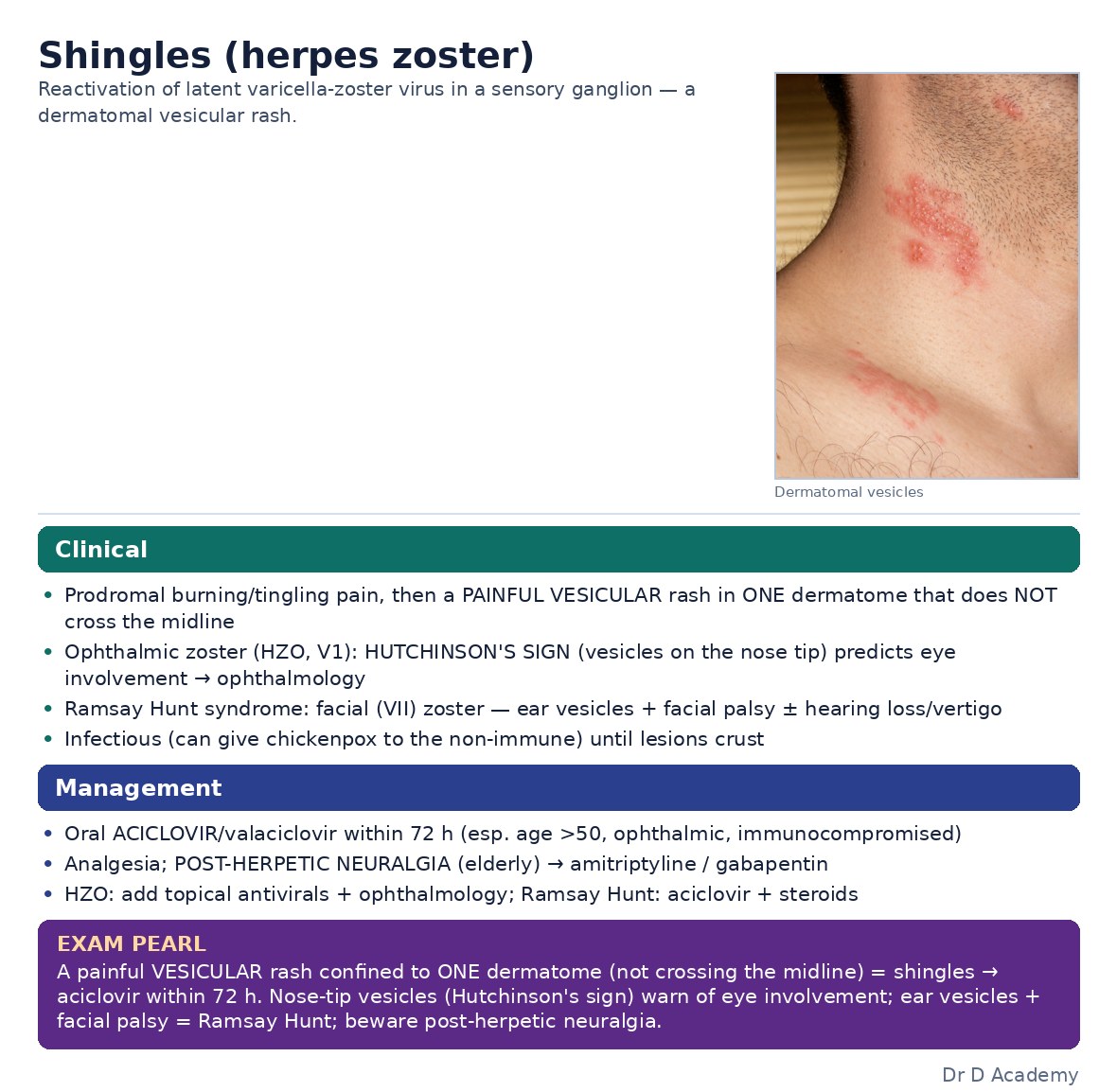
Reactivation of varicella-zoster virus in the ophthalmic (V1) division of the trigeminal nerve. A painful vesicular rash in the V1 dermatome can be accompanied by keratitis, uveitis, scleritis, raised IOP, retinitis and cranial nerve palsies. The key principle is to START SYSTEMIC ANTIVIRALS early (ideally within 72 hours) and refer for an ophthalmology assessment whenever there is any ocular involvement.
Figures & algorithms
Red flags
- Hutchinson sign / reduced vision
- Acute retinal necrosis (floaters, visual loss)
- Ophthalmoplegia (orbital apex / cavernous sinus)
- Immunocompromise or disseminated zoster
Assessment
Differential diagnosis
- Hutchinson sign (vesicles on the tip/side of the nose = nasociliary nerve) predicts ocular involvement
- HZO pseudodendrites are raised mucous plaques WITHOUT true terminal bulbs — distinguish from HSV dendritic keratitis
- Consider orbital apex/cavernous sinus involvement if there is ophthalmoplegia
Investigations
- Examine vision, cornea with fluorescein (pseudodendrites), anterior chamber (uveitis), IOP and fundus
- Usually a clinical diagnosis; viral swab/PCR if atypical; assess immune status
Management
- Identify V1 zoster and check the Hutchinson sign (nose-tip vesicles indicate high risk of eye involvement).
- Start a systemic antiviral as soon as possible — ideally within 72 hours of rash onset; still treat beyond 72 hours if there are new lesions or ocular involvement.
- Assess the eye (vision, cornea, anterior chamber, IOP, fundus) and refer urgently to ophthalmology for any ocular signs.
- Topical corticosteroids and cycloplegics for stromal keratitis/uveitis are given ONLY under ophthalmology direction; add lubricants and analgesia.
- For severe, sight-threatening (e.g. acute retinal necrosis), orbital-apex or immunocompromised disease, consider IV aciclovir and admission.
- Address post-herpetic neuralgia and arrange follow-up.
Drugs & doses
Aciclovir 800 mg PO five times daily for 7–10 days (confirm against local policy)
Valaciclovir 1 g PO three times daily, or famciclovir 500 mg PO three times daily, for 7 days (confirm against local policy)
IV aciclovir 10 mg/kg every 8 hours for severe/disseminated/immunocompromised disease or acute retinal necrosis (confirm against local policy)
Topical lubricants; topical steroid and cycloplegic for keratouveitis — ophthalmology-directed only
Disposition
Discharge uncomplicated cases on oral antivirals with ophthalmology review; admit for sight-threatening, orbital or immunocompromised disease.
Complications & pitfalls
- Keratitis (epithelial, stromal, neurotrophic)
- Anterior uveitis and secondary glaucoma
- Acute retinal necrosis and optic neuritis
- Post-herpetic neuralgia; cicatricial lid changes
Exam pearls
- HZO pseudodendrites are raised mucous plaques lacking terminal bulbs — do not mistake them for HSV dendrites.
- Start antivirals even slightly beyond 72 hours if there is ocular involvement or new vesicles.
- Any eye involvement warrants ophthalmology review.
Educational — confirm all doses against local policy.
Disclaimer: Educational decision support for qualified clinicians and students — not a substitute for clinical judgement, local protocols or a full drug reference. Confirm every dose and contraindication against your formulary before prescribing.