Herpes zoster ophthalmicus
Infection · Dermatology
Physician-written · Verified by three sets of doctors · Reviewed November 2026
Bedside summary
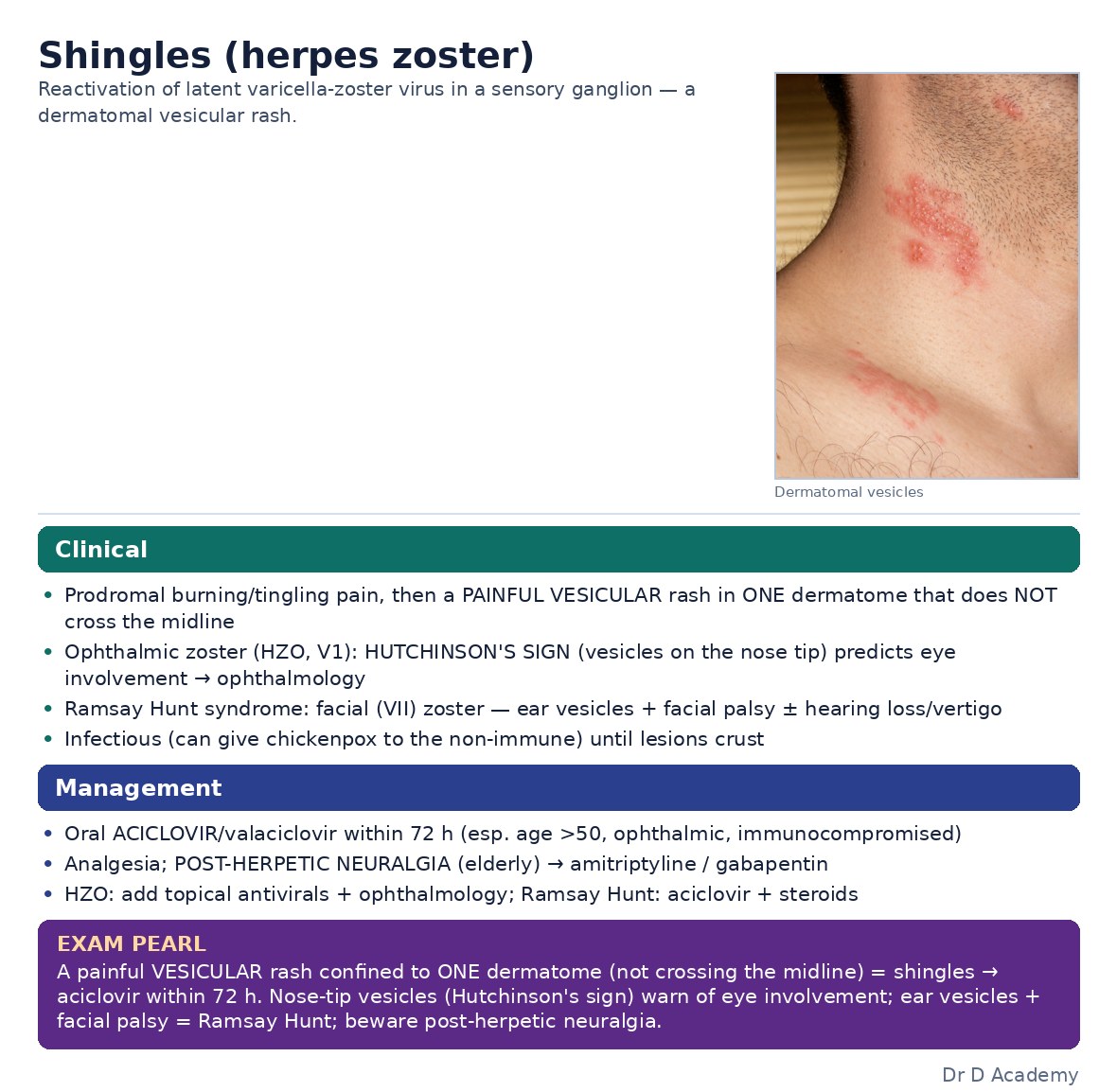
Herpes zoster ophthalmicus is reactivation of varicella-zoster virus in the ophthalmic (V1) division of the trigeminal nerve, threatening the eye through keratitis, uveitis and other complications. A vesicular rash on the tip/side of the nose (Hutchinson sign) predicts ocular involvement. Prompt systemic antiviral therapy and urgent ophthalmology assessment are essential to protect sight.
Figures & algorithms
Red flags
- Hutchinson sign (nose-tip lesions — high risk of ocular involvement)
- Reduced visual acuity, photophobia or red eye
- Immunocompromise or disseminated zoster
- Signs of orbital/periorbital cellulitis
Assessment
Differential diagnosis
- Herpes simplex keratitis/dermatitis
- Bacterial periorbital/orbital cellulitis, contact dermatitis
- Other causes of acute red eye (uveitis, acute glaucoma)
- Erysipelas of the face
Investigations
- Clinical diagnosis from the painful dermatomal V1 vesicular rash; look for the Hutchinson sign (nasociliary involvement — nose tip/side)
- Urgent slit-lamp eye assessment for keratitis (dendrites/pseudodendrites), uveitis, raised intraocular pressure and corneal sensation
- Swab vesicle fluid for VZV PCR if the diagnosis is uncertain
- Assess immune status (more severe/atypical in the immunocompromised) and for disseminated zoster
Management
- Start systemic antiviral therapy promptly — ideally within 72 hours of rash onset, but still give it later if there is active vesiculation or eye involvement.
- Refer urgently to ophthalmology for slit-lamp examination; any ocular symptoms/signs or Hutchinson sign mandate same-day review.
- Manage ocular complications per ophthalmology (e.g. topical lubricants, topical steroids for stromal keratitis/uveitis under specialist supervision, intraocular-pressure control).
- Provide analgesia for acute pain and counsel about post-herpetic neuralgia.
- Treat the skin: keep lesions clean, watch for secondary bacterial infection.
- Use IV antivirals and specialist input for immunocompromised, disseminated or sight-threatening disease.
Drugs & doses
Oral antiviral: aciclovir, valaciclovir or famciclovir started ideally within 72 hours of rash onset (e.g. valaciclovir 1 g PO TDS for 7 days) (confirm against local policy)
IV aciclovir 10 mg/kg every 8 hours for severe, disseminated, or immunocompromised disease (confirm against local policy)
Analgesia for acute zoster pain; neuropathic agents for post-herpetic neuralgia
Topical ocular therapy (lubricants; topical corticosteroid/cycloplegic for keratitis/uveitis) under ophthalmology supervision (confirm against local policy)
Disposition
Arrange urgent/same-day ophthalmology review; discharge immunocompetent patients on oral antivirals with close follow-up, and admit severe, disseminated or immunocompromised disease.
Complications & pitfalls
- Keratitis, uveitis and secondary glaucoma
- Vision loss
- Post-herpetic neuralgia
- Cranial nerve palsies; rarely stroke/encephalitis
Exam pearls
- Nose-tip vesicles (Hutchinson sign) predict eye involvement — refer for urgent slit-lamp review.
- Start antivirals promptly; the 72-hour window is a target, not an absolute cut-off when lesions are active.
- Topical ocular steroids are an ophthalmology decision, not an ED one.
Educational — confirm all doses against local policy.
Disclaimer: Educational decision support for qualified clinicians and students — not a substitute for clinical judgement, local protocols or a full drug reference. Confirm every dose and contraindication against your formulary before prescribing.