Erythema multiforme (minor & major)
erythema multiforme, EM, target lesions, EM major, EM minor, HSV-associated erythema multiforme, Mycoplasma · Dermatology
Physician-written · Verified by three sets of doctors · Reviewed November 2026
Bedside summary
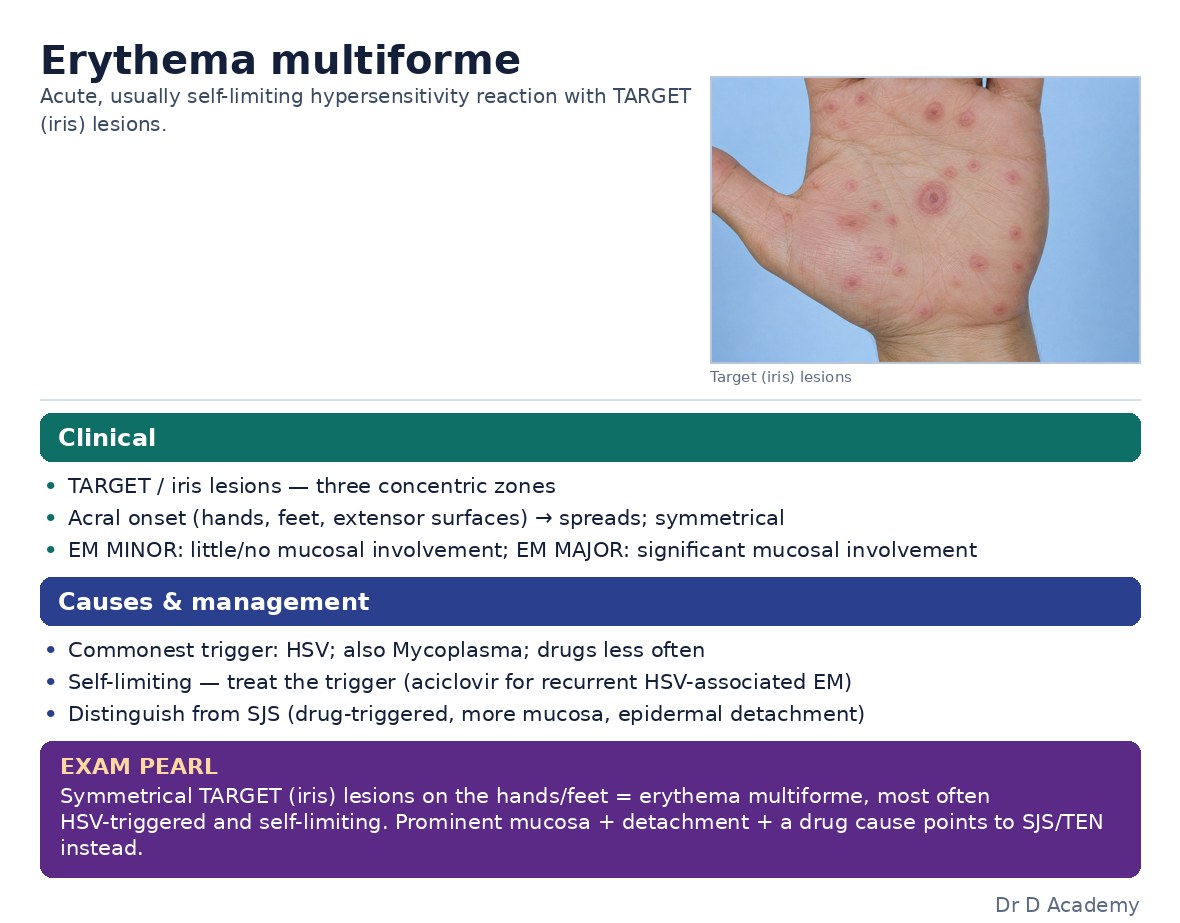
Acute, often recurrent, immune-mediated reaction with characteristic typical target lesions (3 zones) on the extremities/acral sites. Most commonly triggered by herpes simplex virus (and Mycoplasma pneumoniae in children); drugs are a less common trigger than in SJS. EM major has mucosal involvement. It is distinct from SJS/TEN (which is drug-induced with central-to-truncal atypical targets, epidermal detachment and higher mortality).
Figures & algorithms
Red flags
- Truncal distribution, atypical flat targets, skin pain, Nikolsky-positive detachment, blistering >10% BSA - this is SJS/TEN, not EM - escalate
- Extensive mucosal involvement limiting eating/drinking
- Ocular involvement - risk of scarring/symblepharon (urgent ophthalmology)
- Systemic toxicity / high fever / organ involvement
- Rapidly progressive or recurrent severe disease
Assessment
Differential diagnosis
- Stevens-Johnson syndrome / TEN (drug-induced, truncal atypical targets, skin detachment, sicker)
- Urticaria / urticarial vasculitis (lesions fixed >24 h, target vs)
- Fixed drug eruption
- Mycoplasma-induced rash and mucositis (MIRM)
- Acute febrile neutrophilic dermatosis (Sweet's)
- Bullous pemphigoid (urticarial phase)
- Vasculitis
- Kawasaki disease (children)
Investigations
- Clinical diagnosis - typical target lesions, acral/extensor distribution, assess mucosae
- Identify trigger: history of recent/recurrent herpes labialis; in children/atypical - Mycoplasma serology/PCR and CXR; drug history
- Bloods if systemically unwell / EM major: FBC, U&E, LFTs, CRP
- HSV PCR of lesion if diagnostic doubt; swab mucosal lesions
- Skin biopsy if diagnosis unclear or to differentiate from SJS/TEN
- Ophthalmology review if ocular mucosal involvement
Management
- Confirm EM and distinguish from SJS/TEN (truncal atypical targets + skin detachment + mucosal necrosis = SJS/TEN, a different pathway - see SJS/TEN protocol)
- Identify and treat trigger: aciclovir if active HSV; macrolide/appropriate antibiotic if Mycoplasma; stop any culprit drug
- EM minor (no/limited mucosal, well patient): symptomatic - topical steroid, oral antihistamine, analgesia; self-limiting over ~2 weeks
- EM major (significant mucosal involvement): supportive care - oral/ophthalmic/genital mucosal care, hydration, analgesia, nutrition; admit if unable to eat/drink or eyes involved
- Ophthalmology, oral care and urology/gynae input for mucosal disease
- Consider short course systemic corticosteroid for severe symptomatic mucosal EM major (specialist, evidence limited)
- Recurrent HSV-associated EM: continuous suppressive aciclovir/valaciclovir for 6-12 months
Drugs & doses
Aciclovir 400 mg ORAL five times daily for active HSV-triggered EM; or valaciclovir 1 g twice daily [verify local dose]
Recurrent HSV-associated EM: aciclovir 400 mg ORAL twice daily (or valaciclovir 500 mg twice daily) continuous suppression for 6-12 months [verify local dose]
Mycoplasma: azithromycin or doxycycline per age/local guidance [verify local dose]
Topical corticosteroid (moderate-potent) for cutaneous lesions + oral antihistamine for itch
Mucosal care: antiseptic/anaesthetic mouthwash (e.g. benzydamine, or lidocaine + chlorhexidine), soft diet
Prednisolone 0.5-1 mg/kg/day ORAL short tapering course for severe EM major mucosal disease - specialist, controversial [verify local dose]
Analgesia and IV fluids if unable to maintain oral intake
Disposition
EM minor: discharge with trigger treatment and symptomatic care. EM major / unable to eat-drink / ocular involvement: admit with dermatology, ophthalmology and mucosal-care input. Any suspicion of SJS/TEN: manage per SJS/TEN protocol (burns/HDU).
Complications & pitfalls
- Recurrence (HSV-driven)
- Mucosal scarring and ocular sequelae (symblepharon, vision loss) in EM major
- Secondary infection of eroded skin/mucosa
- Dehydration/malnutrition from oral disease
- Post-inflammatory pigmentation
Exam pearls
- Typical targets (3 concentric zones) on acral/extensor sites with a well patient = EM; central truncal atypical targets with skin detachment and a sick patient = SJS/TEN (different cause, prognosis and pathway)
- HSV is the commonest trigger - ask about cold sores; Mycoplasma in children (think MIRM with prominent mucositis and sparse skin)
- Drugs cause SJS/TEN far more than EM - do not over-attribute EM to drugs
- Recurrent EM = give suppressive antiviral even without visible herpes
- Mucosal EM major needs ophthalmology and multidisciplinary mucosal care
Disclaimer: Educational decision support for qualified clinicians and students — not a substitute for clinical judgement, local protocols or a full drug reference. Confirm every dose and contraindication against your formulary before prescribing.