Angioedema of the lip & tongue (ACE-inhibitor & allergic)
Airway · Dental & Oral
Physician-written · Verified by three sets of doctors · Reviewed November 2026
Bedside summary
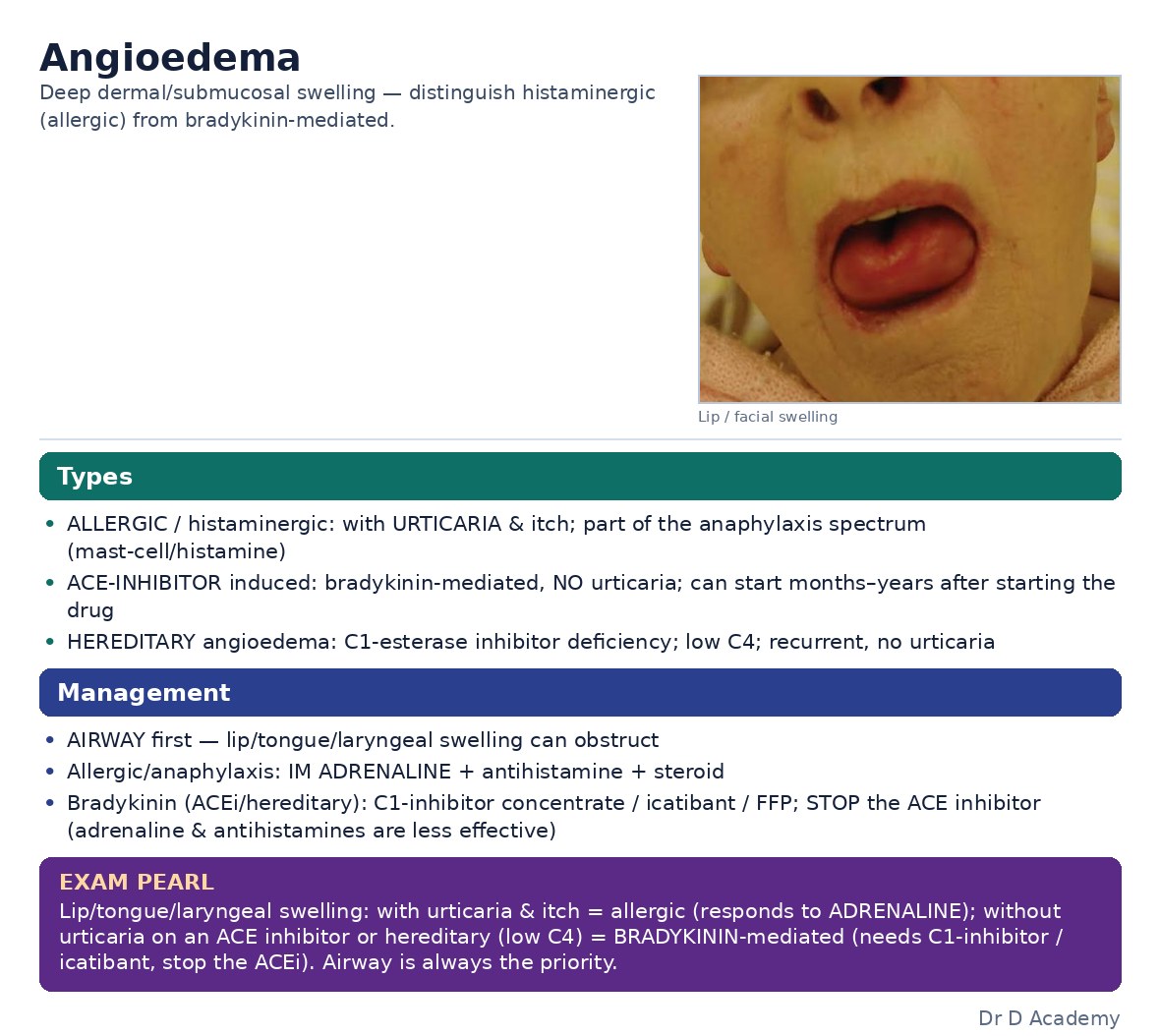
Rapid swelling of the lips, tongue, floor of mouth or larynx that can obstruct the airway. Two mechanisms matter: histaminergic/allergic (mast-cell, often with urticaria — responds to adrenaline/antihistamines/steroids) and bradykinin-mediated (ACE-inhibitor-induced or hereditary C1-inhibitor deficiency — NO urticaria and poor response to adrenaline/steroids). The overriding priority is the AIRWAY.
Figures & algorithms
Red flags
- Stridor, voice change, drooling, difficulty swallowing secretions
- Tongue or floor-of-mouth swelling
- Rapid progression
- Hypotension/wheeze (anaphylaxis)
Assessment
Differential diagnosis
- Allergic/anaphylactic angioedema (urticaria, itch, rapid onset after trigger)
- ACE-inhibitor-induced angioedema (bradykinin; can occur after years of use, no urticaria)
- Hereditary/acquired C1-inhibitor deficiency (recurrent, family history, no urticaria)
- Ludwig's angina / deep space infection, haematoma
Investigations
- This is a clinical airway emergency — assessment must not delay airway management
- Nasendoscopy (by ENT/anaesthetics) to assess laryngeal/supraglottic involvement
- Serum tryptase if anaphylaxis suspected; C4 / C1-inhibitor level and function if hereditary angioedema suspected (do not delay treatment)
Management
- ASSESS THE AIRWAY first: stridor, voice change, drooling, tongue/floor-of-mouth swelling signal imminent obstruction — call anaesthetics/ENT early for a difficult-airway plan (awake fibreoptic / surgical airway readiness).
- Sit the patient up, give high-flow oxygen and prepare difficult-airway and front-of-neck-access equipment.
- If any features of anaphylaxis (urticaria, wheeze, hypotension, known allergen): treat as ANAPHYLAXIS with IM adrenaline, then antihistamine and steroid.
- STOP any ACE inhibitor (and ARB) immediately and document it as the likely cause if no allergic features; these respond poorly to adrenaline/steroids/antihistamines — airway support is key.
- For known/suspected hereditary or ACE-I bradykinin angioedema with airway threat, consider specific therapy (C1-inhibitor concentrate, icatibant) per local protocol/immunology advice.
- Admit for airway observation; most ACE-I angioedema is self-limiting over 24–72 h but can progress — monitor closely.
Drugs & doses
IM adrenaline 1:1000 (0.5 mg = 0.5 mL adult) for anaphylaxis/allergic angioedema, repeat as needed (confirm against local policy)
Antihistamine and corticosteroid for allergic/histaminergic angioedema (confirm against local policy)
STOP ACE inhibitor / ARB
Bradykinin-targeted therapy for hereditary angioedema or severe ACE-I angioedema: C1-inhibitor concentrate or icatibant per local/immunology protocol (confirm against local policy)
High-flow oxygen; nebulised adrenaline may temporise laryngeal oedema
Disposition
Admit for airway monitoring (HDU/ICU if significant swelling); permanently stop and document ACE-I allergy, refer to immunology for recurrent/hereditary cases.
Complications & pitfalls
- Complete airway obstruction and asphyxia
- Failed/difficult intubation
- Recurrence (especially if ACE inhibitor not stopped)
Exam pearls
- No urticaria + on an ACE inhibitor = think bradykinin angioedema (adrenaline/steroids work poorly) — protect the airway and stop the drug.
- Tongue/floor-of-mouth or voice change means a potentially lost airway — call for senior airway help early.
- If in doubt and any allergic features, treat as anaphylaxis with IM adrenaline.
Educational — confirm all doses against local policy.
Disclaimer: Educational decision support for qualified clinicians and students — not a substitute for clinical judgement, local protocols or a full drug reference. Confirm every dose and contraindication against your formulary before prescribing.