Acute pharyngitis / tonsillitis
Bedside summary
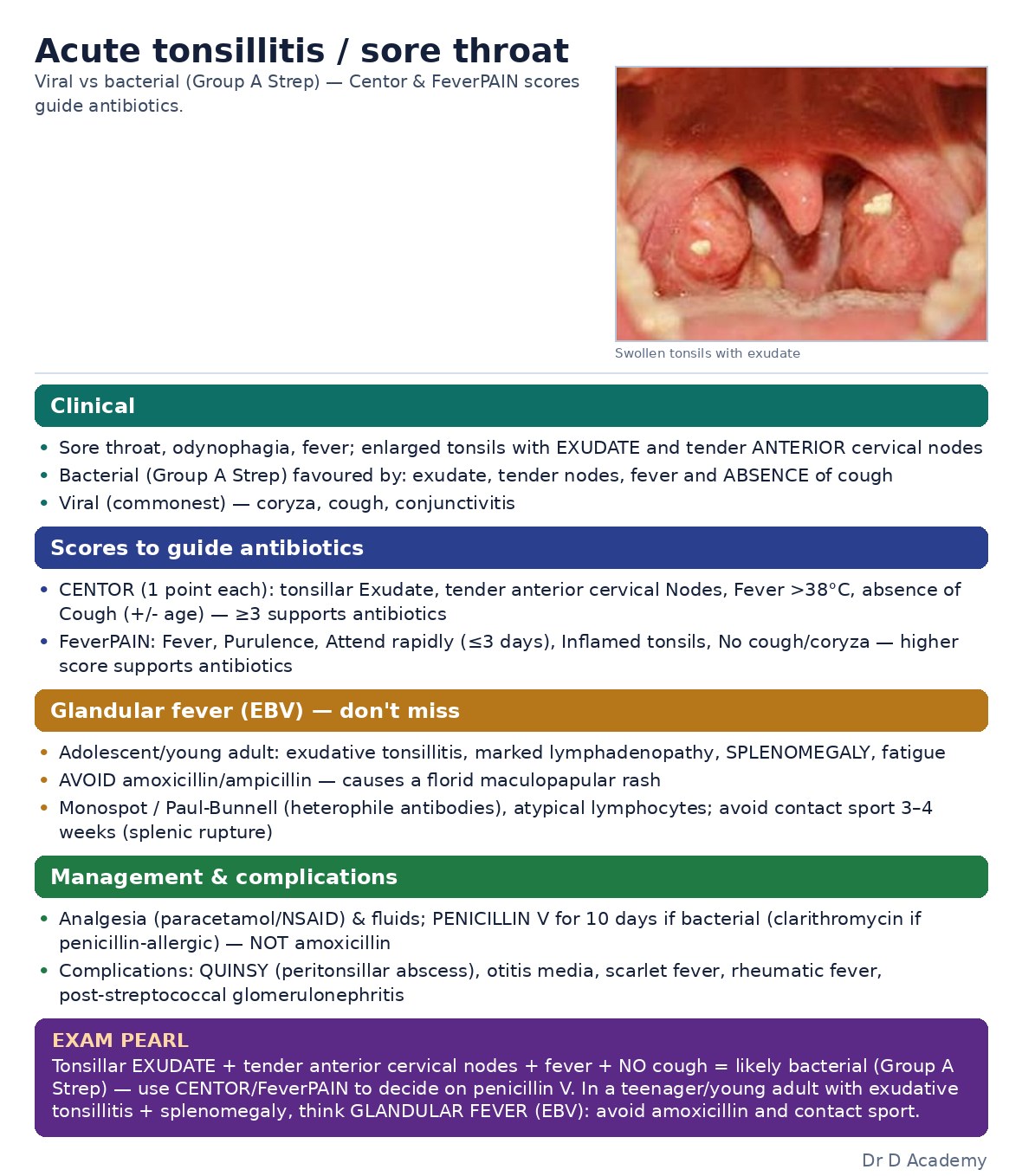
Acute sore throat is usually a self-limiting VIRAL infection (rhinovirus, adenovirus, influenza, EBV and others). The main job is to identify the minority with GROUP A STREPTOCOCCUS (GAS, Strep pyogenes) — who may benefit from antibiotics to shorten symptoms and reduce suppurative and (historically) rheumatic complications — and to spot the DANGEROUS mimics that threaten the airway or deep neck spaces. Use a clinical score to estimate GAS likelihood rather than treating every sore throat.
Figures & algorithms
Red flags
- Stridor, drooling, muffled voice, tripod posture — impending airway obstruction (epiglottitis)
- Severe unilateral pain, trismus, uvular deviation — peritonsillar abscess (quinsy)
- Neck swelling/stiffness, systemic sepsis — deep-space infection or Lemierre syndrome
- Marked splenomegaly (EBV) — advise avoiding contact sport (splenic rupture)
- Immunocompromise, or failure to improve/worsening despite treatment
Assessment
Differential diagnosis
- Viral pharyngitis (commonest)
- Group A streptococcal (GAS) pharyngitis
- Infectious mononucleosis (EBV) — young adult, marked cervical nodes, splenomegaly, malaise
- Peritonsillar abscess (quinsy) — see separate protocol
- Epiglottitis / supraglottitis — airway emergency
- Gonococcal/HIV/candidal pharyngitis; Lemierre syndrome (septic jugular thrombophlebitis)
Investigations
- Score GAS probability: CENTOR / McIsaac (tonsillar exudate, tender anterior cervical nodes, fever > 38°C, absence of cough, age) or FeverPAIN — higher scores raise the chance of GAS
- Where indicated, confirm with a rapid antigen detection test (RADT) and/or throat culture; do NOT routinely test very low-probability (clearly viral) cases
- Consider a monospot/EBV serology and FBC/film if mononucleosis is suspected (young adult, posterior nodes, splenomegaly, prolonged malaise)
- Bloods/observations if systemically unwell; look for scarlet-fever rash
Management
- ABC first — screen for AIRWAY red flags (stridor, drooling, muffled “hot-potato” voice, tripod posture, severe trismus): if present, do NOT examine the throat aggressively — get senior ENT/anaesthetics and treat as epiglottitis/deep-space infection.
- Estimate GAS likelihood with Centor/McIsaac or FeverPAIN; reserve antibiotics for higher-probability or systemically unwell patients (test-and-treat, or delayed-prescription strategies for intermediate scores).
- When antibiotics are indicated for GAS, give PENICILLIN V (or amoxicillin) first-line — clarithromycin/erythromycin if truly penicillin-allergic; AVOID amoxicillin if mononucleosis is possible (causes a rash).
- Symptom relief for all: analgesia/antipyretics (paracetamol/NSAIDs), fluids, and safety-netting; a short course of corticosteroid can help severe odynophagia in selected patients.
- Identify and refer complications — peritonsillar abscess (quinsy), parapharyngeal/retropharyngeal abscess, epiglottitis, or Lemierre syndrome.
Drugs & doses
Disposition
Complications & pitfalls
- Peritonsillar (quinsy) and parapharyngeal/retropharyngeal abscess
- Epiglottitis / airway compromise
- Lemierre syndrome (Fusobacterium jugular thrombophlebitis)
- Scarlet fever; (historically) rheumatic fever and post-streptococcal glomerulonephritis
Exam pearls
- Most sore throats are viral — use Centor/McIsaac or FeverPAIN to decide who needs a GAS test/antibiotic rather than treating everyone.
- Penicillin V is first-line for GAS; NEVER give amoxicillin when EBV mononucleosis is possible — it causes a florid rash.
- Airway red flags (stridor, drooling, muffled voice, tripod position) mean epiglottitis/deep-space infection — don’t force a throat exam; call ENT/anaesthetics.
- Unilateral severe pain with trismus and uvular deviation = quinsy — needs drainage (separate protocol).
- Consider EBV in a young adult with prolonged malaise, posterior cervical nodes and splenomegaly; consider gonococcal/HIV pharyngitis from the sexual history.
Treat sore throat by RISK: screen for airway red flags first (epiglottitis/quinsy/deep-space infection → ENT + anaesthetics, no aggressive exam). For the rest, estimate GAS probability with Centor/McIsaac or FeverPAIN, test where indicated, and give penicillin V only for likely/confirmed GAS or the systemically unwell — analgesia and safety-netting for all. Avoid amoxicillin if mononucleosis is possible.
Disclaimer: Educational decision support for qualified clinicians and students — not a substitute for clinical judgement, local protocols or a full drug reference. Confirm every dose and contraindication against your formulary before prescribing.