Acute ocular involvement in Stevens-Johnson syndrome / TEN
Bedside summary
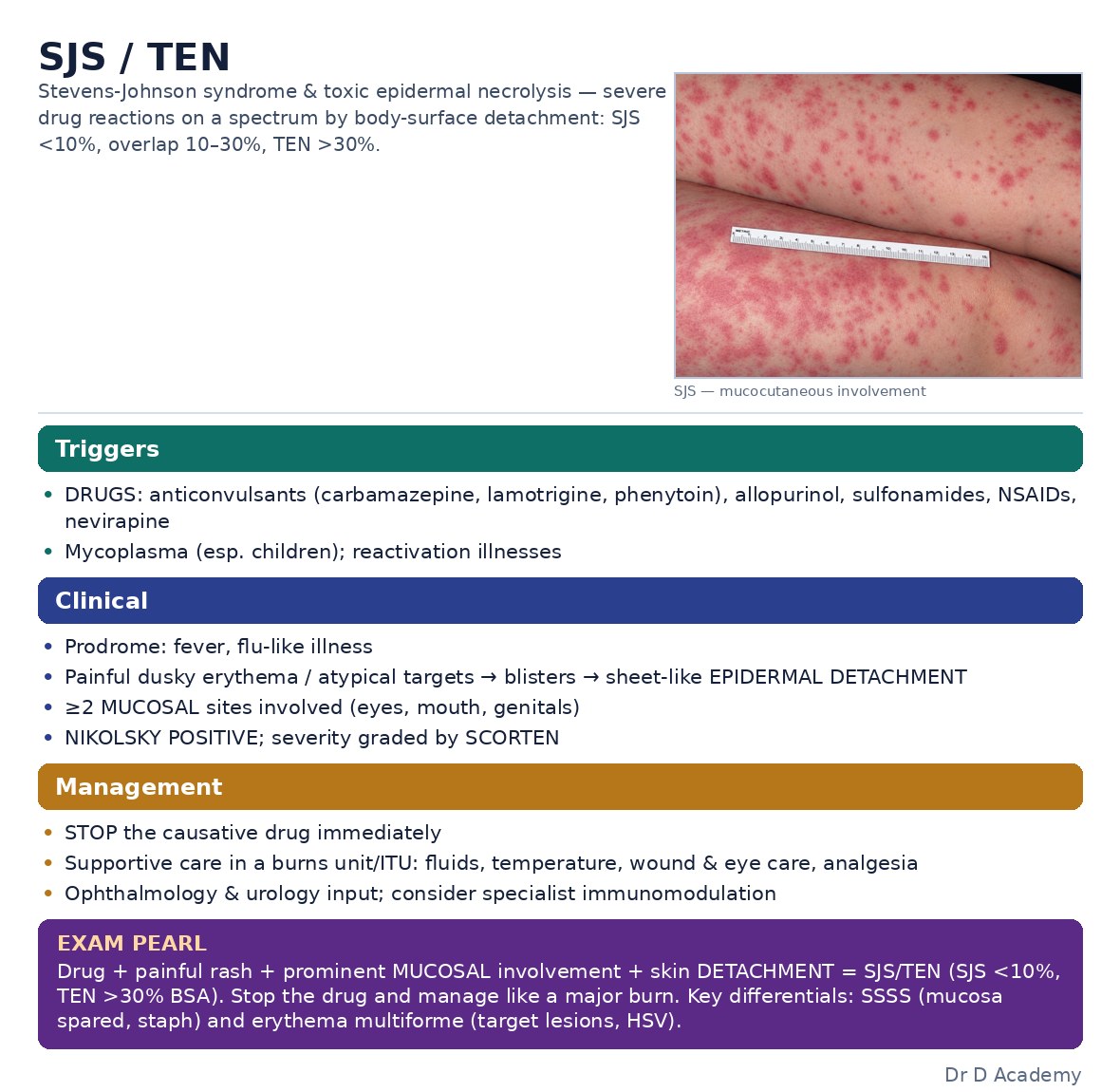
Up to half of patients with Stevens-Johnson syndrome / toxic epidermal necrolysis develop acute ocular surface inflammation — conjunctivitis, epithelial defects, pseudomembranes and symblepharon — that can scar and cause lifelong blindness. Early ophthalmology involvement and aggressive ocular surface care (including amniotic membrane for severe cases) markedly reduce long-term visual loss. Every SJS/TEN patient needs an eye assessment.
Figures & algorithms
Red flags
- Large corneal/conjunctival epithelial defects
- Pseudomembranes and symblepharon formation
- Lid-margin involvement
- Rapidly worsening ocular surface
Assessment
Differential diagnosis
- Any patient with SJS/TEN (painful mucocutaneous blistering, usually drug-induced) must have an eye review
- Grade acute ocular severity (epithelial defects, pseudomembranes, lid-margin involvement)
Investigations
- Slit-lamp assessment of conjunctiva, cornea and lid margins; fluorescein for epithelial defects
- Daily review while the ocular surface is actively inflamed
Management
- Request urgent ophthalmology review and grade ocular severity in every SJS/TEN patient.
- Provide intensive ocular surface care: frequent preservative-free lubricants, plus topical steroid and antibiotic prophylaxis as directed.
- Lyse symblepharon/adhesions and remove pseudomembranes; review daily while active.
- For moderate-to-severe acute ocular involvement, arrange early amniotic membrane transplantation to reduce scarring and chronic sight loss.
- Treat the systemic condition: stop the culprit drug and give supportive/burns-type care with dermatology and critical care.
Drugs & doses
Disposition
Complications & pitfalls
- Symblepharon
- Corneal scarring/neovascularisation and limbal stem cell failure
- Severe dry eye
- Lifelong blindness
Exam pearls
- Every SJS/TEN patient needs an early eye exam — acute severity predicts chronic blindness.
- Preservative-free lubrication, topical steroid and early amniotic membrane protect the ocular surface.
- Stop the culprit drug.
Educational — confirm all doses against local policy. Antibiotic doses per BNF (current edition); confirm choice in the in-app Antibiotic Dosing tool.
Disclaimer: Educational decision support for qualified clinicians and students — not a substitute for clinical judgement, local protocols or a full drug reference. Confirm every dose and contraindication against your formulary before prescribing.