Cushing syndrome
Bedside summary
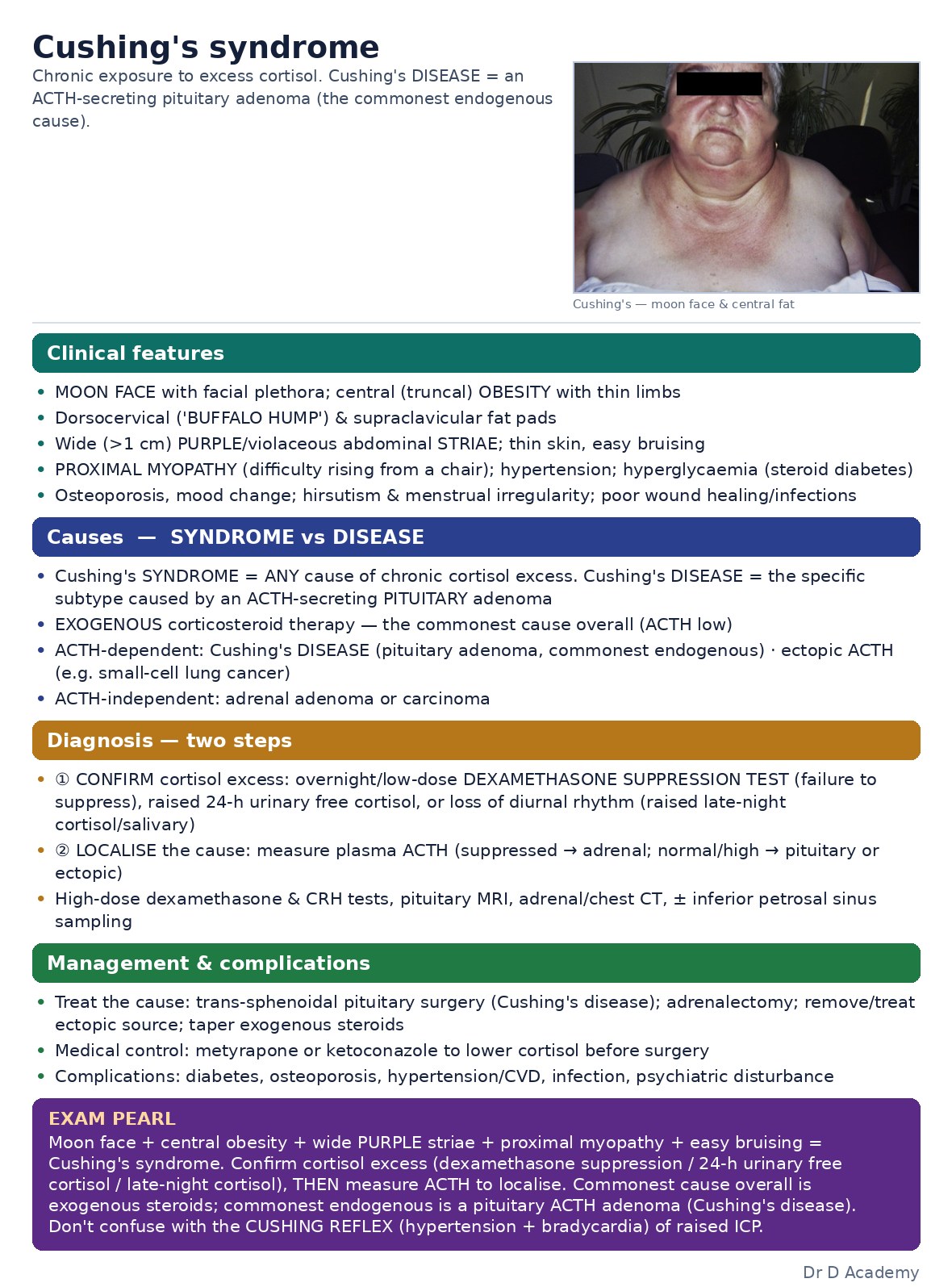
Cushing syndrome is the clinical state of chronic GLUCOCORTICOID EXCESS. By far the commonest cause is EXOGENOUS (iatrogenic) corticosteroid use — always ask about oral, inhaled, topical, intra-articular and “over-the-counter” steroids. Endogenous causes are much rarer: ACTH-DEPENDENT (a pituitary corticotroph adenoma = Cushing DISEASE, the commonest endogenous cause, or an ectopic ACTH-secreting tumour such as small-cell lung cancer) and ACTH-INDEPENDENT (an adrenal adenoma/carcinoma). It matters in emergency and general practice because it drives HYPERTENSION, DIABETES, obesity, osteoporosis, immunosuppression, thromboembolism and psychiatric disturbance, and because ectopic ACTH can present acutely with severe hypokalaemic metabolic alkalosis.
Figures & algorithms
Red flags
- Severe hypokalaemia with metabolic alkalosis (suggests ectopic ACTH — e.g. small-cell lung cancer)
- New severe/resistant hypertension or diabetes with typical features
- Venous thromboembolism (hypercortisolism is prothrombotic)
- Psychosis or profound proximal myopathy
- Signs of an adrenal carcinoma (rapid virilisation, abdominal mass)
Assessment
Differential diagnosis
- Exogenous (iatrogenic) steroid use — the commonest cause
- Simple obesity / metabolic syndrome
- Poorly controlled diabetes / alcohol excess (“pseudo-Cushing”)
- PCOS (in women with hirsutism/menstrual change)
- Depression (can cause mild hypercortisolism)
Investigations
- First, EXCLUDE exogenous steroids by history
- Screen for endogenous Cushing with any of: overnight 1 mg DEXAMETHASONE SUPPRESSION test, LATE-NIGHT SALIVARY CORTISOL (loss of diurnal rhythm), or 24-hour URINARY FREE CORTISOL (≥ 2 abnormal tests)
- Then measure PLASMA ACTH to split ACTH-dependent vs -independent, and localise (pituitary MRI, adrenal CT, inferior petrosal sinus sampling, or CT chest/abdomen for ectopic source)
- Supporting clues: hypokalaemic metabolic alkalosis and hyperglycaemia (marked in ectopic ACTH)
Disposition
Complications & pitfalls
- Cardiovascular disease, hypertension and diabetes
- Osteoporosis and fragility fractures
- Immunosuppression and serious infection
- Venous thromboembolism
- Psychiatric disease; proximal myopathy
Exam pearls
- The commonest cause of Cushing syndrome is EXOGENOUS steroids — take a thorough steroid history (including inhaled/topical) before chasing rare tumours.
- Discriminating features (more specific than obesity/striae): proximal MYOPATHY, easy bruising, wide (> 1 cm) purple striae, facial plethora and unexplained osteoporosis.
- Screen with overnight dexamethasone suppression, late-night salivary cortisol, or 24-h urinary free cortisol — then ACTH to classify.
- Ectopic ACTH (e.g. small-cell lung cancer) can present abruptly with severe hypokalaemia, alkalosis, hyperglycaemia and pigmentation rather than classic body habitus.
- Cushing’s is prothrombotic — have a low threshold for VTE and for thromboprophylaxis around surgery.
Recognise glucocorticoid excess (central obesity, plethora, wide purple striae, proximal myopathy, easy bruising, hypertension, diabetes, osteoporosis). EXCLUDE exogenous steroids first; then screen with 1 mg overnight dexamethasone suppression / late-night salivary cortisol / 24-h urinary free cortisol, measure ACTH to classify, and localise (pituitary MRI, adrenal CT, or search for an ectopic source). Refer to endocrinology; watch for hypokalaemia, VTE and infection.
Disclaimer: Educational decision support for qualified clinicians and students — not a substitute for clinical judgement, local protocols or a full drug reference. Confirm every dose and contraindication against your formulary before prescribing.