Osmotic demyelination syndrome (prevention)
Neurological · Critical Care / ICU
Physician-written · Verified by three sets of doctors · Reviewed November 2026
Bedside summary
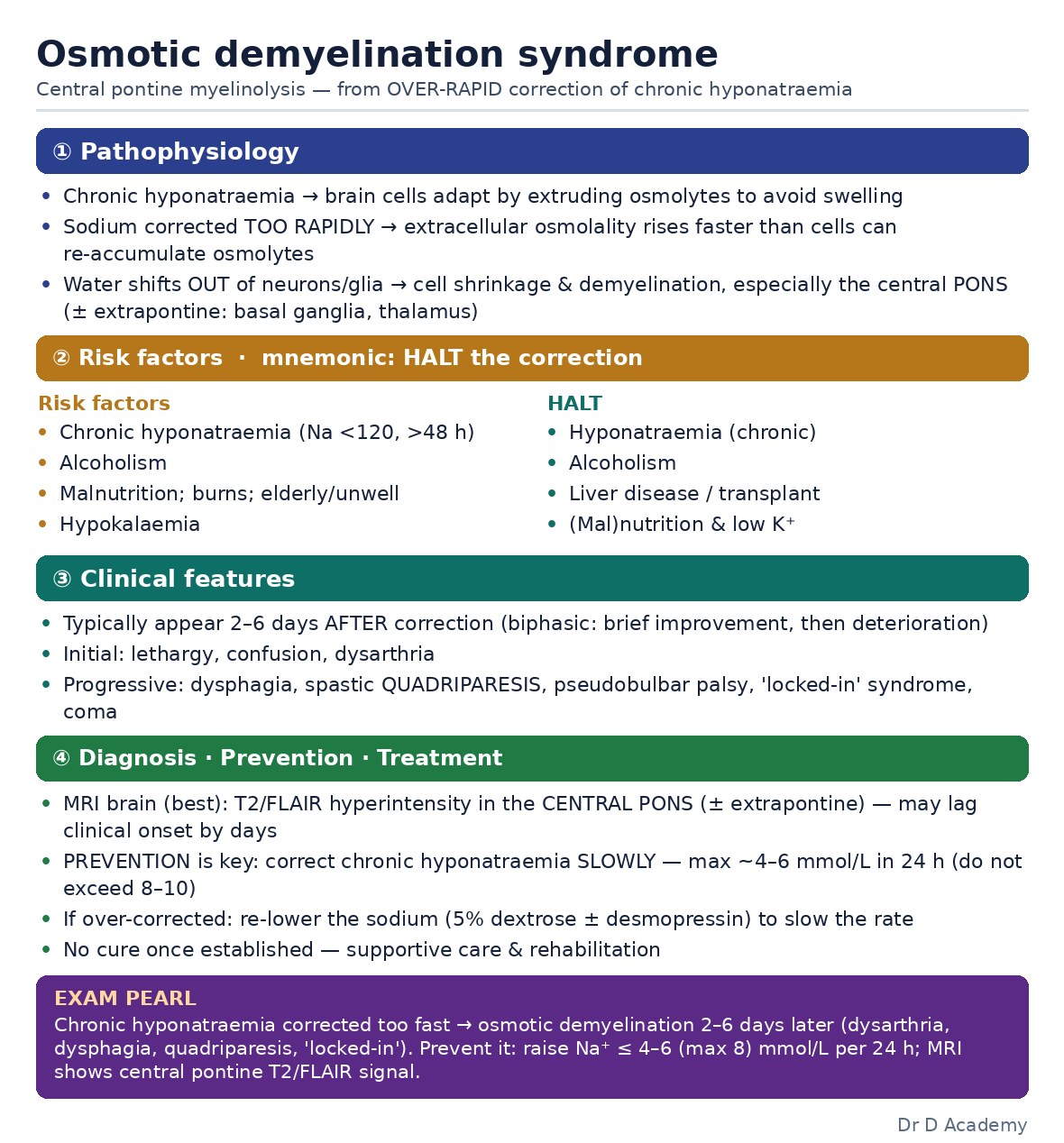
Demyelination (central pontine and extrapontine) caused by overly rapid correction of chronic hyponatraemia; prevention centres on controlled, limited rates of sodium rise.
Figures & algorithms
Red flags
- Sodium rising faster than the safe daily limit
- Brisk water diuresis (impending over-correction)
- Delayed neurological deterioration after initial improvement
- High-risk substrate (alcoholism, malnutrition)
Assessment
Differential diagnosis
- Hyponatraemic encephalopathy (under-correction)
- Stroke
- Wernicke encephalopathy
- Hepatic encephalopathy
- Seizure disorder
Investigations
- Serial serum sodium (frequent monitoring during correction)
- Urine output and osmolality (watch for a brisk aquaresis)
- Assess chronicity and cause of hyponatraemia
- MRI brain (delayed) if osmotic demyelination suspected
Management
- Establish whether hyponatraemia is chronic and identify high-risk patients (alcohol, malnutrition, hypokalaemia, liver disease)
- Correct sodium slowly - limit the rise over 24 h to within safe targets
- Monitor sodium frequently (e.g. every few hours) during active correction
- Watch for and pre-empt over-correction from a spontaneous water diuresis
- If sodium is rising too fast, relower it (free water, and desmopressin as directed) to stay within limits
- Treat severe symptomatic hyponatraemia with careful hypertonic saline while respecting the daily limit
Drugs & doses
Hypertonic (3%) saline in small controlled aliquots for severe symptoms only
Desmopressin (specialist use) to prevent/reverse over-rapid correction
5% dextrose / free water to relower sodium if over-corrected
Replace potassium (which itself raises sodium)
Disposition
HDU/ICU for frequent monitoring; endocrinology/nephrology and ICU involvement.
Complications & pitfalls
- Central pontine/extrapontine myelinolysis (quadriparesis, dysarthria, locked-in syndrome)
- Permanent neurological disability
- Death
Exam pearls
- Correcting chronic hyponatraemia too quickly - not the hyponatraemia itself - causes demyelination
- Even in severe symptomatic hyponatraemia, respect the total daily rise limit
- Potassium replacement raises sodium and must be counted in the correction
Disclaimer: Educational decision support for qualified clinicians and students — not a substitute for clinical judgement, local protocols or a full drug reference. Confirm every dose and contraindication against your formulary before prescribing.