Second-degree AV block (Mobitz I / Wenckebach)
Bedside summary
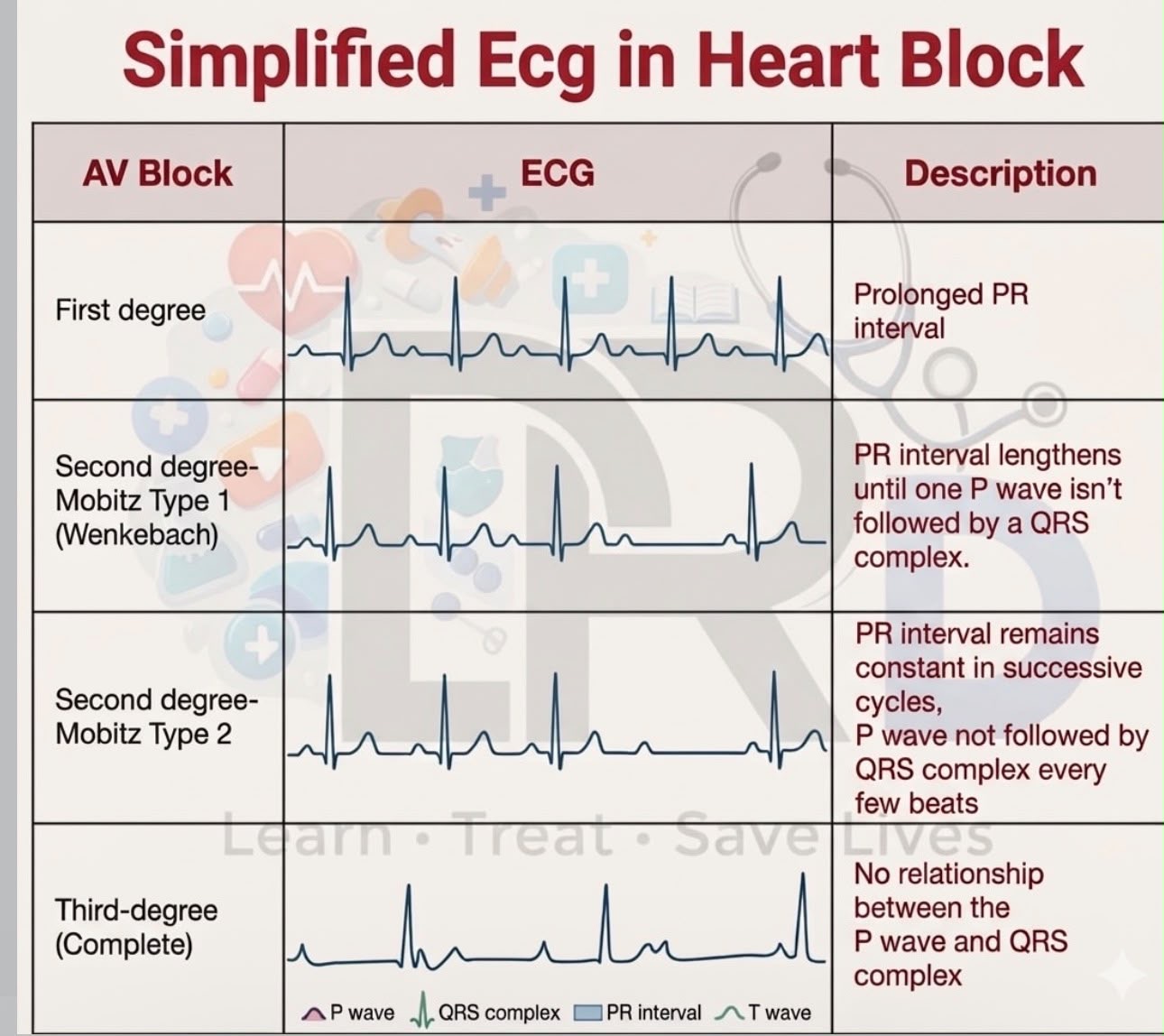
Mobitz type I (Wenckebach) second-degree AV block shows PROGRESSIVE PR-interval prolongation from beat to beat until one P wave FAILS to conduct (a “dropped” QRS), then the cycle repeats — giving grouped beating and a lengthening-then-dropped pattern. The block is almost always at the AV NODE (supra-Hisian) and is therefore usually BENIGN and often reversible — commonly from high vagal tone (athletes, sleep), inferior ischaemia, or AV-nodal-blocking drugs. It rarely progresses to complete heart block, and — unlike Mobitz II — most patients need no specific treatment. The key skill is telling it apart from the dangerous, infranodal Mobitz II.
Figures & algorithms
Red flags
- Symptomatic bradycardia (syncope, presyncope, hypotension, heart failure)
- Features suggesting MOBITZ II or high-grade/complete block (constant PR then sudden drop, wide QRS) — different, higher-risk pathway
- Bradycardia complicating an acute MI
- Progression to higher-grade block on monitoring
Assessment
Differential diagnosis
- Mobitz type II second-degree AV block (infranodal, high-risk — see its protocol)
- First-degree AV block; 2:1 AV block (can be type I or II)
- High-grade/complete AV block
- Blocked atrial ectopics (non-conducted PACs)
- Sinus arrhythmia/pauses
Investigations
- 12-lead ECG and a rhythm strip — look for progressive PR prolongation before the dropped beat (grouped beating), narrow QRS favouring a nodal level
- Electrolytes and a DRUG review (beta-blocker, calcium-channel blocker, digoxin), thyroid function
- Assess for inferior ischaemia; consider ambulatory monitoring if symptomatic/intermittent
- Compare with any Mobitz II features (constant PR then sudden drop, often wide QRS) — that changes management
Management
- Assess symptoms and haemodynamics — most Mobitz I is asymptomatic and needs only observation and treating the cause.
- Identify and reverse causes: stop/reduce AV-nodal-blocking drugs, correct electrolytes, and treat inferior ischaemia.
- Treat only if there is SYMPTOMATIC bradycardia (per the bradycardia approach): atropine 500 mcg IV (often effective for nodal block), and pacing readiness if unstable.
- Do NOT reflexively pace asymptomatic Mobitz I — but DO re-examine the ECG to be sure it is not Mobitz II or high-grade block.
- Refer to cardiology if symptomatic, if the level of block is uncertain, or if there are features suggesting infranodal disease.
Drugs & doses
Disposition
Complications & pitfalls
- Symptomatic bradycardia (uncommon)
- Rarely, progression to higher-grade AV block
- Misclassification as Mobitz II (over-treatment) or vice versa (under-treatment)
Exam pearls
- Mobitz I = PR gets LONGER until a beat drops (grouped beating) — nodal, usually BENIGN, and often needs no treatment.
- Contrast with Mobitz II — CONSTANT PR then a sudden dropped beat, infranodal, high-risk, needs pacing.
- Atropine usually works for symptomatic Mobitz I (it is a vagal/nodal block); reserve pacing for atropine-unresponsive symptomatic cases.
- Common benign triggers: high vagal tone (athletes/sleep), AV-nodal drugs, inferior ischaemia — treat the cause.
- A 2:1 AV block can be either type — look at the surrounding rhythm/QRS width and get cardiology input if unsure.
Recognise Mobitz I (Wenckebach) — progressive PR prolongation then a dropped beat, usually a benign AV-NODAL block. Most needs only observation and treating the cause (drugs, vagal tone, inferior ischaemia). Treat only symptomatic bradycardia (atropine, then pacing if unresponsive), and — crucially — confirm it is not the dangerous infranodal Mobitz II, which needs pacing. Refer if symptomatic or the level of block is uncertain.
Disclaimer: Educational decision support for qualified clinicians and students — not a substitute for clinical judgement, local protocols or a full drug reference. Confirm every dose and contraindication against your formulary before prescribing.