Peri-infarction (early) pericarditis
Post-MI pericarditis · Cardiac
Physician-written · Verified by three sets of doctors · Reviewed November 2026
Bedside summary
Early post-MI pericarditis (peri-infarction pericarditis) arises within a few days of a transmural infarct, from inflammation overlying the necrotic myocardium. It is now uncommon with reperfusion and is usually self-limiting. A friction rub is diagnostic and signals a larger infarct. It is distinct from the late, immune-mediated Dressler syndrome.
Figures & algorithms
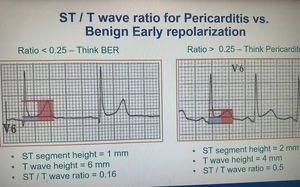
Red flags
- Effusion >10 mm or haemopericardium (impending / subacute free-wall rupture)
- Cardiac tamponade
- New or worsening rub with haemodynamic change
Assessment
Differential diagnosis
- Recurrent ischaemia / re-infarction
- Pulmonary embolism
- Dressler (post-cardiac-injury) syndrome — late
- Post-MI pericardial effusion / tamponade
- Myocardial free-wall rupture
Investigations
- Auscultate for a pericardial friction rub (scratchy, intermittent, left sternal border)
- ECG — ST remaining elevated with persistently upright T waves, or T waves rapidly becoming upright after inversion
- Echocardiography — effusion size (an effusion >10 mm raises rupture concern)
- Troponin reflects infarct size
Management
- Supportive care — this is usually self-limiting
- Continue aspirin for secondary prevention
- Avoid other anti-inflammatory drugs for 7–10 days after MI (they impair infarct healing)
- Analgesia with paracetamol
- Monitor the effusion and reassess anticoagulation if the effusion appears haemorrhagic
Drugs & doses
Paracetamol for pericardial pain — confirm against local protocol / BNF
If pain persists beyond 7–10 days: aspirin 650 mg every 6–8 hours, rather than other NSAIDs or glucocorticoids — confirm against local protocol / BNF
Avoid NSAIDs and glucocorticoids early after MI (impair healing) — confirm against local protocol / BNF
Disposition
Inpatient monitoring with echocardiographic surveillance; escalate urgently for effusion / rupture signs.
Complications & pitfalls
- Pericardial effusion
- Cardiac tamponade (rare)
- Free-wall rupture
- Progression to Dressler syndrome
Exam pearls
- Incidence fell with reperfusion (~5% with fibrinolysis vs 12–20% without; around 1% in contemporary PCI cohorts)
- A rub appearing on day 1–3 marks a larger / anterior infarct, lower EF and higher mortality
- Colchicine evidence is insufficient to recommend it for peri-infarction pericarditis
- Discontinue anticoagulation for a pericardial effusion >1 cm or increasing by >3 mm
A post-MI rub means a bigger infarct — support, use paracetamol or aspirin and watch the effusion, rather than reaching for NSAIDs or steroids.
Disclaimer: Educational decision support for qualified clinicians and students — not a substitute for clinical judgement, local protocols or a full drug reference. Confirm every dose and contraindication against your formulary before prescribing.