First-degree AV block (prolonged AV conduction)
Benign conduction finding · Cardiac
Physician-written · Verified by three sets of doctors · Reviewed November 2026
Bedside summary
A prolonged PR interval (>200 ms at rest; >210 ms at slow rates) with EVERY P wave still conducting — so it is slowed AV conduction, not a true block. Almost always benign and asymptomatic; it cannot be diagnosed clinically, only on the ECG. In nearly all patients it needs no treatment and no pacemaker.
Figures & algorithms
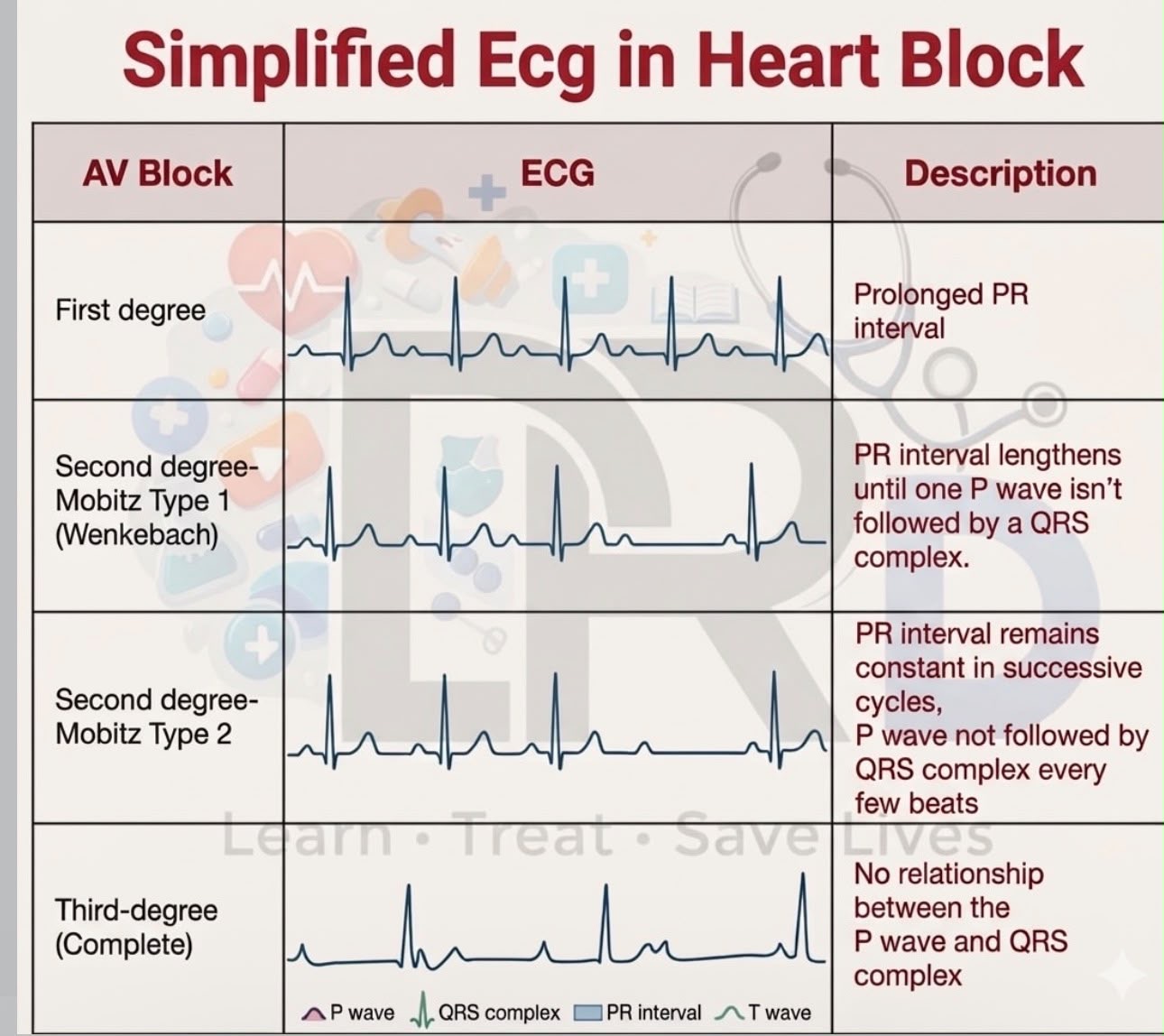
Red flags
- Wide QRS with the long PR (possible infranodal delay / more extensive conduction disease)
- Syncope or presyncope (consider undetected higher-grade block)
- Neuromuscular disease / Lamin-A/C cardiomyopathy (myotonic dystrophy, Kearns-Sayre, limb-girdle) — unpredictable progression
- Marked block with pseudopacemaker-syndrome symptoms (fatigue, dyspnoea, awareness of beats)
- New first-degree block during acute MI (anterior → bundle/fascicular; inferior → AV-nodal)
Assessment
Investigations
- 12-lead ECG: confirm PR >200 ms and note the QRS width — a WIDE QRS with a long PR raises the possibility of infranodal (His-Purkinje) delay and more widespread conduction disease
- Medication review (beta-blocker, non-dihydropyridine CCB, digoxin, some antiarrhythmics) and recent dose changes
- Electrolytes and TSH; troponin if ischaemia suspected
- History: structural/congenital heart disease, recent cardiac procedures, athletic conditioning (high vagal tone), Lyme exposure
Management
- Confirm ISOLATED first-degree block and exclude higher-grade block (dropped beats, AV dissociation) — those follow their own higher-risk protocols
- Identify and treat/withhold reversible contributors (ischaemia, AV-nodal-blocking drugs); high vagal tone in a conditioned athlete is a benign explanation
- Do NOT treat isolated asymptomatic first-degree block — no atropine, no pacing, no admission for the finding itself
- Consider specialist referral for higher-risk features (below) or pseudopacemaker-syndrome symptoms
- Discharge with GP/cardiology follow-up, a repeat ECG and syncope safety-netting
Drugs & doses
No drug therapy for isolated asymptomatic first-degree block
Review / withhold AV-nodal blockers (beta-blocker, diltiazem/verapamil, digoxin, some antiarrhythmics)
Disposition
Discharge with GP/cardiology follow-up and repeat ECG for isolated asymptomatic block; refer earlier for wide-QRS block, syncope, neuromuscular disease or pseudopacemaker symptoms. Admission is driven by the associated condition, not the first-degree block itself.
Exam pearls
- First-degree block is "prolonged AV conduction", not a true block — almost always a benign incidental ECG finding
- Narrow QRS + long PR = AV-nodal and reassuring; wide QRS + long PR = look harder for infranodal/structural disease
- Atropine has a VARIABLE effect: it shortens nodal delay but can worsen an infranodal delay — a diagnostic curiosity, not a treatment
- Think infiltrative/neuromuscular disease (sarcoid, amyloid, muscular dystrophy) when it appears with other clues
Disclaimer: Educational decision support for qualified clinicians and students — not a substitute for clinical judgement, local protocols or a full drug reference. Confirm every dose and contraindication against your formulary before prescribing.