Acute symptomatic complete AV block
Bedside summary
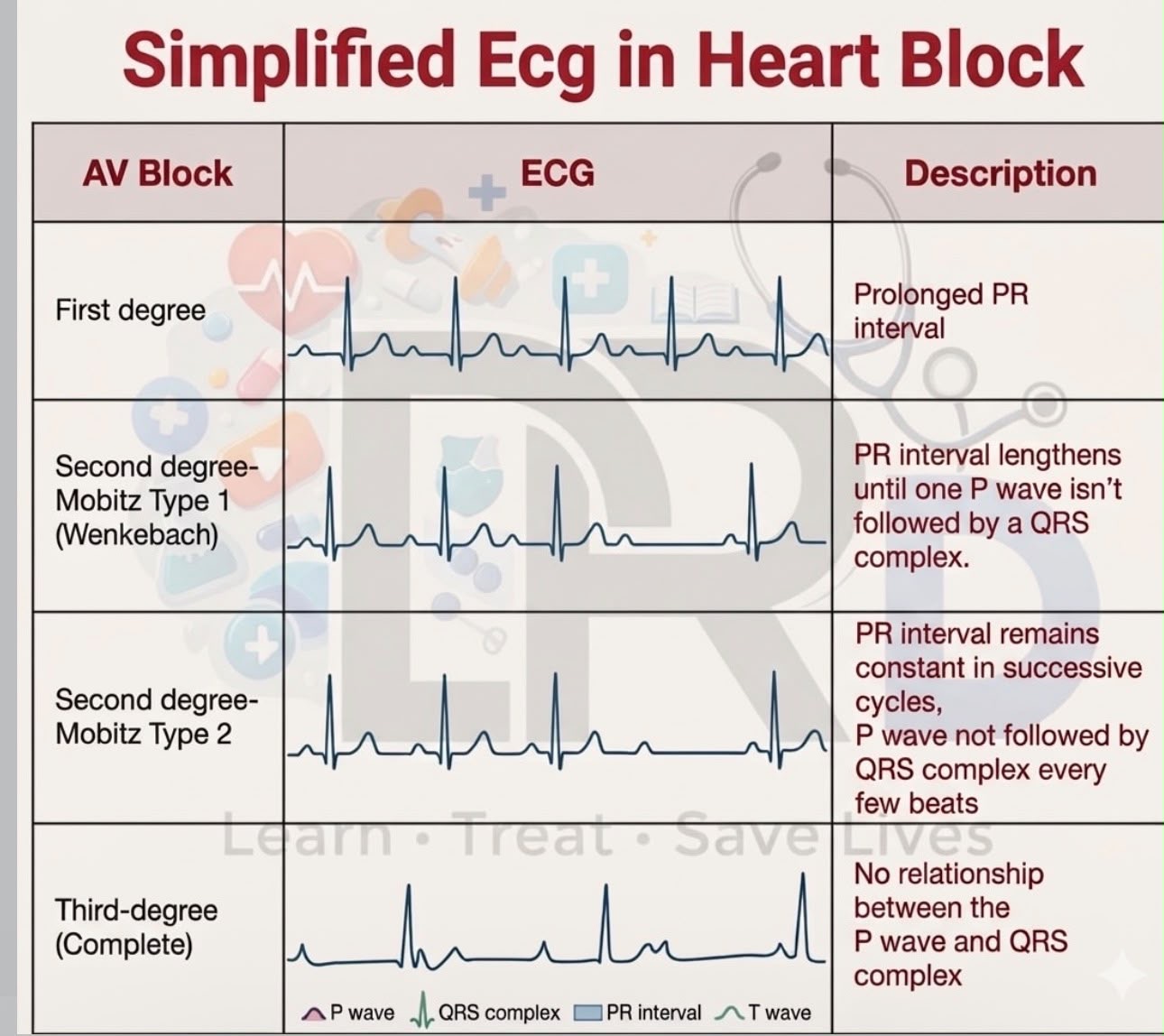
Third-degree (complete) AV block: atrial impulses fail entirely to reach the ventricles, so atria and ventricles beat independently (AV dissociation) and the rate depends on an escape pacemaker. A narrow-complex junctional escape (~40–60/min) is relatively stable; a wide-complex ventricular escape (~20–40/min) is slow and unreliable, risking asystole. Common acquired causes: ischaemia (esp. inferior MI), degenerative conduction disease (Lenègre/Lev), drugs (beta-blockers, calcium-channel blockers, digoxin), hyperkalaemia, cardiac surgery/TAVI, infiltrative disease, endocarditis with aortic-root abscess, and Lyme carditis.
Figures & algorithms
Red flags
- Wide-complex (ventricular) escape or rate < 40/min
- Syncope, shock, heart failure or ischaemic chest pain
- Complete block complicating ANTERIOR MI (often infranodal, unstable — may need urgent pacing)
- Pauses/asystole; alternating bundle branch block
- Fever + new AV block → endocarditis with aortic-root abscess
Assessment
Differential diagnosis
- High-grade second-degree (Mobitz II) AV block
- Complete AV block with junctional vs ventricular escape
- AV dissociation from other causes
- Hyperkalaemia
- Drug toxicity (digoxin, beta-blocker, CCB)
- Sinus arrest with escape rhythm
Investigations
- 12-lead ECG + continuous monitoring (define escape width/rate, look for ischaemia)
- U&E (POTASSIUM), calcium, magnesium; troponin; TSH
- Digoxin level and drug history; consider Lyme serology in endemic/at-risk patients
- Echocardiogram (structural/ischaemic cause, endocarditis); blood cultures if febrile
Management
- A–E assessment; attach defibrillator/pacing pads and continuous ECG; give oxygen and IV access.
- If unstable (shock, syncope, heart failure, ischaemic chest pain): treat per the bradycardia algorithm — ATROPINE 500 mcg IV (repeat to 3 mg), but expect it to be INEFFECTIVE in infranodal/wide-complex block.
- Start TRANSCUTANEOUS PACING without delay for unstable block unresponsive to atropine; provide analgesia/sedation for pacing discomfort.
- Chemical temporising while arranging pacing: an ISOPRENALINE (isoproterenol) or ADRENALINE infusion to maintain rate/perfusion.
- Correct reversible causes: stop and reverse offending drugs (glucagon/high-dose insulin for beta-blocker/CCB; digoxin-specific antibody for digoxin), treat HYPERKALAEMIA, treat ischaemia (reperfusion for MI — inferior MI block is often transient/nodal and atropine-responsive).
- Arrange urgent cardiology review for TRANSVENOUS temporary pacing and, for irreversible acquired complete block, PERMANENT PACEMAKER implantation.
Drugs & doses
Disposition
Complications & pitfalls
- Asystole / cardiac arrest
- Syncope and injury (Stokes–Adams attacks)
- Cardiogenic shock, heart failure
- Torsades from bradycardia-related QT prolongation
Exam pearls
- Atropine works on the AV node — it usually FAILS in infranodal (wide-complex) complete block; get the pacing pads on early.
- Inferior MI block tends to be nodal, transient and atropine-responsive; anterior MI block is infranodal, unstable and often needs pacing.
- Always screen for reversible causes — drugs, hyperkalaemia, Lyme, endocarditis — before assuming a pacemaker is inevitable.
- A ventricular escape rhythm is unreliable — treat as pre-arrest.
Complete heart block with instability is a peri-arrest emergency: pads on, atropine (expect failure in wide-complex block), transcutaneous pacing and an isoprenaline/adrenaline infusion to bridge to transvenous pacing, while aggressively correcting reversible causes (drugs, hyperkalaemia, ischaemia, Lyme, endocarditis). Irreversible acquired complete block needs a permanent pacemaker.
Disclaimer: Educational decision support for qualified clinicians and students — not a substitute for clinical judgement, local protocols or a full drug reference. Confirm every dose and contraindication against your formulary before prescribing.