Acute STEMI — reperfusion strategy
Bedside summary
ST-elevation MI needs IMMEDIATE reperfusion of the occluded artery — “time is muscle”. There are two strategies: PRIMARY PERCUTANEOUS CORONARY INTERVENTION (PCI) — the preferred method when it can be delivered promptly — and FIBRINOLYSIS, used when timely PCI is not available. The choice hinges on the time from symptom onset and, critically, the anticipated time to PCI; benefit is greatest in the first 2–3 hours and for presentations within 12 hours (and beyond 12 h if there is ongoing ischaemia/instability).
Figures & algorithms
Red flags
- Cardiogenic shock or acute heart failure — primary PCI strongly preferred (transfer even if beyond usual windows)
- Contraindication to fibrinolysis (bleeding risk, recent stroke/surgery, uncontrolled hypertension, suspected aortic dissection)
- Failed reperfusion after lysis (< 50% ST resolution, ongoing pain) — rescue PCI now
- Re-elevation/re-occlusion after initial success — urgent angiography
Assessment
Differential diagnosis
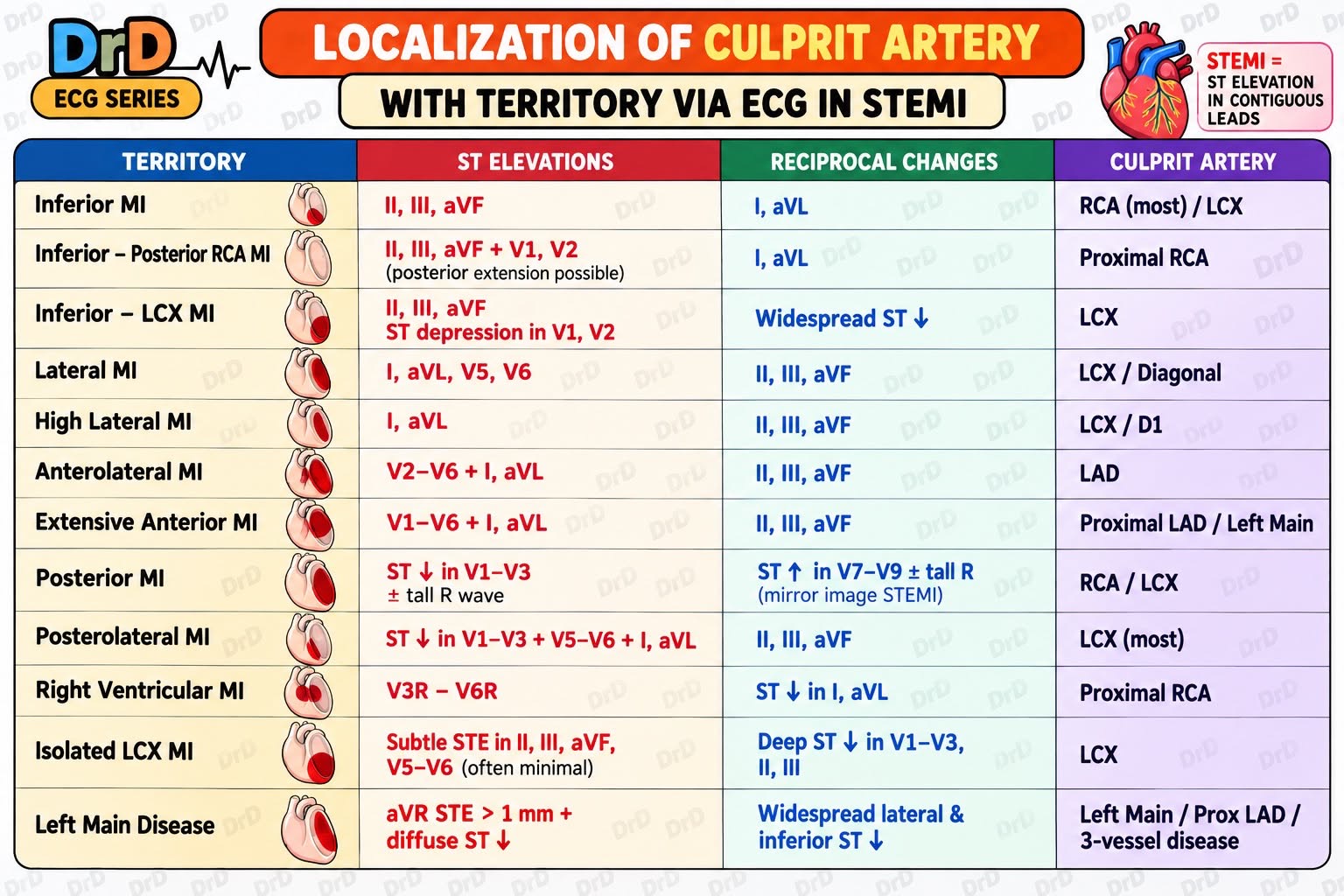
- STEMI vs STEMI-equivalent (new LBBB, posterior MI, de Winter, hyperacute T waves)
- Pericarditis / myocarditis; early repolarisation
- Aortic dissection (a contraindication to fibrinolysis — exclude before lysing)
- Takotsubo; benign ST elevation
Investigations
- 12-lead ECG immediately (± posterior/right-sided leads) and continuous monitoring; repeat if evolving
- Note SYMPTOM-ONSET time and calculate the anticipated time to PCI (first-medical-contact-to-device)
- Troponin, bloods, and screen for fibrinolysis CONTRAINDICATIONS (recent bleeding/surgery/stroke, uncontrolled hypertension, suspected dissection)
- Do not delay reperfusion for the troponin result
Management
- Choose PRIMARY PCI if it can be delivered within ~120 minutes of first medical contact (target device time ≤ 90 min at a PCI centre) — it is superior to fibrinolysis, especially in cardiogenic shock, heart failure, late presentation or when lysis is contraindicated.
- If timely PCI is NOT achievable, give FIBRINOLYSIS promptly (door-to-needle ≤ 30 min) provided there is no contraindication — then TRANSFER to a PCI centre (a “pharmaco-invasive” strategy).
- After fibrinolysis, ASSESS REPERFUSION at 60–90 minutes: SUCCESS = ≥ 50% resolution of the worst-lead ST elevation, relief of pain, and haemodynamic/electrical stability (reperfusion arrhythmias may occur).
- FAILED FIBRINOLYSIS (< 50% ST resolution, ongoing pain/instability) → IMMEDIATE transfer for RESCUE PCI; do NOT re-administer a fibrinolytic.
- After SUCCESSFUL lysis, still transfer for routine early angiography (typically within 2–24 h) — the pharmaco-invasive approach; give antiplatelet and anticoagulant therapy throughout (see the ACS protocols) and manage complications.
Drugs & doses
Disposition
Complications & pitfalls
- Reperfusion arrhythmias; re-occlusion/re-infarction
- Bleeding / intracranial haemorrhage from fibrinolysis
- Cardiogenic shock, mechanical complications, heart failure
- Missed dissection lysed in error
Exam pearls
- Primary PCI beats fibrinolysis when it can be delivered in time (~120 min of first medical contact) — and is clearly preferred in shock, heart failure, late presentation or when lysis is contraindicated.
- If PCI will be delayed, don’t wait — give fibrinolysis within 30 minutes (no contraindication) and transfer (pharmaco-invasive).
- Judge lysis at 60–90 min: ≥ 50% ST resolution + pain relief = success; anything less = FAILED → rescue PCI, never a second dose of lytic.
- Even after successful lysis, arrange early angiography within 2–24 h.
- Always exclude aortic dissection before giving a fibrinolytic.
Reperfuse every STEMI fast. Prefer PRIMARY PCI if achievable within ~120 min of first medical contact (≤ 90 min door-to-device) — especially in shock/heart failure/late presentation or if lysis is contraindicated. Otherwise give FIBRINOLYSIS within 30 min (no contraindication) and transfer. Reassess at 60–90 min: < 50% ST resolution or ongoing ischaemia = FAILED lysis → immediate RESCUE PCI (not a repeat lytic); after successful lysis still go for early angiography (2–24 h). Exclude dissection before lysing.
Disclaimer: Educational decision support for qualified clinicians and students — not a substitute for clinical judgement, local protocols or a full drug reference. Confirm every dose and contraindication against your formulary before prescribing.