Acute pericarditis
Protocol · Cardiac
Physician-written · Verified by three sets of doctors · Reviewed November 2026
Bedside summary
Pericardial inflammation — sharp pleuritic chest pain, worse lying flat and better sitting forward, may radiate to the trapezius ridge; ± friction rub, fever, viral prodrome. Diagnose with ≥2 of 4: typical pleuritic pain, friction rub, typical ECG changes, new/worse effusion (ESC 2015).
Figures & algorithms
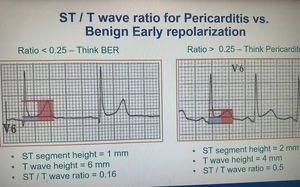
Assessment
Investigations
- ECG: widespread concave (saddle) ST elevation + PR depression (PR elevation in aVR), evolving over days — distinguish from STEMI: diffuse not territorial, no reciprocal change except aVR/V1, ST starts at the J point and is usually <5 mm
- Troponin (raised in ~⅓ = myopericarditis), CRP/ESR, FBC; echo (effusion in ~60%, usually small; a normal echo does not exclude it)
- Initial work-up in all: ECG, CXR, troponin, CRP/ESR, FBC, echo
Management
- First-line = NSAID or high-dose aspirin PLUS colchicine (colchicine cuts recurrence); taper over weeks guided by symptoms + CRP
- AVOID corticosteroids first-line in idiopathic/viral pericarditis (↑ recurrence) — reserve for specific causes/contraindications
- Restrict strenuous exercise until symptoms and CRP/ECG normalise
- Treat a specific cause (purulent, TB, autoimmune, malignant)
Disposition
Low-risk (none of the high-risk features) → discharge + outpatient follow-up (>80% of cases). ADMIT if fever >38 °C, subacute onset, large effusion/tamponade, immunosuppression, on anticoagulation, trauma, raised troponin (myopericarditis), or no improvement after 7 days of NSAID + colchicine.
Disclaimer: Educational decision support for qualified clinicians and students — not a substitute for clinical judgement, local protocols or a full drug reference. Confirm every dose and contraindication against your formulary before prescribing.