Difficult airway follow-up, alert & referral
Airway safety · Perioperative & Anaesthesia
Physician-written · Verified by three sets of doctors · Reviewed November 2026
Bedside summary
Structured actions after a difficult or failed airway to protect the patient at future anaesthetics: clear documentation, direct communication with the patient, an alert letter, and registration/referral where appropriate. Prevents repetition of a dangerous airway event.
Figures & algorithms
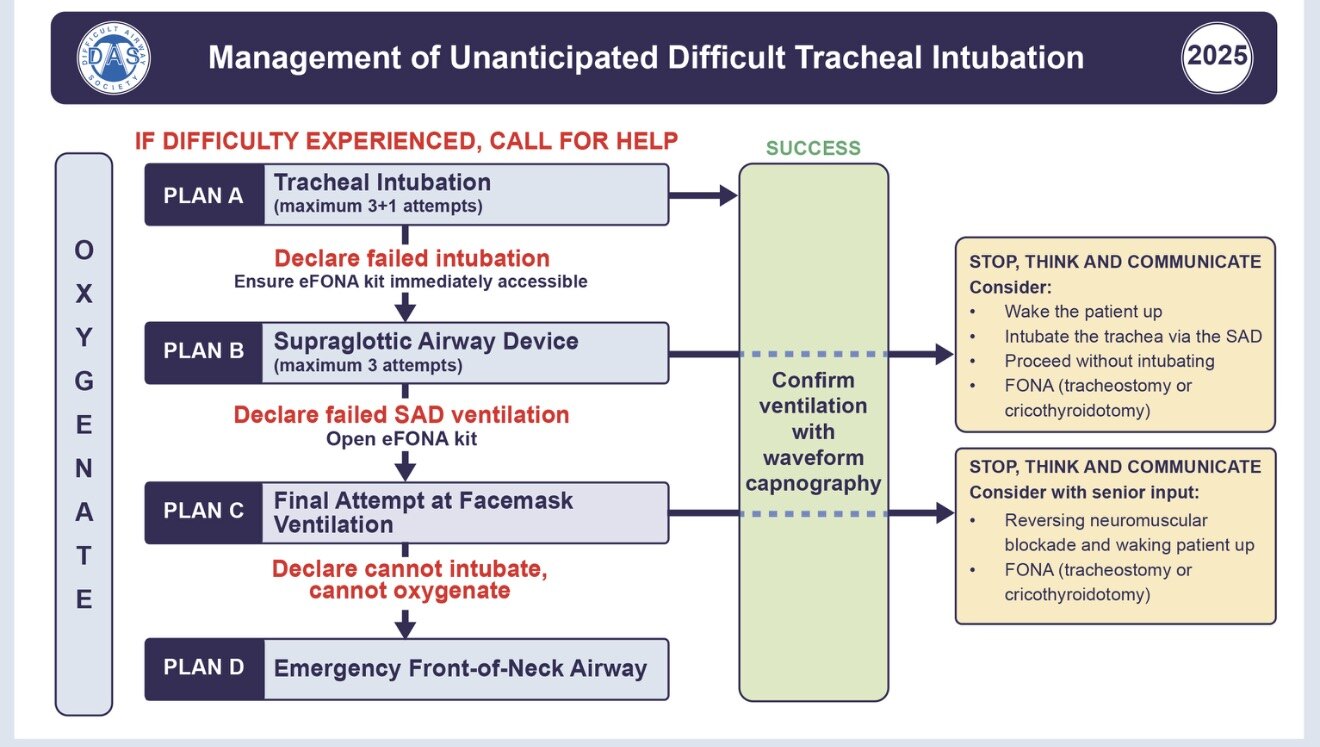
Red flags
- Event not documented or communicated, so the patient faces the same danger again
- Progressive airway pathology (tumour/stridor) needing urgent ENT referral
- Patient unaware of their airway risk before further surgery
- Prior can't-intubate-can't-oxygenate event without a future plan
Assessment
Differential diagnosis
- Anticipated difficult airway managed successfully
- Unanticipated difficult/failed intubation during the case
- Can't-intubate-can't-oxygenate event requiring front-of-neck access
- Difficult mask ventilation or supraglottic device placement
- Awake intubation required for future surgery
Investigations
- Review of the intraoperative airway record (grade of view, number/type of attempts, devices used, what worked)
- Assessment for a reversible/anatomical cause (tumour, radiotherapy, obstructive pathology) warranting ENT/imaging
- Nasendoscopy/imaging referral where structural pathology is suspected
- Documentation audit to ensure the event is captured and communicated
Management
- Immediately after the event, document precisely: the problem, grade of laryngoscopy, techniques tried, what succeeded and what failed, and recommendations for future management
- Explain the difficulty to the patient (and family) in person and in writing so they can inform future anaesthetists
- Issue a difficult-airway alert letter to the patient and copy it to the GP and hospital records
- Flag the hospital record/electronic system prominently so it is visible at any future admission
- Register the patient with a national difficult airway database/alert scheme where available
- Refer for investigation of any underlying structural cause (ENT, imaging) if relevant
- Advise the patient to carry the alert and consider a medical-alert bracelet
- Ensure the airway plan is readily available for any future surgery and consider awake techniques next time
Drugs & doses
No specific pharmacotherapy — the intervention is documentation and communication
For any future anaesthetic, plan awake tracheal intubation with topicalisation — e.g. Lidocaine 4% topical to the airway (stay within 9 mg/kg maximum)
Have emergency front-of-neck access equipment and drugs prepared for subsequent high-risk airways
Disposition
Routine recovery with a documented alert, written patient information, GP/record flagging and onward ENT/airway-clinic referral where a structural cause is suspected.
Complications & pitfalls
- Repeated difficult/failed airway at a subsequent anaesthetic
- Hypoxic brain injury or death from an unanticipated repeat event
- Missed underlying structural airway pathology
- Medicolegal consequences of poor documentation
Exam pearls
- The airway record must say not just that it was difficult, but exactly what worked — this saves the next anaesthetist and the patient
- Tell the patient in person and in writing; empowered patients prevent repeat events
- Register with a national difficult-airway alert scheme and flag the hospital record prominently
- A difficult airway can be dynamic — new or worsening pathology warrants ENT referral and reassessment
- Plan an awake technique for the next elective airway after a serious prior difficulty
Disclaimer: Educational decision support for qualified clinicians and students — not a substitute for clinical judgement, local protocols or a full drug reference. Confirm every dose and contraindication against your formulary before prescribing.