Difficult airway & rapid sequence induction
Perioperative · Perioperative & Anaesthesia
Physician-written · Verified by three sets of doctors · Reviewed November 2026
Bedside summary
A planned, stepwise approach to the difficult airway: optimise the first attempt, limit attempts, escalate through the DAS plans, and recognise and act on 'can't intubate, can't oxygenate' with front-of-neck access before hypoxic arrest.
Figures & algorithms
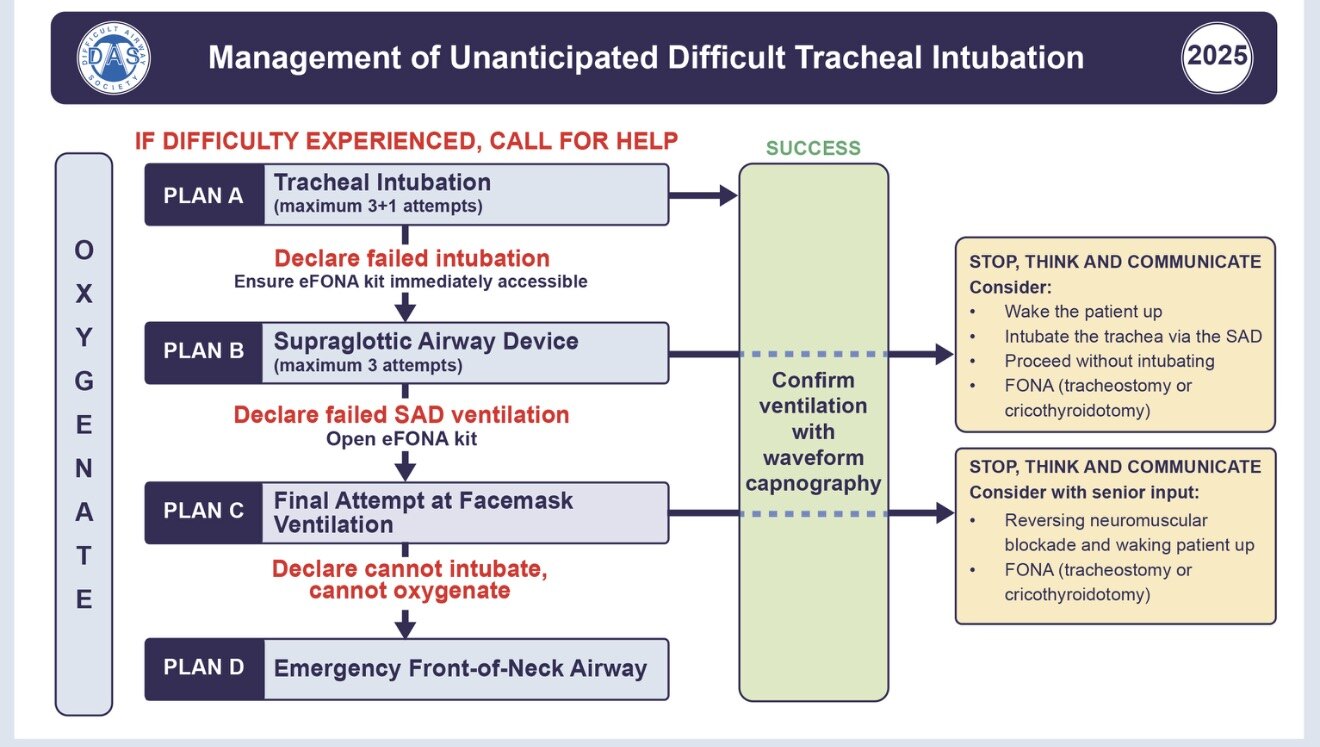
Management
- Prepare & preoxygenate — Assess the airway, make a plan and a backup, and have equipment/skilled help ready; videolaryngoscopy improves first-pass success and should be readily available. Optimise preoxygenation (and apnoeic oxygenation, e.g. nasal high-flow) to extend safe apnoea time, especially in the obese, obstetric and critically ill.
- The DAS ladder (Plans A–D) — Plan A: optimal facemask/tracheal intubation — limit to a small number of attempts to avoid trauma and the 'can't ventilate' spiral. Plan B/C: supraglottic airway then facemask ventilation to oxygenate and reassess ('stop and think'). Plan D: 'can't intubate, can't oxygenate' (CICO) → declare it and perform emergency front-of-neck access (scalpel– bougie–tube cricothyroidotomy).
- Rapid sequence induction — For aspiration risk (full stomach, GORD, obstruction, obstetric, GLP-1 agonists): preoxygenate, induce with a prompt- onset relaxant (rocuronium — reversible with sugammadex — or suxamethonium), with the option of gentle mask ventilation. Confirm tube placement with continuous waveform capnography — the standard of care everywhere, including cardiac arrest.
- Human factors — Most airway disasters involve fixation and delayed escalation — verbalise the plan, call for help early, and move to the next plan rather than repeating a failed one.
Exam pearls
- The commonest fatal airway error is not the difficult larynx but failure to declare CICO and cut the neck in time — limit intubation attempts, oxygenate by any route, and move down the plans decisively.
Disclaimer: Educational decision support for qualified clinicians and students — not a substitute for clinical judgement, local protocols or a full drug reference. Confirm every dose and contraindication against your formulary before prescribing.